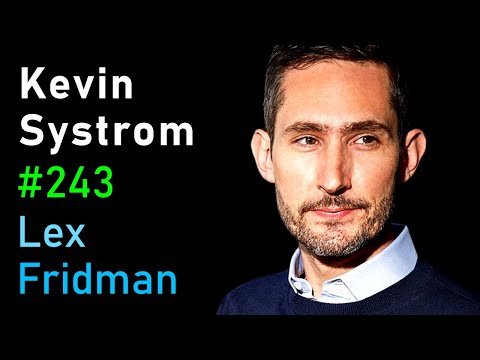
Kevin Systrom: Instagram | Lex Fridman Podcast #243
Lex Fridman (host), Kevin Systrom (guest)
In this episode of Lex Fridman Podcast, featuring Lex Fridman and Kevin Systrom, Kevin Systrom: Instagram | Lex Fridman Podcast #243 explores instagram’s Creator Reveals Startup Grit, Product Intuition, Algorithm Future Kevin Systrom walks through Instagram’s evolution from a failed check‑in app (Burbn) into a globally dominant photo‑sharing network by ruthlessly following user behavior and simplifying around what worked: photos. He explains his product philosophy using ideas from machine learning—especially feedback loops, loss functions, and learning rates—to describe how great products iterate toward product‑market fit.
Instagram’s Creator Reveals Startup Grit, Product Intuition, Algorithm Future
Kevin Systrom walks through Instagram’s evolution from a failed check‑in app (Burbn) into a globally dominant photo‑sharing network by ruthlessly following user behavior and simplifying around what worked: photos. He explains his product philosophy using ideas from machine learning—especially feedback loops, loss functions, and learning rates—to describe how great products iterate toward product‑market fit.
He details early technical and design decisions (filters, square photos, latency tricks, Python/Django stack, AWS migration) and how focusing on speed, polish, and community seeding mattered more than sophisticated tech. Systrom also reflects on selling Instagram to Facebook for $1B, the emotional aftermath of “arriving,” and the long arc of competing with Snapchat and TikTok.
The conversation shifts to social network algorithms, recommender systems, and reinforcement learning, exploring how feeds are optimized, why current engagement‑driven models are problematic, and how future networks might optimize for long‑term well‑being instead. He closes with personal views on hard work, funding, love, and choosing to “opt in” to hard but meaningful games in life.
Key Takeaways
Follow what users actually do, not what they say they want.
Instagram only emerged when Systrom and Krieger looked at usage data, saw that people overwhelmingly used Burbn for photos, and cut almost everything else. ...
Get the full analysis with uListen AI
Iterate like a neural network: adjust your “learning rate” wisely.
Systrom likens startups to backpropagation: try something, measure error, nudge the product. ...
Get the full analysis with uListen AI
Simplicity, constraints, and perceived speed beat fancy tech early on.
Using small 512×512 square images, naive CPU filters, and background uploads, Instagram felt fast and polished on weak phones while competitors were objectively slower. ...
Get the full analysis with uListen AI
Design for both single‑player and network effects from day one.
Instagram worked even if no one you knew was on it—you could just beautify photos. ...
Get the full analysis with uListen AI
Anchor every feature to a clear “job to be done.”
Using Clayton Christensen’s “jobs to be done,” he frames Instagram’s core job as visually sharing your life to feel connected and seen. ...
Get the full analysis with uListen AI
Social feeds are shifting from who‑you‑follow to what‑is‑good.
Systrom argues the “worst part of social networks is the people” in the sense that relying on friends’ shares selects for divisive, attention‑seeking content. ...
Get the full analysis with uListen AI
Hard work is non‑negotiable for outsized outcomes; just be explicit about the bargain.
He pushes back on anti‑grind narratives, noting that Instagram cost him and his team years of intense effort. ...
Get the full analysis with uListen AI
Money, exits, and fame don’t resolve the basic human condition.
Selling for $1B triggered a brief high followed by a “we have arrived” letdown; the same insecurities and problems remained. ...
Get the full analysis with uListen AI
Notable Quotes
“We put it out to 100 people, watched what they did, realized we were wrong, and shifted toward what they loved. If you do that enough, quickly enough, you find product‑market fit.”
— Kevin Systrom
“As long as you have product‑market fit, people will put up with a lot. You can be slow, you can be terrible—then you just make it performant over time.”
— Kevin Systrom
“I have this thesis that the worst part about social networks is the people.”
— Kevin Systrom
“Everything’s hard. You might as well be playing the game you love to play.”
— Kevin Systrom
“Doing things on purpose because you choose to do them is so important in life. Don’t just float down the river hitting branches along the way—opt in.”
— Kevin Systrom
Questions Answered in This Episode
If you were building a new social network today, what specific ‘crack’ or underserved job in the current ecosystem would you target?
Kevin Systrom walks through Instagram’s evolution from a failed check‑in app (Burbn) into a globally dominant photo‑sharing network by ruthlessly following user behavior and simplifying around what worked: photos. ...
Get the full analysis with uListen AI
How could a social platform realistically design and measure a value function around long‑term user well‑being instead of short‑term engagement?
He details early technical and design decisions (filters, square photos, latency tricks, Python/Django stack, AWS migration) and how focusing on speed, polish, and community seeding mattered more than sophisticated tech. ...
Get the full analysis with uListen AI
Where is the line between responsibly responding to harms (e.g., teen mental health, misinformation) and over‑correcting in ways that undermine free expression or innovation?
The conversation shifts to social network algorithms, recommender systems, and reinforcement learning, exploring how feeds are optimized, why current engagement‑driven models are problematic, and how future networks might optimize for long‑term well‑being instead. ...
Get the full analysis with uListen AI
In practice, how can founders calibrate their ‘learning rate’—knowing when to persist with a vision versus pivoting toward data they might not like?
Get the full analysis with uListen AI
What forms of transparency and governance would make you personally trust a large social platform’s use of machine learning and reinforcement learning in its feeds?
Get the full analysis with uListen AI
Transcript Preview
The following is a conversation with Kevin Systrom, co-founder and longtime CEO of Instagram, including for six years after Facebook's acquisition of Instagram. This is the Lex Fridman podcast. To support it, please check out our sponsors in the description, and now here's my conversation with Kevin Systrom. At the risk of, uh, asking the Rolling Stones to play Satisfaction, let me ask you about the origin story of Instagram.
Sure.
So, maybe some context. You, like we were talking about offline, grew up in Massachusetts, learned computer programming there, liked to play Doom II-
(laughs)
... uh, worked at a vinyl record store, then you went to Stanford, turned down Mr. Uh, Mark Zuckerberg and Facebook, went to Florence to study photography. Those are just some random, beautiful, impossibly brief glimpses into a life. So let me ask again, can you take me through the origin story (laughs) of Instagram, given that context?
Yeah. You basically set it up. Um...
(laughs)
All right. So, uh, we have a fair amount of time so I'll go into some detail, but basically what I'll say is, um, Instagram started out of a company actually called Burbn, and it was spelled B-U-R-B-N.
Mm-hmm.
And, uh, a couple of things were happening at the time. So if we zoom back to 2010, not a lot of people remember what was happening in the dot-com world then, uh, but check-in apps were all the rage.
Mm-hmm.
So, this-
What's a check-in app?
Uh, Gowalla, Foursquare, Hot Potato.
So I'm at a place, I'm gonna tell the world that I'm at this place?
That's right.
What's- what's the idea behind this kind of app, by the way?
You know what? I- I'm gonna answer that, but through what Instagram became and why I believe Instagram replaced them.
Mm-hmm.
So the whole idea was to share with the world what you were doing, specifically with your friends, right?
Mm-hmm.
Um, but they were all the rage, and Foursquare was getting all the press. And I remember sitting around saying, "Hey, I want to build something but I don't know what I want to build. What if I built a better version of Foursquare?" And I asked myself, "Well, why don't I like Foursquare?" Or, "How could it be improved?"
Right.
Um, and basically, I sat down and I said, "I think that if you have a few extra features, it might be enough," one of which happened to be posting a photo of where you were.
Mm-hmm.
There were some others. It turns out that wasn't enough. My co-founder joined, we were going to attack, uh, you know, Foursquare and the likes and- and try to build something interesting, um, and no one used it, no one cared because it wasn't enough. It wasn't- it wasn't different enough, right? So one day, we were sitting down (laughs) and we asked ourselves, "Okay, it's a come to Jesus moment. Are we gonna do this startup? And if we're going to, we can't do what we're currently doing, we have to switch it up. So what do people love the most?" So we sat down and we wrote out three things that we thought people uniquely loved about our product that weren't in other products. Photos happened to be the top one. So sharing a photo of what you were doing, where you were at the moment was not something products let you do really. Facebook was like, "Post an album of your vacation from two weeks ago."
Install uListen to search the full transcript and get AI-powered insights
Get Full TranscriptGet more from every podcast
AI summaries, searchable transcripts, and fact-checking. Free forever.
Add to Chrome