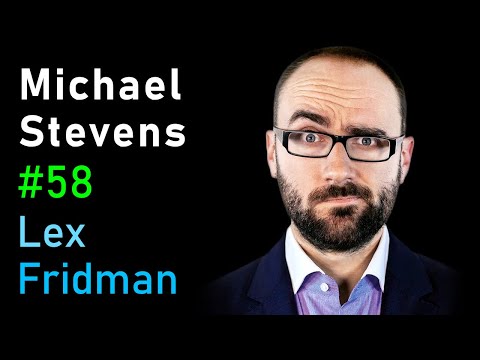
Michael Stevens: Vsauce | Lex Fridman Podcast #58
Lex Fridman (host), Michael Stevens (guest)
In this episode of Lex Fridman Podcast, featuring Lex Fridman and Michael Stevens, Michael Stevens: Vsauce | Lex Fridman Podcast #58 explores michael Stevens and Lex Fridman Explore Curiosity, Reality, and Responsibility Lex Fridman and Michael Stevens (Vsauce) range across consciousness, free will, perception versus reality, and the speculative nature of human knowledge. Michael emphasizes that consciousness and even free will are likely explainable within physics, yet many of our deepest questions may remain matters of faith and uncertainty for a long time. They discuss science as a method rather than a body of truths, using topics like Flat Earth belief and simulations to illustrate how belief, doubt, and good explanations work. The conversation also covers AI risk, technological progress, the YouTube recommendation algorithm, Elon Musk’s influence, and how mortality and legacy shape what it means to live a meaningful, curious life.
Michael Stevens and Lex Fridman Explore Curiosity, Reality, and Responsibility
Lex Fridman and Michael Stevens (Vsauce) range across consciousness, free will, perception versus reality, and the speculative nature of human knowledge. Michael emphasizes that consciousness and even free will are likely explainable within physics, yet many of our deepest questions may remain matters of faith and uncertainty for a long time. They discuss science as a method rather than a body of truths, using topics like Flat Earth belief and simulations to illustrate how belief, doubt, and good explanations work. The conversation also covers AI risk, technological progress, the YouTube recommendation algorithm, Elon Musk’s influence, and how mortality and legacy shape what it means to live a meaningful, curious life.
Key Takeaways
Treat consciousness and free will as physical, but accept uncertainty.
Michael leans toward consciousness being fully explainable by physics and configuration states of the universe, yet stresses that we may live with unresolvable uncertainty for millennia and should be comfortable holding speculative views as such.
Get the full analysis with uListen AI
Distinguish between science as a method and beliefs as certainty.
He argues that science doesn’t prove; it reduces uncertainty through falsifiable tests. ...
Get the full analysis with uListen AI
Use fringe beliefs as teaching tools, not reasons to ridicule.
Michael values Flat Earth discussions because they force us to ask how we know anything, show how ad hoc explanations differ from cohesive theories, and become an engaging way to teach gravity, geometry, and Occam’s razor—without demeaning believers.
Get the full analysis with uListen AI
Recognize our psychological biases toward anthropomorphizing AI and robots.
He notes that a robot merely acting like it’s in pain is enough for humans to feel moral concern, underscoring that many AI ethics questions are psychological and social, not just technical or philosophical.
Get the full analysis with uListen AI
Balance worry about AI and technology with progress, not paralysis.
Michael acknowledges existential risks (especially from weapons) but feels excessive preemptive fear can stall beneficial advances, much as historical anxieties about writing or new tools almost always accompany but shouldn’t halt innovation.
Get the full analysis with uListen AI
See platforms like YouTube as mirrors of human behavior, not sole drivers.
He frames the recommendation algorithm as reflecting what people click and watch, arguing we should understand it as a mirror of aggregate desire while still pushing for features (like stronger creator-driven curation) that foster educational communities.
Get the full analysis with uListen AI
View mortality as a shift from person to “notion,” and act accordingly.
Michael thinks often about death and finds meaning in the idea that we eventually survive only as memories, ripples of influence, and ideas—arguing that humans are “autobiographers of the universe” whose true legacy is the knowledge and stories they record.
Get the full analysis with uListen AI
Notable Quotes
“I think that consciousness is probably something that can be fully explained within the laws of physics.”
— Michael Stevens
“Science doesn't prove anything. It just reduces uncertainty.”
— Michael Stevens
“We need to be really generous to even wild ideas, because they're all thinking, they're all the communication of ideas, and what else can it mean to be a human?”
— Michael Stevens
“Humans and human technology are one organism.”
— Michael Stevens
“We are autobiographers of the universe, and we're really good at it.”
— Michael Stevens
Questions Answered in This Episode
If consciousness is fully physical, what concrete experiments might start to reveal its underlying structures rather than just its correlations?
Lex Fridman and Michael Stevens (Vsauce) range across consciousness, free will, perception versus reality, and the speculative nature of human knowledge. ...
Get the full analysis with uListen AI
How can educators and scientists better engage people drawn to fringe or conspiratorial ideas without alienating them or endorsing bad reasoning?
Get the full analysis with uListen AI
What criteria, beyond passing a Turing test, should define when an AI system deserves moral consideration similar to a human or an animal?
Get the full analysis with uListen AI
In what practical ways could large platforms like YouTube redesign recommendation systems to promote long-term intellectual development without sacrificing engagement?
Get the full analysis with uListen AI
How should individuals think about personal legacy in a universe where both memories and physical records are ultimately fragile and temporary?
Get the full analysis with uListen AI
Transcript Preview
The following is a conversation with Michael Stevens, the creator of Vsauce, one of the most popular educational YouTube channels in the world with over 15 million subscribers and over 1.7 billion views. His videos often ask and answer questions that are both profound and entertaining, spanning topics from physics to psychology. Popular questions include: What if everyone jumped at once? Or what if the Sun disappeared? Or why are things creepy? Or what if the Earth stopped spinning? As part of his channel, he created three seasons of Mind Field, a series that explored human behavior. His curiosity and passion are contagious and inspiring to millions of people. And so as an educator, his impact and contribution to the world is truly immeasurable. This is the Artificial Intelligence Podcast. If you enjoy it, subscribe on YouTube, give us five stars on Apple Podcasts, support it on Patreon, or simply connect with me on Twitter @lexfridman, spelled F-R-I-D-M-A-N. I recently started doing ads at the end of the introduction. I'll do one or two minutes after introducing the episode and never any ads in the middle that break the flow of the conversation. I hope that works for you and doesn't hurt the listening experience. This show is presented by Cash App, the number one finance app in the App Store. I personally use Cash App to send money to friends, but you can also use it to buy, sell, and deposit Bitcoin in just seconds. Cash App also has a new investing feature. You can buy fractions of a stock, say $1 worth, no matter what the stock price is. Broker services are provided by Cash App Investing, a subsidiary of Square and member SIPC. I'm excited to be working with Cash App to support one of my favorite organizations called FIRST, best known for their FIRST Robotics and Lego competitions. They educate and inspire hundreds of thousands of students in over 110 countries, and have a perfect rating on Charity Navigator, which means the donated money is used in maximum effectiveness. When you get Cash App from the App Store or Google Play and use code LEXPODCAST, you'll get $10 and Cash App will also donate $10 to FIRST, which, again, is an organization that I've personally seen inspire girls and boys to dream of engineering a better world. And now, here's my conversation with Michael Stevens. One of your deeper interests is psychology-
Yeah.
... understanding human behavior. You've pointed out how messy studying human behavior is and that it's far from the scientific rigor of something like, uh, physics, for example. How do you think we can take psychology from where it's been in the 20th century to something more like what the physicists, theoretical physicists are doing, something precise, something rigorous?
Well, we, we could do it by finding the physical foundations of psychology, right? If, if all of our emotions and moods and feelings and behaviors are the result of mechanical behaviors of atoms and molecules in our brains, then can we find correlations? Perhaps, like, chaos makes that really difficult and the uncertainty principle and all these things. Like, we can't know the position and, uh, velocity of every single, you know, quantum state in a brain probably, but I think that if we, you know, can get to that point with psychology, then we can start to think about consciousness in a physical and, and mathematical way. When we ask questions like, "Well, what is self-reference? How can you think about yourself thinking?" What are some mathematical structures that could bring that about?
Install uListen to search the full transcript and get AI-powered insights
Get Full TranscriptGet more from every podcast
AI summaries, searchable transcripts, and fact-checking. Free forever.
Add to Chrome