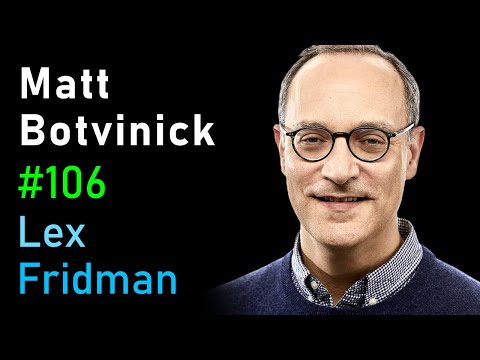
Matt Botvinick: Neuroscience, Psychology, and AI at DeepMind | Lex Fridman Podcast #106
Lex Fridman (host), Matt Botvinick (guest), Lex Fridman (host), Narrator, Narrator
In this episode of Lex Fridman Podcast, featuring Lex Fridman and Matt Botvinick, Matt Botvinick: Neuroscience, Psychology, and AI at DeepMind | Lex Fridman Podcast #106 explores deepMind’s Matt Botvinick on brains, behavior, learning, and AI’s future Matt Botvinick discusses how cognitive psychology, neuroscience, and AI are converging into one science of mind and behavior, with the brain viewed as a computational system mapping perception to adaptive action.
DeepMind’s Matt Botvinick on brains, behavior, learning, and AI’s future
Matt Botvinick discusses how cognitive psychology, neuroscience, and AI are converging into one science of mind and behavior, with the brain viewed as a computational system mapping perception to adaptive action.
He explains why high‑level psychological constructs (like attention and memory) and low‑level neural mechanisms (spikes, synapses, dopamine) must ultimately be linked, using deep learning both as a scientific model of brain function and as an engineering tool.
Key research topics include prefrontal cortex as a meta‑reinforcement learning system, dopamine as a distributional value signal, and how agents can learn to learn across families of tasks.
He closes by arguing that building AI that genuinely benefits humans requires serious work on human–AI interaction, social choice, values, and even warmth and “lovability,” not just raw capability or safety constraints.
Key Takeaways
Treat psychology and neuroscience as one integrated enterprise focused on behavior.
Botvinick argues that the point of neuroscience is to explain what the brain is *for*—producing adaptive behavior from perception—so high‑level constructs like attention and memory must eventually be grounded in physical neural mechanisms, not kept in separate silos.
Get the full analysis with uListen AI
Use deep learning as both a brain model and an AI engine.
Artificial neural networks, particularly recurrent and deep architectures trained with reinforcement learning, often reproduce neural response patterns seen in biology, suggesting they’re reasonable approximations of how brains compute while also being powerful engineering tools.
Get the full analysis with uListen AI
Prefrontal cortex may implement meta‑learning through recurrent dynamics.
By training recurrent networks across families of related tasks, a slow reinforcement‑learning process over synaptic weights can create fast, emergent ‘learning to learn’ in activity patterns—an effect Botvinick proposes as an analogue of how prefrontal cortex supports rapid, flexible learning and cognitive control.
Get the full analysis with uListen AI
Represent value as a distribution, not just a single expectation.
Distributional reinforcement learning maintains full reward distributions instead of collapsing them into averages, enabling richer internal representations and faster learning; Botvinick’s work suggests dopamine neurons may implement a distributional code for value, with different cells encoding optimistic or pessimistic prediction errors.
Get the full analysis with uListen AI
Flexibility and task‑general abilities are the central missing pieces in current AI.
Human intelligence is marked by quick adaptation, abstraction, and the ability to switch between many tasks; modern deep RL systems excel in narrow domains but lack this general cognitive flexibility, making it a primary target for future research.
Get the full analysis with uListen AI
Environment and task distributions critically shape intelligence.
Meta‑learning and abstraction emerge when agents face an endless variety of tasks that share underlying structure, mirroring how humans live in rich, quasi‑repetitive environments; designing such environments is as important as designing architectures and algorithms.
Get the full analysis with uListen AI
AI must address human–AI interaction, values, and warmth—not just safety.
Beyond preventing catastrophic outcomes, Botvinick emphasizes understanding what humans actually want from AI, how agents should interact with diverse human preferences, and even how agents might exhibit “warmth” and care, which he sees as essential to building AI systems people can trust and perhaps even love.
Get the full analysis with uListen AI
Notable Quotes
“To me, the point of neuroscience is to study what the brain is for. The brain, as far as I can tell, is for producing behavior.”
— Matt Botvinick
“Remaining forever at the level of description that is natural for psychology, for me personally, would be disappointing. I want to understand how mental activity arises from neural activity.”
— Matt Botvinick
“If you have a system that has memory and it’s trained with reinforcement learning across related tasks, this kind of meta‑learning just happens. You can’t stop it.”
— Matt Botvinick
“We shouldn’t only be asking what can go wrong. We also have to bring into focus the question of what it would look like for things to go right.”
— Matt Botvinick
“It’s not out of the question that we could build systems that end up learning what it is to interact with humans in a way that’s gratifying to humans. Honestly, if that’s not where we’re headed, I want out.”
— Matt Botvinick
Questions Answered in This Episode
How can we practically bridge the ‘yawning gap’ between high‑level psychological constructs and low‑level neural mechanisms in experimental research?
Matt Botvinick discusses how cognitive psychology, neuroscience, and AI are converging into one science of mind and behavior, with the brain viewed as a computational system mapping perception to adaptive action.
Get the full analysis with uListen AI
What kinds of task distributions and environments are most effective for inducing powerful meta‑learning and abstraction in artificial agents?
He explains why high‑level psychological constructs (like attention and memory) and low‑level neural mechanisms (spikes, synapses, dopamine) must ultimately be linked, using deep learning both as a scientific model of brain function and as an engineering tool.
Get the full analysis with uListen AI
If dopamine implements a distributional code for value, how might that change current reinforcement learning architectures and exploration strategies in AI?
Key research topics include prefrontal cortex as a meta‑reinforcement learning system, dopamine as a distributional value signal, and how agents can learn to learn across families of tasks.
Get the full analysis with uListen AI
What concrete design principles or metrics could capture ‘warmth’ and ‘care’ in human–AI interaction, beyond simple usability or performance?
He closes by arguing that building AI that genuinely benefits humans requires serious work on human–AI interaction, social choice, values, and even warmth and “lovability,” not just raw capability or safety constraints.
Get the full analysis with uListen AI
Given that only a small group can build advanced AI systems, how should broader societal preferences and values be incorporated into their objectives and training?
Get the full analysis with uListen AI
Transcript Preview
The following is a conversation with Matt Botvinick, director of neuroscience research at DeepMind. He's a brilliant cross-disciplinary mind, navigating effortlessly between cognitive psychology, computational neuroscience, and artificial intelligence. Quick summary of the ads. Two sponsors, The Jordan Harbinger Show and Magic Spoon Cereal. Please consider supporting the podcast by going to jordanharbinger.com/lex and also going to magicspoon.com/lex and using code LEX at checkout after you buy all of their cereal. Click the links, buy the stuff. It's the best way to support this podcast and the journey I'm on. If you enjoy this podcast, subscribe on YouTube, review it with five stars on Apple Podcast, follow on Spotify, support on Patreon, or connect with me on Twitter @lexfridman, spelled surprisingly without the E, just F-R-I-D-M-A-N. As usual, I'll do a few minutes of ads now and never any ads in the middle that can break the flow of the conversation. This episode is supported by The Jordan Harbinger Show. Go to jordanharbinger.com/lex. It's how he knows I sent you. On that page, subscribe to his podcast on Apple Podcasts, Spotify, and you know where to look. I've been binging on his podcast. Jordan is a great interviewer and even a better human being. I recently listened to his conversation with Jack Barsky, former sleeper agent for the KGB in the '80s and author of Deep Undercover, which is a memoir that paints yet another interesting perspective on the Cold War era. I've been reading a lot about the Stalin and then Gorbachev and Putin eras of Russia, but this conversation made me realize that I need to do a deep dive into the Cold War era to get a complete picture of Russia's recent history. Again, go to jordanharbinger.com/lex, subscribe to his podcast. It's how he knows I sent you. It's awesome. You won't regret it. This episode is also supported by Magic Spoon, low-carb, keto-friendly, super amazingly delicious cereal. I've been on a keto or very low-carb diet for a long time now. It helps with my mental performance, it helps with my physical performance, even doing this crazy pushup, uh, pull-up challenge I'm doing, including the running. It just feels great. Uh, I used to love cereal. Obviously, I can't have it, uh, now because most cereals have a crazy amount of sugar, which is terrible for you. So I quit it years ago, but Magic Spoon amazingly somehow is a totally different thing. Zero sugar, 11 grams of protein, and only three net grams of carbs. It tastes delicious. It has a lot of flavors, two new ones, including peanut butter. But if you know what's good for you, you'll go with cocoa, my favorite flavor and the flavor of champions. Click the magicspoon.com/lex link in the description and use code LEX at checkout for free shipping and to let them know I sent you. They've agreed to sponsor this podcast for a long time. They're an amazing sponsor and an even better cereal. I highly recommend it. It's delicious. It's good for you. You won't regret it. And now here's my conversation with Matt Botvinick. How much of the human brain do you think we understand?
Install uListen to search the full transcript and get AI-powered insights
Get Full TranscriptGet more from every podcast
AI summaries, searchable transcripts, and fact-checking. Free forever.
Add to Chrome