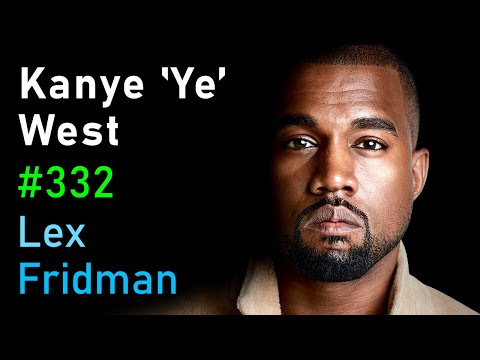
Kanye 'Ye' West Interview | Lex Fridman Podcast #332
Lex Fridman (host), Ye (Kanye West) (guest), Lex Fridman (host), Lex Fridman (host)
In this episode of Lex Fridman Podcast, featuring Lex Fridman and Ye (Kanye West), Kanye 'Ye' West Interview | Lex Fridman Podcast #332 explores ye and Lex Fridman Clash on Truth, Pain, Power, and Engineering In this wide‑ranging and contentious conversation, Ye (Kanye West) and Lex Fridman debate engineering, history, media power, race, Judaism, and Ye’s recent antisemitic comments. Ye repeatedly reframes life as “a being with engineering opportunities,” outlining utopian design ideas, social platforms, and Black economic empowerment while defending his controversial statements as reactions to exploitation. Lex continually pushes back—especially on Holocaust analogies, Jewish “control” of media, and group blame—pressing Ye toward personal responsibility, specificity, and non‑hateful language. The episode oscillates between visionary design talk, raw personal pain (family, industry betrayal, mental health), and difficult real‑time attempts at apology, clarification, and mutual understanding.
Ye and Lex Fridman Clash on Truth, Pain, Power, and Engineering
In this wide‑ranging and contentious conversation, Ye (Kanye West) and Lex Fridman debate engineering, history, media power, race, Judaism, and Ye’s recent antisemitic comments. Ye repeatedly reframes life as “a being with engineering opportunities,” outlining utopian design ideas, social platforms, and Black economic empowerment while defending his controversial statements as reactions to exploitation. Lex continually pushes back—especially on Holocaust analogies, Jewish “control” of media, and group blame—pressing Ye toward personal responsibility, specificity, and non‑hateful language. The episode oscillates between visionary design talk, raw personal pain (family, industry betrayal, mental health), and difficult real‑time attempts at apology, clarification, and mutual understanding.
Key Takeaways
Reframe problems as engineering opportunities, not fixed identities.
Ye’s recurring line—“You are a being with engineering opportunities before you”—captures his belief that individuals and societies should see challenges (career, family, social systems) as solvable design problems, not unchangeable fates.
Get the full analysis with uListen AI
Separate specific bad actors from entire groups to avoid hate.
Lex pushes Ye to call out named individuals and concrete contracts instead of saying “Jewish media” or “they,” arguing that group blame fuels historical patterns of hatred and obscures real, fixable issues.
Get the full analysis with uListen AI
Use success to reshape unfair systems transparently, not just complain about them.
Ye suggests auditing top contracts in music, sports, and film and openly “re‑engineering” them—creating a new, fairer ‘constitution’ for artists—rather than remaining in opaque, exploitative legacy structures.
Get the full analysis with uListen AI
If you demand accountability from others, accept it for your own words.
Throughout, Lex insists that Ye’s tweets and Holocaust comparisons caused genuine harm; Ye eventually acknowledges pain caused, calls his tweet a “mistake,” and wrestles with how to apologize without abandoning his critique of industry practices.
Get the full analysis with uListen AI
Visionary design must account for human well‑being and the planet, not just aesthetics.
In describing clothing, housing “cells,” and future cities, Ye emphasizes biodegradable materials, integrated water and light systems, and spaces designed for happiness and family—suggesting design should optimize long‑term health, not only style or profit.
Get the full analysis with uListen AI
True independence requires building your own platforms and teams.
Ye interprets de‑platforming and broken brand relationships (Adidas, Gap, Balenciaga) as signals to build his own social network (Parler), factories, and Black‑led engineering teams so his voice and vision aren't hostage to existing gatekeepers.
Get the full analysis with uListen AI
Honest, uncomfortable dialogue is essential but must be grounded in empathy.
The conversation shows that difficult topics—antisemitism, race, abortion, exploitation—can be confronted directly, but progress only happens when both sides acknowledge each other’s pain, avoid dehumanizing language, and keep returning to shared human goals.
Get the full analysis with uListen AI
Notable Quotes
“You are a being with engineering opportunities before you.”
— Ye
“Engineering isn’t everything. You desperately have to study the lessons of history.”
— Lex Fridman
“The biggest mistake from the past that we keep making is looking at the past too much.”
— Ye
“When you say ‘Jewish media,’ it rings like something Joseph Goebbels said. It brings hate to the surface.”
— Lex Fridman
“Causing people to hurt is not helping. That means I have to take a more sophisticated approach to engineering this problem.”
— Ye
Questions Answered in This Episode
Where is the line between legitimate systemic critique and harmful, group‑based rhetoric, and who gets to draw it?
In this wide‑ranging and contentious conversation, Ye (Kanye West) and Lex Fridman debate engineering, history, media power, race, Judaism, and Ye’s recent antisemitic comments. ...
Get the full analysis with uListen AI
How can artists and engineers practically ‘re‑engineer’ exploitative contracts and industry norms without simply recreating new power imbalances?
Get the full analysis with uListen AI
Is Ye’s proposal to minimize history education visionary or dangerous, given how often ignorance of history leads to repeated atrocities?
Get the full analysis with uListen AI
What would truly ‘healthy’ social media platforms look like in design, incentives, and governance—and can they scale without becoming toxic?
Get the full analysis with uListen AI
How should public figures balance radical honesty and provocation with their responsibility not to inflame existing traumas and prejudices?
Get the full analysis with uListen AI
Transcript Preview
The following is a conversation with Ye, the legendary artist, producer, and designer formerly known as Kanye West, on this, The Lex Fridman Podcast.
Based off of our connection, and just you being a friend, I need to show you my two tech companies and get your perspective on it. 'Cause now I have friends that can give a perspective. Like, when I would work on albums, I had other friends that worked on albums and they would give me their perspectives on it.
You wanna do this? (sighs)
We are doing it. This is part of it.
This is part of it?
Absolutely.
All right. Beautiful.
Oh, what I wanted to finish, the thing is, okay, you're gonna ask me different questions. But I'm about growing and building and bringing the idea to life. So when I see you, I say, "Oh, this guy understands how to hire engineers." Where I'm coming from, coming from Hollywood, coming from press, coming from media, all of the guys, you know, that... So many of the guys that have been like voices and faces and talking heads, whatever, have not understood how to engineer product. And that's the reason why I was able to jump past everyone in the entertainment field and become, um, you know, whatever the net worth is, 11 billion. I'm gonna stop putting the whole Black thing on my worth. Like, let's just see where I am on the scale of life, because that's a cop out for me to say richest Black guy of all time, because that's feeding into the same, you know, trauma economy that Black Lives Matter feeds into. That's why I love and respect engineers. That's the only thing that we really need to teach in school, is engineering. We don't need to teach history. We don't need to teach anything that is subjective. It needs to only be engineering taught in school. And everything else needs to be recess. Nothing that, at all, any forced subjective information is just to weaken and indoctrinate our species. And that's what schools do now.
As an engineer, I love hearing you say that. But to push back, history is not... The interpretation of history might be subjective, but history has some facts, and they're useful to give a grounding to the way you do engineering.
I don't 100% believe in anything, any concept of the future or any concept of history, because history was just written by the victors.
Yeah. That's right.
So if I see stuff happen on the day that later that day is reported wrong, so how wrong is something reported 1,000 years ago? And why would we argue about something that's not in the now? Because that's the only thing that everyone can agree upon is that it is now, right now.
Yeah. Well, you try not to make the mistakes of the past. That's the usefulness of history.
Install uListen to search the full transcript and get AI-powered insights
Get Full TranscriptGet more from every podcast
AI summaries, searchable transcripts, and fact-checking. Free forever.
Add to Chrome