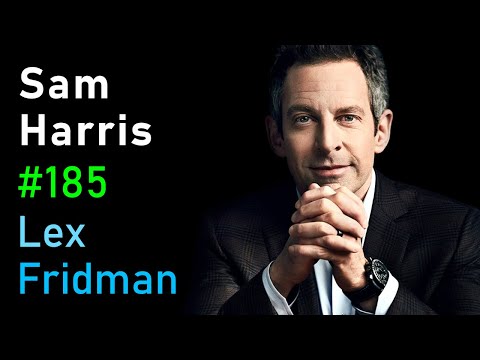
Sam Harris: Consciousness, Free Will, Psychedelics, AI, UFOs, and Meaning | Lex Fridman Podcast #185
Lex Fridman (host), Sam Harris (guest), Narrator, Narrator
In this episode of Lex Fridman Podcast, featuring Lex Fridman and Sam Harris, Sam Harris: Consciousness, Free Will, Psychedelics, AI, UFOs, and Meaning | Lex Fridman Podcast #185 explores sam Harris and Lex Fridman Dismantle Self, Free Will, and Reality Sam Harris and Lex Fridman explore the nature of consciousness, arguing that while conscious experience is undeniable, the sense of a stable self and free will are constructed illusions that can dissolve under close attention or meditation.
Sam Harris and Lex Fridman Dismantle Self, Free Will, and Reality
Sam Harris and Lex Fridman explore the nature of consciousness, arguing that while conscious experience is undeniable, the sense of a stable self and free will are constructed illusions that can dissolve under close attention or meditation.
They discuss how thoughts and intentions simply appear in consciousness, why this undermines traditional notions of authorship and moral blame, and how seeing through these illusions can radically reduce hatred and self‑loathing while deepening compassion.
The conversation ranges through psychedelics, dreams, panpsychism, idealism, AI, UFOs, and existential risk, with Harris emphasizing our cognitive limits, the dangers of misaligned superintelligence and engineered pandemics, and the failure of collective rationality revealed by COVID.
They close on love and meaning: love as deep alignment with others’ wellbeing, and the “meaning of life” as the skill of fully inhabiting the present moment—something Harris sees as trainable through meditation rather than dependent on external achievements.
Key Takeaways
Consciousness is undeniable, but the self and free will are not.
Harris argues that consciousness is simply “what it’s like” for anything to seem to happen and cannot be an illusion, whereas the feeling of being a separate, enduring self who freely authors thoughts and actions disappears under careful scrutiny or meditation.
Get the full analysis with uListen AI
Thoughts and intentions arise unbidden, undermining traditional free will.
We do not know our next thought or intention, nor can we choose its arrival; they simply emerge from causes we did not create (genes, environment, brain states), so the notion that we could truly have “done otherwise” is incoherent on any causal picture.
Get the full analysis with uListen AI
Seeing through free will drastically softens hatred and self‑hatred.
Recognizing that no one ultimately made themselves reframes others’ wrongdoing as bad luck plus causes, not pure evil, and reframes our own past mistakes as inevitable outcomes of prior conditions—supporting compassion, regret-as-information, and less psychological torture.
Get the full analysis with uListen AI
Meditation and psychedelics reveal how much language and concepts narrow experience.
Non‑linguistic states—through deep meditation or psychedelics—show that our ordinary, concept‑driven perception is a thin, filtered slice of possible experience; the world can appear overwhelmingly rich and meaningful once those filters loosen.
Get the full analysis with uListen AI
Our cognitive limits are huge; we likely grasp only a tiny fraction of reality.
Given evolution optimized us for survival, not truth, and considering how close we are to chimps, Harris suspects much of what we “know” is wrong or incomplete, and that many domains (physics, consciousness, values) vastly exceed our built‑in capacities.
Get the full analysis with uListen AI
AI and bioengineering pose real existential risks we’re not socially equipped to manage.
Harris fears that incremental progress will eventually yield superhuman, possibly conscious systems and powerful synthetic biology; our COVID response shows we cannot even agree on basic facts, making coordinated, rational risk management unlikely.
Get the full analysis with uListen AI
Meaning is found by fully inhabiting the present, not in future achievements.
The recurring sense that life’s meaning lies in future milestones is a mirage; for Harris, the “meaning of life” is the capacity to let attention fully rest in the current moment—something practices like meditation can cultivate even amid ordinary or difficult circumstances.
Get the full analysis with uListen AI
Notable Quotes
“You don’t know what you’re going to think next, and you don’t think it before you think it.”
— Sam Harris
“It’s not merely that free will is an illusion; the illusion of free will is an illusion.”
— Sam Harris
“No scientist has ever done an experiment outside of consciousness. We are only ever experiencing consciousness and its contents.”
— Sam Harris
“We are apes with egos whose wisdom is not scaling with our power.”
— Sam Harris
“You don’t arrive until you cease to step over the present moment in search of the next thing.”
— Sam Harris
Questions Answered in This Episode
If the self and free will are illusions, how should legal systems and moral responsibility be rethought in practice rather than just in theory?
Sam Harris and Lex Fridman explore the nature of consciousness, arguing that while conscious experience is undeniable, the sense of a stable self and free will are constructed illusions that can dissolve under close attention or meditation.
Get the full analysis with uListen AI
How can an individual begin to experientially test Harris’s claims about the illusion of free will or self without extensive meditation training or psychedelics?
They discuss how thoughts and intentions simply appear in consciousness, why this undermines traditional notions of authorship and moral blame, and how seeing through these illusions can radically reduce hatred and self‑loathing while deepening compassion.
Get the full analysis with uListen AI
Given our cognitive and cultural limitations, what concrete mechanisms could improve our collective ability to converge on truth about threats like AI and engineered pandemics?
The conversation ranges through psychedelics, dreams, panpsychism, idealism, AI, UFOs, and existential risk, with Harris emphasizing our cognitive limits, the dangers of misaligned superintelligence and engineered pandemics, and the failure of collective rationality revealed by COVID.
Get the full analysis with uListen AI
If we build AI that perfectly simulates love and consciousness, what kind of evidence—if any—could ever justify believing it truly feels anything?
They close on love and meaning: love as deep alignment with others’ wellbeing, and the “meaning of life” as the skill of fully inhabiting the present moment—something Harris sees as trainable through meditation rather than dependent on external achievements.
Get the full analysis with uListen AI
How can someone balance the drive for ambitious world-changing work with Harris’s insistence that meaning is only ever available in the present moment?
Get the full analysis with uListen AI
Transcript Preview
The following is a conversation with Sam Harris, one of the most influential and pioneering thinkers of our time. He's the host of the Making Sense podcast, and the author of many seminal books on human nature and the human mind, including The End of Faith, The Moral Landscape, Lying, Free Will, and Waking Up. He also has a meditation app called Waking Up that I've been using to guide my own meditation. A quick mention of our sponsors: National Instruments, Belcampo, Athletic Greens, and Linode. Check them out in the description to support this podcast. As a side note, let me say that Sam has been an inspiration to me, as he has been for many, many people, first from his writing, then his early debates, maybe 13, 14 years ago on the subject of faith, his conversations with, uh, Christopher Hitchens, and since 2013, his podcast. I didn't always agree with all of his ideas, but I was always drawn to the care and depth of the way he explored those ideas, the calm and clarity amid the storm of difficult, at times controversial discourse. I really can't express in words how much it meant to me that he, Sam Harris, someone who I've listened to for many hundreds of hours, would write a kind email to me saying he enjoyed this podcast, and more that he thought I had a unique voice that added something to this world. Whether it's true or not, it made me feel special, and truly grateful to be able to do this thing, and motivated me to work my ass off to live up to those words. Meeting Sam and getting to talk with him was one of the most memorable moments of my life. This is the Lex Fridman Podcast, and here is my conversation with Sam Harris. I've been enjoying meditating with the Waking Up app recently. It makes me, uh, think about the origins of cognition and consciousness. So let me ask, where do thoughts come from?
Well, that's, that's a very difficult question to answer. Um, subjectively, they appear to come from nowhere, right? I mean, it's just, they, they, they come out of some kind of mystery that is at our backs subjectively, right? So, which is to say that if you pay attention to the nature of your mind in this moment, you realize that you don't know what you're going to think next, right? Now, you're expecting to think something that seems like you authored it, right? You, you, you know, you're not, unless you, you're schizophrenic or you, you have some kind of thought disorder where you, where your thoughts seem fundamentally foreign to you, they do have a, a kind of signature of, of self-hood associated with them, uh, and w- people readily identify with them. They feel like what you are. I mean, this, this is the thing, this is the spell that gets broken with meditation. I mean, the, our default state is to feel identical to the stream of thought, right? We, which is fairly paradoxical, 'cause how could you, as a mind, as a self, you know, if there, if there were such a thing as a self, how could you be identical to the next piece of language or the next image, uh, that just springs into, into conscious view? Uh, but, and, you know, p- p- meditation is ultimately about examining that, that point of view closely enough so as to unravel it and feel the, the freedom that's on the other side of that identification. But the, um, subjectively, thoughts simply emerge, right? And you don't think them before you think them, right? There's, there's this first moment where, you know, I mean, just, anyone listening to us or watching us now could perform this experiment for themselves and just imagine something or remember something. You know, just, just pick a memory, any memory, right? You've got a, a storehouse of memory. Just promote one to consciousness. Did you pick that memory? I mean, let's say you remembered breakfast yesterday, or you remembered what you said to your spouse before leaving the house, or you remembered what you watched on Netflix last night, or you remembered something that happened to you when you were four years old, whatever it is, right, it, first it wasn't there, and then it appeared. And that is not a, I mean, I'm sure we'll get, get to the topic of free will ultimately, uh, that's not evidence of free will, right? I mean, that-
Install uListen to search the full transcript and get AI-powered insights
Get Full TranscriptGet more from every podcast
AI summaries, searchable transcripts, and fact-checking. Free forever.
Add to Chrome