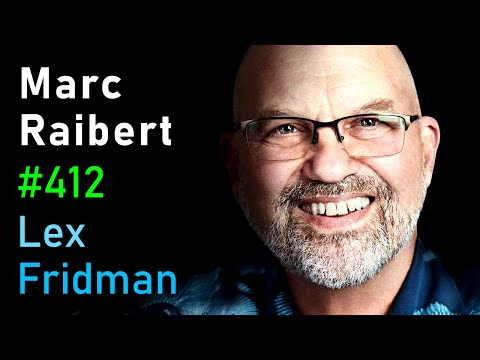
Marc Raibert: Boston Dynamics and the Future of Robotics | Lex Fridman Podcast #412
Marc Raibert (guest), Lex Fridman (host), Narrator
In this episode of Lex Fridman Podcast, featuring Marc Raibert and Lex Fridman, Marc Raibert: Boston Dynamics and the Future of Robotics | Lex Fridman Podcast #412 explores marc Raibert on athletic robot intelligence, hardware, and daring design Marc Raibert traces his 40+ year journey from early hopping robots and MIT’s Leg Lab to founding Boston Dynamics and now leading the Boston Dynamics AI Institute. He explains why dynamic, aggressive movement and continual hardware innovation are central to lifelike robots, contrasting this with the cautious, quasi-static approach common in robotics. The conversation dives into BigDog, LS3, Spot, Atlas, and dancing robots, emphasizing robustness through brutal real-world testing and iterative failure. Raibert also outlines his new focus on combining “athletic” and “cognitive” intelligence so robots can watch humans, understand tasks, and then perform them autonomously.
Marc Raibert on athletic robot intelligence, hardware, and daring design
Marc Raibert traces his 40+ year journey from early hopping robots and MIT’s Leg Lab to founding Boston Dynamics and now leading the Boston Dynamics AI Institute. He explains why dynamic, aggressive movement and continual hardware innovation are central to lifelike robots, contrasting this with the cautious, quasi-static approach common in robotics. The conversation dives into BigDog, LS3, Spot, Atlas, and dancing robots, emphasizing robustness through brutal real-world testing and iterative failure. Raibert also outlines his new focus on combining “athletic” and “cognitive” intelligence so robots can watch humans, understand tasks, and then perform them autonomously.
Key Takeaways
Dynamic, ‘athletic’ movement is essential for lifelike robots.
Raibert argues that animals and humans move by balancing, flying phases, and reusing energy like springs—not by creeping with multiple legs always on the ground—so robots must embrace dynamic, underactuated motion to approach natural performance.
Get the full analysis with uListen AI
Hardware innovation still profoundly matters in robotics.
Contrary to views that software and AI alone drive progress, he stresses that advanced actuators, lightweight structures, integrated hydraulic power units, and clever mechanical design (e. ...
Get the full analysis with uListen AI
Real-world robustness comes from aggressive, repeated failure.
Boston Dynamics’ motto of “build it, break it, fix it” led to robots enduring hundreds of falls and harsh tests (like tugging ropes, pushing doors) to expand their operational envelope; reliability is engineered through systematically exploring and surviving edge cases.
Get the full analysis with uListen AI
Athletic and cognitive intelligence must be combined for useful robots.
Today’s robots are physically capable but “pretty dumb,” requiring experts to script behaviors; the AI Institute aims for systems that can watch a human perform a task, segment and understand it, and then execute it—“watch, understand, do”—across varied environments.
Get the full analysis with uListen AI
Good teams depend on four cultural pillars: fearlessness, diligence, intrepidness, and fun.
Raibert looks for engineers who take on unsolved problems, insist on broad, robust solutions, persist through long stretches of failure, and genuinely enjoy technical work, creating an environment where ambitious robotics is sustainable.
Get the full analysis with uListen AI
Simple, honest demonstrations communicate robotics breakthroughs best.
The iconic Boston Dynamics videos deliberately avoid narration and flashy production; by showing raw performance (including perturbations and failures), they let viewers directly grasp difficulty, capability, and progress—and helped define the public’s image of modern robotics.
Get the full analysis with uListen AI
Long-term innovation needs ‘stepping-stones to moonshots.’
For ambitious goals like on-the-job training for robots or inspect-diagnose-fix capabilities, Raibert insists on intermediate milestones visible within roughly a year, providing feedback, motivation, and course correction while keeping the larger vision intact.
Get the full analysis with uListen AI
Notable Quotes
““People who think you don't need to innovate hardware anymore are wrong.””
— Marc Raibert
““Most robots are pretty dumb… If robots are gonna satisfy our dreams, they need to be smarter.””
— Marc Raibert
““We had a motto at Boston Dynamics: you have to run before you can walk.””
— Marc Raibert
““Technical fearlessness means being willing to take on a problem that you don't know how to solve.””
— Marc Raibert
““Engineers get to make stuff that didn’t exist before… it’s really a higher calling.””
— Marc Raibert
Questions Answered in This Episode
How far can dynamic legged robots realistically advance before passive mechanical design becomes the main bottleneck instead of software?
Marc Raibert traces his 40+ year journey from early hopping robots and MIT’s Leg Lab to founding Boston Dynamics and now leading the Boston Dynamics AI Institute. ...
Get the full analysis with uListen AI
What are the most promising techniques for teaching robots complex manipulation skills by watching humans, without hand-coded object models?
Get the full analysis with uListen AI
How might the balance between model-based control and learning-based methods shift as reinforcement learning for real robots matures?
Get the full analysis with uListen AI
What new safety, ethical, or social challenges will arise when humanoid and quadruped robots become inexpensive and common in homes?
Get the full analysis with uListen AI
In combining athletic and cognitive intelligence, what early real-world tasks will best demonstrate that robots can truly ‘watch, understand, and do’?
Get the full analysis with uListen AI
Transcript Preview
So BigDog became LS3, which is the big load-carrying one.
Just, just a quick pause. It can carry 400 pounds and-
It was designed to carry 400, but we had it carrying about 1,000 pounds, uh, one time. (laughs)
Of course you did. (laughs) Just to make sure.
We had one carrying the other one. We had two of them, so we had one carrying the other one.
So one of the things that stands out about the robots Boston Dynamics have created is how beautiful the movement is, how natural the walking is and r- running is, even flipping is, throwing is. So maybe you can talk about what, what's involved in making it look natural.
Well, I think having good hardware is part of the story, and people who think you don't need to innovate hardware anymore are wrong.
The following is a conversation with Marc Raibert, a legendary roboticist, founder and longtime CEO of Boston Dynamics, and recently, the executive director of the newly created Boston Dynamics AI Institute that focuses on research and the cutting edge, on creating future generations of robots that are far better than anything that exists today. He has been leading the creation of incredible legged robots for over 40 years, at CMU, at MIT, the legendary MIT Leg Lab, and then of course, Boston Dynamics, with amazing robots like BigDog, Atlas, Spot, and Handle. This was a big honor and pleasure for me. This is the Lex Fridman Podcast. To support it, please check out our sponsors in the description. And now, dear friends, here's Marc Raibert. When did you first fall in love with robotics?
Well, I was always a builder from a, from a young age. I wa- I was lucky. My father was a, uh, frustrated, uh, engineer, and by that I mean, uh, he wanted to be an aerospace engineer, but his mom, from the old country, thought that that would be like a grease monkey. (laughs)
Mm-hmm.
And so she said no, so he became an accountant. But the, but the result of that was our basement was always full of, uh, tools and equipment and electronics and, you know, from a young age I would watch him, uh, assembling a kit, an ICO kit or something like that. I still have a couple of his old ICO kits. And, uh, but it was really, uh, during graduate school when, uh, uh, I followed, uh, a professor back, uh, from class. It was, uh, Berthold Horn at MIT, and I was taking a, uh, an interim class. It's IAP, Independent Activities Period.
Mm-hmm.
And I followed him back to his lab, and on the table was a, a Vicarm robot arm taken apart in probably a thousand pieces. And, uh, when I saw that, you know, from that day on, uh, I was a roboticist. (laughs)
Do you remember the year?
1974.
Install uListen to search the full transcript and get AI-powered insights
Get Full TranscriptGet more from every podcast
AI summaries, searchable transcripts, and fact-checking. Free forever.
Add to Chrome