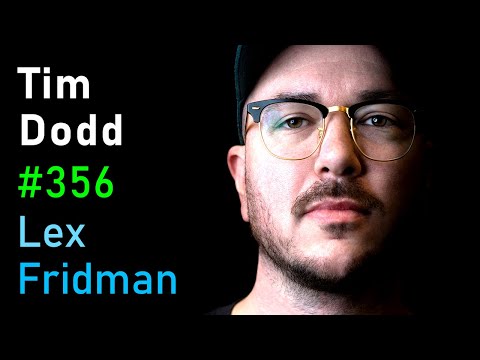
Tim Dodd: SpaceX, Starship, Rocket Engines, and Future of Space Travel | Lex Fridman Podcast #356
Lex Fridman (host), Tim Dodd (guest), Narrator, Narrator, Narrator
In this episode of Lex Fridman Podcast, featuring Lex Fridman and Tim Dodd, Tim Dodd: SpaceX, Starship, Rocket Engines, and Future of Space Travel | Lex Fridman Podcast #356 explores tim Dodd Dissects SpaceX, Starship, Rocket Engines, and Humanity’s Future Lex Fridman and Tim Dodd (Everyday Astronaut) dive deep into the evolution of SpaceX, from Falcon 1 and Falcon 9 to Falcon Heavy, Dragon, Starlink, and the fully reusable Starship system, explaining both the engineering and business logic behind each step.
Tim Dodd Dissects SpaceX, Starship, Rocket Engines, and Humanity’s Future
Lex Fridman and Tim Dodd (Everyday Astronaut) dive deep into the evolution of SpaceX, from Falcon 1 and Falcon 9 to Falcon Heavy, Dragon, Starlink, and the fully reusable Starship system, explaining both the engineering and business logic behind each step.
They unpack rocket engine fundamentals and advanced cycles (open, closed, full-flow staged combustion), cooling techniques, reusability, and why specific design choices like methane fuel, grid fins, and belly‑flop landings matter for cost and reliability.
Tim discusses the broader ecosystem of spaceflight: NASA’s partnership and culture clash with SpaceX, international efforts (Russia, China), and emerging competitors (Rocket Lab, Blue Origin, Firefly, Relativity, Stoke) in the race toward reusability and lower launch costs.
The conversation becomes personal as Tim reflects on being selected for the DearMoon circumlunar Starship mission, the psychology of risk, the inspiration of Apollo, and the role of social media, science communication, and long‑term thinking in making humanity multi‑planetary.
Key Takeaways
Reusability is the economic key to interplanetary travel.
Dodd emphasizes that fully or largely reusable rockets are mandatory to make Mars missions financially viable; every kilogram of hardware recovered and reflown directly reduces cost per kilogram to orbit.
Get the full analysis with uListen AI
Engine and nozzle design are constant trade‑studies between efficiency, cost, and manufacturability.
SpaceX’s move from early Merlin layouts to the Falcon 9 octaweb and then to Raptor full-flow cycles shows how simplifying parts (“fiddly bits”), standardizing geometry, and using cost-per-thrust as a metric can beat raw performance specs alone.
Get the full analysis with uListen AI
Starship’s design pushes risk and complexity to enable order‑of‑magnitude gains.
The stainless‑steel structure, 33 Raptor engines, tower “chopsticks” catch, and belly‑flop to flip landing are all extreme engineering choices that, if matured, could deliver unprecedented payload and full reusability, but require iterative testing and spectacular failures.
Get the full analysis with uListen AI
Culture and process differences between NASA and SpaceX are a feature, not a bug.
NASA’s paperwork‑heavy, risk‑averse certification processes and SpaceX’s fast iteration, “try it and see” mentality created friction, but together yielded safer systems faster: NASA acted as a safety backstop while SpaceX accelerated hardware learning cycles.
Get the full analysis with uListen AI
Orbital mechanics and staging make single‑stage‑to‑orbit on Earth commercially pointless.
Physics and mass fractions mean SSTO rockets could only deliver tiny payloads; shedding empty mass via staging and using different engines optimized for sea level vs vacuum is far more efficient and underpins all practical launch architectures.
Get the full analysis with uListen AI
Global internet constellations like Starlink are both a business engine and a civilizational lever.
By vertically integrating rockets and satellites, SpaceX uses Starlink as its biggest customer, driving high launch cadence and mass-to-orbit while also potentially unlocking education, economic growth, and connectivity in underserved regions.
Get the full analysis with uListen AI
Questioning constraints—technical and personal—is central to breakthrough progress.
Tim recounts how Elon Musk habitually challenges implicit constraints (materials, languages, legacy practices), and says this mindset also changed his own life—pushing him from wedding photography into space education and ultimately onto a mission around the Moon.
Get the full analysis with uListen AI
Notable Quotes
“At the end of the day, a rocket engine is just converting high pressure and heat into kinetic energy.”
— Tim Dodd
“If you aren’t working on a reusable vehicle right now, you’re done.”
— Tim Dodd
“It’s so hard to predict. Five years ago I wouldn’t have predicted where we are today.”
— Tim Dodd
“You can’t have everyone questioning constraints all the time, but you need someone who will walk in and say, ‘Why are we even doing it this way?’”
— Lex Fridman
“I still have to actually stop, pause, think, and realize the reality that I am going to the Moon.”
— Tim Dodd
Questions Answered in This Episode
How likely is Starship to achieve fully rapid reusability, and what specific technical milestones will make or break that goal?
Lex Fridman and Tim Dodd (Everyday Astronaut) dive deep into the evolution of SpaceX, from Falcon 1 and Falcon 9 to Falcon Heavy, Dragon, Starlink, and the fully reusable Starship system, explaining both the engineering and business logic behind each step.
Get the full analysis with uListen AI
In what ways could nuclear thermal propulsion practically change mission profiles to Mars and beyond compared to chemical rockets?
They unpack rocket engine fundamentals and advanced cycles (open, closed, full-flow staged combustion), cooling techniques, reusability, and why specific design choices like methane fuel, grid fins, and belly‑flop landings matter for cost and reliability.
Get the full analysis with uListen AI
How should regulators and companies balance launch cadence, mega‑constellations, and the Kessler syndrome risk to keep low Earth orbit usable?
Tim discusses the broader ecosystem of spaceflight: NASA’s partnership and culture clash with SpaceX, international efforts (Russia, China), and emerging competitors (Rocket Lab, Blue Origin, Firefly, Relativity, Stoke) in the race toward reusability and lower launch costs.
Get the full analysis with uListen AI
What are the biggest unknowns in human biology for multi‑year deep space missions, particularly for reproduction and child development off‑Earth?
The conversation becomes personal as Tim reflects on being selected for the DearMoon circumlunar Starship mission, the psychology of risk, the inspiration of Apollo, and the role of social media, science communication, and long‑term thinking in making humanity multi‑planetary.
Get the full analysis with uListen AI
Could international collaboration in space (e.g., with China or a post‑war Russia) once again act as a stabilizing force amid rising geopolitical tensions?
Get the full analysis with uListen AI
Transcript Preview
And the nozzles, so as you're saying, there's a bunch of different design options, but it's a critical part of this.
Yeah.
How you do that conversion, which is what -
It's basically like how much can you convert is really like the ultimate game. How much pressure and heat can we convert into thrust? Like that's really, at the end of the day, that's what a rocket engine is.
The following is a conversation with Tim Dodd, host of The Everyday Astronaut YouTube channel, where he educates and inspires all of us with detailed but accessible explanations of rocket engines and all things space travel. This is a Lex Fridman podcast. To support it, please check out our sponsors in the description and now dear friends, here's Tim Dodd. Can you give a brief history of SpaceX rockets? So we got Falcon 1, Falcon 9, there's different versions of those. Falcon Heavy, uh, Starship, and also the, the Dragon capsules and so on.
Well, uh, yeah, Falcon 1 is where it all started. The original intent and the original idea of, of SpaceX was Elon wanted to try to get something to Mars. You know, um, he saw that NASA didn't have a current Mars plan and he wanted to go to Mars so he decided how do I best do this? Um, he literally wanted to at first purchase a rocket from, from Russia. Uh, then on the (laughs) after a foiled attempt at doing that, he decided that he was gonna try to develop his own rocket and the Falcon 1 is what came out of that process and he developed a pretty incredible team. Like I don't know how exactly he stumbled upon the team that he stumbled upon that quickly, but the people that he assembled were amazing and they built the Falcon 1 which was a single Merlin engine followed by an upper stage engine called the Kestrel engine. Um, pretty small compared to the things they're working on today, but that Merlin engine continued to evolve, uh, into being the power plant for the Falcon 9. They went from a small lift launch vehicle up into the medium class launch vehicle so they could provide services for NASA. Um, that's one of the big things they first kind of hung their hat up was they got the opportunity to fly cargo to the International Space Station under, um, originally it was called the COTS program, the Commercial Orbital Transportation Services, uh, for NASA which evolved into the commercial resupply contracts and that's when SpaceX developed both their Dragon capsule which is a, uh, uncrewed at first, uh, spacecraft that can dock to the ISS, and the Falcon 9 rocket that can take it to the International Space Station. And then-
The Dragon rides on... It's the thing up top that rides on the big booster thing that sh- uh, that launches it into orbit.
Exactly. Yep. The Falcon 9's the, the semi-truck, the Dragon capsule's the payload. You know, it's the thing being dropped off basically at its destination and in this case the destination is the International Space Station. Um, and, uh, yeah, so they developed those relatively quickly and, uh, became a commercial success before you know it. They're now the number one launch provider in the world, launching more mass to pa- to orbit than anybody else, launching more frequently than, um, countries (laughs) like the entire country of China who's going crazy right now with launches. Granted China beat them by two launches this last, in 2022, but prior, uh, prior year SpaceX beat the entire country of China. I mean it's, it's nuts what they're-
Install uListen to search the full transcript and get AI-powered insights
Get Full TranscriptGet more from every podcast
AI summaries, searchable transcripts, and fact-checking. Free forever.
Add to Chrome