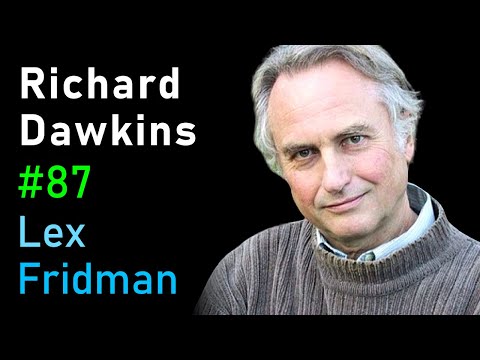
Richard Dawkins: Evolution, Intelligence, Simulation, and Memes | Lex Fridman Podcast #87
Lex Fridman (host), Richard Dawkins (guest), Narrator
In this episode of Lex Fridman Podcast, featuring Lex Fridman and Richard Dawkins, Richard Dawkins: Evolution, Intelligence, Simulation, and Memes | Lex Fridman Podcast #87 explores richard Dawkins on evolution, memes, AI, gods, and morality Richard Dawkins and Lex Fridman explore how Darwinian evolution underpins not only biological life but potentially any extraterrestrial or artificial intelligence. Dawkins argues that intelligence and even superintelligence must emerge via gradual, physical processes, rejecting supernatural shortcuts, whether in religion, intelligent design, or simulation hypotheses.
Richard Dawkins on evolution, memes, AI, gods, and morality
Richard Dawkins and Lex Fridman explore how Darwinian evolution underpins not only biological life but potentially any extraterrestrial or artificial intelligence. Dawkins argues that intelligence and even superintelligence must emerge via gradual, physical processes, rejecting supernatural shortcuts, whether in religion, intelligent design, or simulation hypotheses.
They discuss memes as cultural analogs of genes, noting how the internet radically accelerates the spread and evolution of ideas, for better and worse. The conversation also examines the cultural evolution of morality, Dawkins’ critique of religion and childhood indoctrination, and his views on consciousness as a profound but natural mystery.
Finally, Dawkins reflects on meaning, mortality, and the ‘lottery of birth,’ suggesting that while biology’s “purpose” is DNA propagation, human beings create their own higher-level goals—intellectual, artistic, and moral—as sources of fulfillment.
Key Takeaways
Intelligent life elsewhere is likely, but would still be Darwinian.
Given the vast number of stars and planets, Dawkins thinks both life and intelligence are probable beyond Earth. ...
Get the full analysis with uListen AI
There is no serious scientific alternative to evolution for explaining complex life.
Dawkins maintains that evolution by natural selection is our only coherent theory for the emergence of complex, intelligent organisms. ...
Get the full analysis with uListen AI
Natural selection is both wasteful and astonishingly effective as a design process.
Evolution produces exquisite ‘engineering’ (like birds’ wings) but also obvious “botched jobs,” such as the recurrent laryngeal nerve in giraffes, whose absurd detour can only be explained by historical constraints rather than optimal design.
Get the full analysis with uListen AI
Artificial superintelligence, not biological evolution, is the likely future of higher intelligence.
Human brain expansion seems to have stalled because higher intelligence no longer reliably yields more offspring. ...
Get the full analysis with uListen AI
Memes and the internet have created a new, rapid Darwinian arena for ideas.
Memes—cultural replicators like ideas, styles, and practices—spread and compete in a way loosely analogous to genes. ...
Get the full analysis with uListen AI
Morality is culturally evolving and not grounded in ancient religious texts.
Dawkins argues that moral norms shift over centuries—away from sexism, racism, and brutality—and that modern people cherry-pick humane verses from old scriptures using already-modern moral standards. ...
Get the full analysis with uListen AI
Invoking the supernatural is, to Dawkins, an intellectually ‘cowardly’ way to handle mystery.
On consciousness, origins, and other deep unknowns, he insists that gaps in current science justify more and better science—not religious or mystical explanations. ...
Get the full analysis with uListen AI
Notable Quotes
“If you deny life elsewhere in the universe, you’re committed to the view that what happened here is ludicrously, off-the-charts improbable.”
— Richard Dawkins
“Natural selection is fundamentally based on waste. On the other hand, it does produce magnificent results.”
— Richard Dawkins
“All that matters is that an idea should spread; it doesn’t have to be true to spread.”
— Richard Dawkins
“To invoke a non-scientific, non-physical explanation is simply to lie down in a cowardly way and say, ‘We can’t solve it, so we’re going to invoke magic.’”
— Richard Dawkins
“From a scientific point of view, the meaning of life is the propagation of DNA, but that’s not what I feel. The meaning of my life is something we each make for ourselves.”
— Richard Dawkins
Questions Answered in This Episode
If all advanced intelligences must arise gradually, how might that constrain the kinds of AI architectures we should pursue?
Richard Dawkins and Lex Fridman explore how Darwinian evolution underpins not only biological life but potentially any extraterrestrial or artificial intelligence. ...
Get the full analysis with uListen AI
Can we develop a rigorous, predictive ‘Darwinian’ theory of meme evolution that explains why some online ideas explode while others die?
They discuss memes as cultural analogs of genes, noting how the internet radically accelerates the spread and evolution of ideas, for better and worse. ...
Get the full analysis with uListen AI
What non-religious frameworks for moral progress could guide AI ethics, given that our values themselves are culturally evolving?
Finally, Dawkins reflects on meaning, mortality, and the ‘lottery of birth,’ suggesting that while biology’s “purpose” is DNA propagation, human beings create their own higher-level goals—intellectual, artistic, and moral—as sources of fulfillment.
Get the full analysis with uListen AI
If humans are unlikely to become biologically more intelligent, what responsibilities do we have toward artificial systems that surpass us?
Get the full analysis with uListen AI
Does treating consciousness as a natural but currently mysterious phenomenon change how we should approach building conscious machines, if that is possible at all?
Get the full analysis with uListen AI
Transcript Preview
The following is a conversation with Richard Dawkins, an evolutionary biologist and author of The Selfish Gene, The Blind Watchmaker, The God Delusion, The Magic of Reality, and The Greatest Show of Earth, and his latest, Outgrowing God. He is the originator and popularizer of a lot of fascinating ideas in evolutionary biology and science in general, including, funny enough, the introduction of the word meme in his 1976 book, The Selfish Gene, which, in the context of a gene-centered view of evolution, is an exceptionally powerful idea. He's outspoken, bold, and often fearless in the defense of science and reason, and in this way is one of the most influential thinkers of our time. This conversation was recorded before the outbreak of the pandemic. For everyone feeling the medical, psychological, and financial burden of this crisis, I'm sending love your way. Stay strong. We're in this together. We'll beat this thing. This is the Artificial Intelligence Podcast. If you enjoy it, subscribe on YouTube, review it with five stars on Apple Podcasts, support it on Patreon, or simply connect with me on Twitter @lexfridman, spelled F-R-I-D-M-A-N. As usual, I'll do a few minutes of ads now and never any ads in the middle that can break the flow of the conversation. I hope that works for you and doesn't hurt the listening experience. This show is presented by Cash App, the number one finance app in the App Store. When you get it, use code LEXPODCAST. Cash App lets you send money to friends, buy bitcoin, and invest in the stock market with as little as $1. Since Cash App allows you to send and receive money digitally peer to peer, security in all digital transactions is very important. Let me mention the PCI data security standard that Cash App is compliant with. I'm a big fan of standards for safety and security. PCI DSS is a good example of that, where a bunch of competitors got together and agreed that there needs to be a global standard around the security of transactions. Now we just need to do the same for autonomous vehicles and artificial intelligence systems in general. So again, if you get Cash App from the App Store or Google Play and use the code LEXPODCAST, you get $10 and Cash App will also donate $10 to FIRST, an organization that is helping to advance robotics and STEM education for young people around the world. And now, here's my conversation with Richard Dawkins. Do you think there's intelligent life out there in the universe?
Well, if we accept that there's intelligent life here (laughs) and we accept that the number of planets in the universe is gigantic, I mean, 10 to the 22 stars has been estimated, it seems to me highly likely that there is not only life in the universe elsewhere, but also intelligent life. If you deny that, then you're committed to the view that the things that happened on this planet are staggeringly improbable. I mean, ludicrously, off the charts improbable, and I don't think it's that improbable. Certainly the origin of life itself, there are really two steps. The origin of life, which is probably fairly improbable, and then the subsequent evolution to intelligent life, which is also fairly improbable. So the juxtaposition of those two you could say is pretty improbable, but not 10 to the 22 improbable. It's an interesting question, maybe you're coming onto it, how we would recognize intelligence from outer space if we, if we encountered it. The most likely way we would come across them would be by radio. It's highly unlikely they'd ever visit us. But, um, it's not, it's not that unlikely that we would pick up radio signals, and then we would have to have some means of deciding that it was intelligent. Um, people have w- people involved in the SETI program discuss how they would do it, and things like prime numbers would be an obvious thing to... and obvious, an obvious way for them to broadcast, to say, "We are intel- intelligent. We are here." Um, I suspect it probably would be obvious, actually.
Install uListen to search the full transcript and get AI-powered insights
Get Full TranscriptGet more from every podcast
AI summaries, searchable transcripts, and fact-checking. Free forever.
Add to Chrome