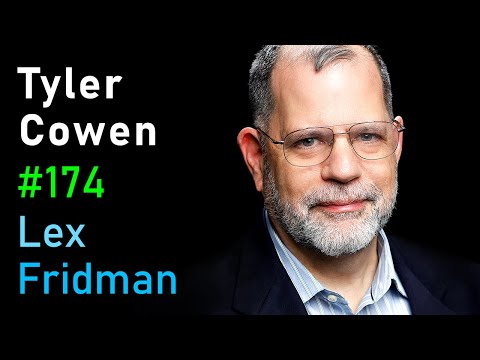
Tyler Cowen: Economic Growth & the Fight Against Conformity & Mediocrity | Lex Fridman Podcast #174
Lex Fridman (host), Tyler Cowen (guest), Narrator
In this episode of Lex Fridman Podcast, featuring Lex Fridman and Tyler Cowen, Tyler Cowen: Economic Growth & the Fight Against Conformity & Mediocrity | Lex Fridman Podcast #174 explores tyler Cowen defends growth, weirdos, and big business against stagnation Lex Fridman and economist Tyler Cowen explore how economics functions less as a predictive science and more as a tool for asking better questions about growth, risk, and human behavior. Cowen argues that American-style capitalism, immigration, and a culture that tolerates weirdness are central engines of innovation, even as they create inequality, precarity, and social tension. They debate existential risks from technology and nuclear weapons, the future of economic growth and crypto, and how institutions like universities, big business, China, and Russia shape opportunity. The conversation ranges into culture—art, food, love, UFOs, and meaning—illustrating Cowen’s view that human flourishing comes from small groups, good mentors, and a relentless fight against conformity and mediocrity.
Tyler Cowen defends growth, weirdos, and big business against stagnation
Lex Fridman and economist Tyler Cowen explore how economics functions less as a predictive science and more as a tool for asking better questions about growth, risk, and human behavior. Cowen argues that American-style capitalism, immigration, and a culture that tolerates weirdness are central engines of innovation, even as they create inequality, precarity, and social tension. They debate existential risks from technology and nuclear weapons, the future of economic growth and crypto, and how institutions like universities, big business, China, and Russia shape opportunity. The conversation ranges into culture—art, food, love, UFOs, and meaning—illustrating Cowen’s view that human flourishing comes from small groups, good mentors, and a relentless fight against conformity and mediocrity.
Key Takeaways
Economics’ real value is framing better questions, not precise forecasts.
Cowen emphasizes that tools like game theory rarely predict specific outcomes (e. ...
Get the full analysis with uListen AI
Low‑probability catastrophic events become near‑inevitable over long time horizons.
He argues that as weapons of mass destruction and destructive technologies become cheaper and more accessible, a "trembling hand" outlier (a Hitler-type actor with powerful tools) almost surely appears over centuries, even if yearly probabilities remain low.
Get the full analysis with uListen AI
American capitalism is deeply flawed yet uniquely powerful at fostering opportunity and weirdness.
Cowen praises big business and U. ...
Get the full analysis with uListen AI
Immigration and meritocracy are central to scientific and economic dynamism.
He strongly supports greatly expanded skilled immigration—"open borders for Belarus" as a slogan—and argues that immigrants often bring the stubbornness and drive (e. ...
Get the full analysis with uListen AI
Growth may be re-accelerating due to computation-driven breakthroughs.
Cowen, once a stagnation pessimist, is now more optimistic, citing mRNA vaccines, battery and green tech, CRISPR, and prospective automation as evidence that computing is unlocking a new wave of innovation and future GDP growth—though with new risks.
Get the full analysis with uListen AI
Free markets need strong legal and institutional scaffolding to work well.
He rejects pure anarchism and simplistic "free market" slogans, stressing that property rights, rule of law, and carefully chosen exceptions (e. ...
Get the full analysis with uListen AI
Human flourishing is built on mentors and small, focused peer groups.
Cowen’s core life advice is to find mentors in every area you care about and to build small groups of peers who obsess over shared problems—because most major intellectual and creative advances emerge from such clusters, not solitary geniuses.
Get the full analysis with uListen AI
Notable Quotes
“Economics will never be very predictive. It’s most useful for helping you ask better questions.”
— Tyler Cowen
“We’re a nation of weirdos, and weirdos are creative.”
— Tyler Cowen
“Big business has mostly been a hero in American history.”
— Tyler Cowen
“The wisdom is in the coming together of different points of view.”
— Tyler Cowen
“All societies are in some regards anarchistic. You want a good anarchy rather than a bad anarchy.”
— Tyler Cowen
Questions Answered in This Episode
If economics is primarily about asking better questions, which questions are we still failing to ask about technology and growth?
Lex Fridman and economist Tyler Cowen explore how economics functions less as a predictive science and more as a tool for asking better questions about growth, risk, and human behavior. ...
Get the full analysis with uListen AI
How can societies preserve the upside of "weirdness" and eccentricity without sacrificing social cohesion and security?
Get the full analysis with uListen AI
What institutional reforms would best balance American-style dynamism with stronger community and safety nets?
Get the full analysis with uListen AI
Are current universities salvageable as engines of original thought, or will most future innovation move outside traditional academia?
Get the full analysis with uListen AI
Where is the line between realistic pessimism about catastrophic risk and counterproductive fatalism that stifles innovation?
Get the full analysis with uListen AI
Transcript Preview
The following is a conversation with Tyler Cowen, an economist at George Mason University and co-creator of an amazing economics blog called Marginal Revolution, author of many books, including The Great Stagnation, Average Is Over, and his most recent, Big Business: A Love Letter to an American Antihero. He's truly a polymath in his work, including his love for food, which makes his amazing podcast called Conversations with Tyler really fun to listen to. Quick mention of our sponsors: Linode, ExpressVPN, SimpliSafe, and Public Goods. Check them out in the description to support this podcast. As a side note, given Tyler's culinary explorations, let me say that one of the things that makes me sad about my love-hate relationship with food is that w- while I've found a simple diet, plain meat and veggies, that makes me happy in day-to-day life, I sometimes wish I had the mental ability to moderate consumption of food so that I could truly enjoy meals that go way outside of that diet. I've seen my mom, for example, enjoy a single piece of chocolate, and yet, if I were to eat one (laughs) piece of chocolate, the odds are high that I would end up eating the whole box. This is definitely something I would like to fix, because some of the amazing artistry in this world happens in the kitchen, and some of the richest human experiences happen over a unique meal. I recently was eating cheeseburgers with Joe Rogan and John Danaher late at night in Austin, talking about jujitsu and life, and I was distinctly aware of the magic of that experience, magic made possible by the incredibly delicious cheeseburgers. This is the Lex Fridman Podcast, and here is my conversation with Tyler Cowen. Would you say economics is more art or science or philosophy or even magic? What is it?
Economics is interesting because it's all of the above. To start with magic, the notion that you can make some change and simply everyone's better off, that is a kind of modern magic that has replaced old-style magic. It's an art in the sense that the models are not very exact. It's a science in the sense that occasionally propositions are falsified.
(laughs)
There are a few basic things we know.
Yeah.
And however trivial they may sound, if you don't know them, you're out of luck. So, all of the above.
But from my outsider's perspective, economics is sometimes able to formulate very simple, almost like E = MC squared, general models of how our human society will function when you do a certain thing. But it seems impossible or almost way too optimistic to think that a single formula or just a s- set of simple principles can describe b- behavior of billions of human beings, well, uh, with all the complexity that we have involved. So do you have, do you have a sense there's a hope for economics to, to, uh, to have those kinds of physics-level descriptions and models of the world? Or is it just our desperate attempts as humans to make sense of it, even though it's more desperate than, uh, than, uh, rigorous and serious and actually predictable, like a, like a physics-type science?
Install uListen to search the full transcript and get AI-powered insights
Get Full TranscriptGet more from every podcast
AI summaries, searchable transcripts, and fact-checking. Free forever.
Add to Chrome