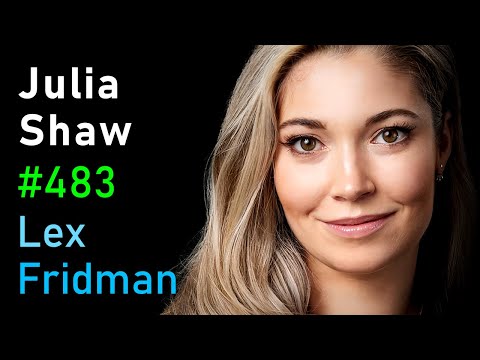
Julia Shaw: Criminal Psychology of Murder, Serial Killers, Memory & Sex | Lex Fridman Podcast #483
Julia Shaw (guest), Lex Fridman (host)
In this episode of Lex Fridman Podcast, featuring Julia Shaw and Lex Fridman, Julia Shaw: Criminal Psychology of Murder, Serial Killers, Memory & Sex | Lex Fridman Podcast #483 explores inside Evil: Julia Shaw On Murder, Memory, Sex, and Green Crime Lex Fridman and criminal psychologist Julia Shaw explore how so‑called “evil” behaviors exist on a psychological continuum rather than in a good–evil binary, focusing on the dark tetrad traits and why ordinary people can commit extraordinary harm. They discuss false memories, lie detection, serial killers, murder fantasies, jealousy, kinks, bisexuality, and non‑monogamy, emphasizing empathy and nuance instead of moral panic. Shaw explains her research showing how easily false criminal memories can be implanted, and why this matters for police interviews, therapy, AI systems, and personal wellbeing. In the final part, she introduces her work on environmental crime, arguing that corporate and ecological offenders are best understood through the same psychological lenses as other criminals, and that tech and social science together can be used to prevent harm.
Inside Evil: Julia Shaw On Murder, Memory, Sex, and Green Crime
Lex Fridman and criminal psychologist Julia Shaw explore how so‑called “evil” behaviors exist on a psychological continuum rather than in a good–evil binary, focusing on the dark tetrad traits and why ordinary people can commit extraordinary harm. They discuss false memories, lie detection, serial killers, murder fantasies, jealousy, kinks, bisexuality, and non‑monogamy, emphasizing empathy and nuance instead of moral panic. Shaw explains her research showing how easily false criminal memories can be implanted, and why this matters for police interviews, therapy, AI systems, and personal wellbeing. In the final part, she introduces her work on environmental crime, arguing that corporate and ecological offenders are best understood through the same psychological lenses as other criminals, and that tech and social science together can be used to prevent harm.
Key Takeaways
Evil is a spectrum of traits, not a fixed category of people.
Shaw argues that psychopathy, sadism, narcissism, and Machiavellianism exist on continua that all humans fall along; calling people “evil” shuts down understanding, fuels dehumanization, and makes atrocities easier to justify.
Get the full analysis with uListen AI
Most people are capable of serious harm under the right conditions.
From war crimes to neighbor betrayals, history shows ordinary individuals can commit murder and torture when factors like dehumanization, group identity, loneliness, entitlement, and social pressure align.
Get the full analysis with uListen AI
Our intuition about who is dangerous or lying is often wrong.
Creepiness and “gut” trustworthiness are poor indicators of actual risk, and even trained police detect lies at chance levels; overconfidence in these instincts contributes to wrongful convictions and broken relationships.
Get the full analysis with uListen AI
Autobiographical memory is reconstructive and highly fallible.
Nearly all personal memories are partly inaccurate, and with leading questions or suggestive therapy you can implant detailed false memories—even of crimes—so key events should be recorded as soon as possible, outside the brain.
Get the full analysis with uListen AI
Dark fantasies and kinks are common and not inherently pathological.
Murder fantasies occur in most men and over half of women, and many people have BDSM or other kinks; these can be adaptive ways of mentally rehearsing boundaries or disinhibiting in consensual contexts, rather than signs of “monsters.”
Get the full analysis with uListen AI
Jealousy, entitlement, and secrecy are strong risk factors in relationships.
Shaw sees chronic jealousy as a red flag rather than proof of love, noting its link to coercive control and partner violence; she suggests honesty, communication, and questioning rigid monogamy norms as healthier defaults for many.
Get the full analysis with uListen AI
Environmental crime is driven by familiar human motives and group dynamics.
Corporate fraud (e. ...
Get the full analysis with uListen AI
Notable Quotes
“We all have the capacity to kill people and murder people and do other terrible things. The question is why we don't do those things rather than why we do.”
— Julia Shaw
“When we call somebody evil we say, ‘This person is so different from me that I don't even need to bother trying to understand why they are capable of doing terrible things.’”
— Julia Shaw
“Most of the time our autobiographical memories are good enough. The question isn't whether they're false, the question is how false.”
— Julia Shaw
“Fraud works because people know what we want to hear and they tell us the things we want to hear.”
— Julia Shaw
“What we want is not just to label people; we want to stop that behavior from happening. And the only way we're going to do that is if we understand what led that person there.”
— Julia Shaw
Questions Answered in This Episode
If we stop using the word “evil” for people, how should media, courts, and educators talk about horrific crimes without minimizing victims’ suffering?
Lex Fridman and criminal psychologist Julia Shaw explore how so‑called “evil” behaviors exist on a psychological continuum rather than in a good–evil binary, focusing on the dark tetrad traits and why ordinary people can commit extraordinary harm. ...
Get the full analysis with uListen AI
Given how easy it is to distort or implant memories, what concrete safeguards should police, therapists, and AI developers put in place right now?
Get the full analysis with uListen AI
Where is the line between healthy violent or dark fantasies and warning signs that someone might act on them—and who should intervene?
Get the full analysis with uListen AI
How should couples realistically negotiate jealousy, monogamy, and non‑monogamy in a way that matches human behavior without destroying trust?
Get the full analysis with uListen AI
What kinds of legal and organizational changes would most effectively deter large‑scale environmental crimes committed by powerful corporations and networks?
Get the full analysis with uListen AI
Transcript Preview
We all have the capacity to kill people and murder people and do other terrible things. The question is why we don't do those things rather than why we do do those things quite often. Most men have fantasized about killing someone, about 70% in two studies, and most women as well. More than 50% of women have fantasized about killing somebody. So murder fantasies are incredibly common.
The following is a conversation with Julia Shaw, a criminal psychologist who has written extensively on a wide variety of topics that explore human nature, including psychopathy, violent crime, psychology of evil, police interrogation, false memory manipulation, deception detection, and human sexuality. Her books include Evil: The Psychology of Murder and Sadism, The Memory Illusion, about false memories, Bi about bisexuality, and her new book that you should definitely go order now called Green Crime, which is a study of the dark underworld of poachers, illegal gold miners, corporate frauds, hitmen, and all kinds of other environmental criminals. Julia is a brilliant and kindhearted person with whom I got the chance to have many great conversations with on and off the mic. This was an honor and a pleasure. This is Lex Fridman Podcast. To support it, please check out our sponsors in the description where you can also find, uh, links to contact me, ask questions, give feedback and so on. And now dear friends, here's Julia Shaw. You wrote the book, Evil: The Science Behind Humanity's Dark Side. So lots of interesting topics to cover here. Let's start with the continuum. You described that evil is a continuum. In other words, the dark tetrad, psychopathy, sadism, narcissism, Machiavellianism are a continuum of traits, not a binary zero-one label of monster or non-monster. So can you, uh, explain this continuum?
Yeah. So each trait on the dark tetrad as it's called, which is the four traits that are associated with dark personality traits, so things that we often associate with the word evil, like sadism, which is a pleasure in hurting other people, Machiavellianism, which is doing whatever it takes to get ahead. Narcissism, which is taking too much pleasure in yourself and seeing yourself as superior to others. And then there's psychopathy. Psychopathic personality specifically often lacks in empathy, and it's usually characterized by a number of different traits including a parasitic lifestyle, so mooching off of others, deceptiveness, lying to people, and again, that empathy dimension where you are more comfortable hurting other people because you don't feel sad when other people feel sad. Now all of those traits, psychopathy, sadism, Machiavellianism, and narcissism, all of them have a scale. And so you can be low on each of those traits or you can be high on each of those traits. And what the dark tetrad is, it's actually a way of classifying people into those who might be more likely to engage in risky behaviors or harmful behaviors and those who are not. And if you score high on all of them, you're most likely to harm other people. But each of us score somewhere, so I might score, score low on sadism, but higher on narcissism. And in all of them I'm probably subclinical. And so this is the other thing we often talk i- about in psychology is that there's clinical traits and clinical diagnoses like someone is diagnosed as having narcissism or they're subclinical, which is you don't quite meet the threshold, but you have traits that are related and that are so important for us to understand in the same context.
Install uListen to search the full transcript and get AI-powered insights
Get Full TranscriptGet more from every podcast
AI summaries, searchable transcripts, and fact-checking. Free forever.
Add to Chrome