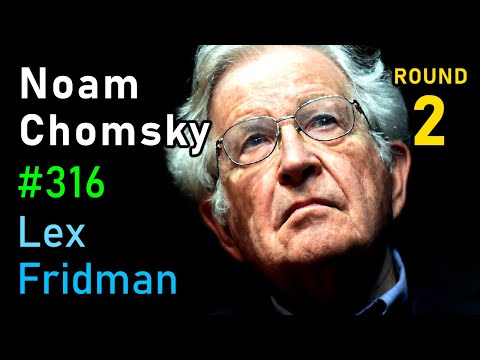
Noam Chomsky: Putin, Ukraine, China, and Nuclear War | Lex Fridman Podcast #316
Lex Fridman (host), Noam Chomsky (guest)
In this episode of Lex Fridman Podcast, featuring Lex Fridman and Noam Chomsky, Noam Chomsky: Putin, Ukraine, China, and Nuclear War | Lex Fridman Podcast #316 explores noam Chomsky warns: Ukraine, China, and choices risking human survival Noam Chomsky discusses the Ukraine war as an act of aggression comparable to major historical crimes, while criticizing NATO expansion and U.S. policy for escalating rather than resolving the conflict. He argues that calibrated military aid to Ukraine should be coupled with serious diplomatic efforts to end the war and avoid nuclear escalation. Chomsky broadens the lens to U.S.–China tensions, warning that war between the two would likely end organized human life and that cooperation is essential to address global crises like climate change and pandemics. He also examines propaganda, media framing, U.S. internal political decay, and the hypocrisy of American foreign policy as key factors shaping a perilous 21st century.
Noam Chomsky warns: Ukraine, China, and choices risking human survival
Noam Chomsky discusses the Ukraine war as an act of aggression comparable to major historical crimes, while criticizing NATO expansion and U.S. policy for escalating rather than resolving the conflict. He argues that calibrated military aid to Ukraine should be coupled with serious diplomatic efforts to end the war and avoid nuclear escalation. Chomsky broadens the lens to U.S.–China tensions, warning that war between the two would likely end organized human life and that cooperation is essential to address global crises like climate change and pandemics. He also examines propaganda, media framing, U.S. internal political decay, and the hypocrisy of American foreign policy as key factors shaping a perilous 21st century.
Key Takeaways
Russia’s invasion of Ukraine is a major crime, but context matters for prevention.
Chomsky labels the invasion a “supreme international crime” comparable to Iraq and Poland 1939, yet stresses that decades of NATO expansion against repeated warnings helped create conditions in which Moscow’s red lines were crossed, a context relevant for preventing future wars.
Get the full analysis with uListen AI
Military aid to Ukraine should be paired with relentless diplomacy to end the war.
He supports calibrated defensive aid but criticizes U. ...
Get the full analysis with uListen AI
Western discussion often ignores the nuclear risk embedded in maximalist war aims.
Chomsky argues that calls to ensure total Russian defeat assume Putin will passively accept humiliation instead of escalating, meaning current policy gambles with both Ukraine’s destruction and a potential nuclear exchange.
Get the full analysis with uListen AI
Propaganda works mostly through selection and framing, not outright lies.
He distinguishes between generally accurate reporting and systemic propaganda, where media and political discourse narrow what is questioned (e. ...
Get the full analysis with uListen AI
The so‑called ‘China threat’ largely reflects Beijing’s refusal to obey U.S. rules.
Chomsky contends that China’s core offense, in Washington’s eyes, is ignoring a U. ...
Get the full analysis with uListen AI
The Global South’s reluctance to align with the West on Ukraine is rooted in experience.
Many non‑Western states condemn Russia’s invasion but see it as similar to interventions they have long suffered from the U. ...
Get the full analysis with uListen AI
Internal U.S. decay may be as dangerous as external threats.
He points to rising mortality, failing infrastructure, extreme partisanship, and a reactionary Supreme Court as signs of a society ‘tearing itself apart’; unless the U. ...
Get the full analysis with uListen AI
Notable Quotes
“A war between the US and China would destroy the possibilities of organized life on Earth.”
— Noam Chomsky
“Anyone who doesn’t worry about nuclear war doesn’t have a gray cell functioning.”
— Noam Chomsky
“Putin’s invasion of Ukraine is on a par with such acts of aggression as the US invasion of Iraq... the Stalin–Hitler invasion of Poland.”
— Noam Chomsky
“How do we find the truth? That’s what you have a brain for. It’s not deep. It’s quite shallow. It’s not quantum physics.”
— Noam Chomsky
“Human civilization will not survive unless the United States takes a lead... in dealing with and overcoming the very severe crises that we face.”
— Noam Chomsky
Questions Answered in This Episode
To what extent can NATO’s eastward expansion be considered a moral or strategic mistake, and how might a different post–Cold War settlement have changed today’s reality in Ukraine?
Noam Chomsky discusses the Ukraine war as an act of aggression comparable to major historical crimes, while criticizing NATO expansion and U. ...
Get the full analysis with uListen AI
What concrete diplomatic frameworks could realistically end the Ukraine war without rewarding aggression or pushing Russia toward nuclear escalation?
Get the full analysis with uListen AI
How can citizens practically distinguish between accurate reporting and systemic propaganda when mainstream media rarely lie but often omit key context?
Get the full analysis with uListen AI
Is there a viable path for the U.S. and China to transition from strategic rivalry to genuine cooperation on climate, pandemics, and nuclear risk?
Get the full analysis with uListen AI
Given the internal political and social fragmentation Chomsky describes in the U.S., what reforms or movements are most critical to preventing both domestic collapse and destructive foreign policy choices?
Get the full analysis with uListen AI
Transcript Preview
Will there be a war between US and China in the 21st century?
If there is, we're finished. A war between the US and China would destroy the possibilities of organized life on Earth.
The following is a conversation with Noam Chomsky, his second time on the podcast. This episode is focused on the war in Ukraine, and it is a departure from the way I usually do this podcast in several ways. Noam is a strong and healthy 93-year-old, but this conversation is enough to be cautious. It is brief, only one hour. It is more of an interview than a conversation due to the limitations of our audio and video connection. I decided it's best to get Noam's clear thoughts on this war and the complicated geopolitics of today and the rest of the 21st century that is unrolling before us. With our decisions and actions fully capable of either helping humanity flourish or unleashing global destruction and suffering. As a brief aside, perhaps you know this, but let me mention that I traveled to Ukraine and saw, heard, felt things that are haunting and gave me a lot to think about. Because of that, I've been really struggling to edit the videos I recorded. I hope to finish it soon. I'm sorry for these delays, and I'm especially sorry to the people there who gave me their time, their story, their heart. Please be patient with me. I hope you understand. This is the Lex Fridman Podcast. To support it, please check out our sponsors in the description. And now, dear friends, here's Noam Chomsky. You have studied and criticized powerful leaders and nations in times of global conflict and struggles for power. So let me ask you, what do you think motivates Vladimir Putin? Is it power, legacy, fame, geopolitical influence, or the flourishing of a nation he loves and represents?
I have no particular insight into Putin's mind. I can only watch the actions over the last 20, 25 years and read the statements. Took power about almost 25 years ago. Has held it since as prime minister or president. Uh, his first task was to try to overcome the chaos and disarray o- of the 1990s. During the '90s, uh, Gorbachev had a proposal. He, uh, called for, uh, a cooperative enterprise with the West. They would share an effort to rebuild what he called a common European home, uh, in which there would be no military alliances, just Russia, Western, US accommodation, with a move towards social democracy in, uh, former USSR and, uh, comparable moves in the United States. Well, that was quickly smashed. Uh, the United States had no interest in that. Uh, Clinton came along pretty soon, early '90s. Uh, Russia was induced to adopt a, what was called shock therapy, harsh quick market transformation, which devastated the economy, uh, created enormous social disarray, uh, uh, rise of, uh, what are called oligarchs, kleptocrats, and great mortali- high mortality. And, uh, Clinton started the policy of expanding NATO to the East in violation of firm, unambiguous promises to Gorbachev not to do so. Uh, Yeltsin, Putin's friend, opposed it, uh, other Russian leaders opposed it, but they didn't react. They accepted it. Uh, when Putin came in, he continued that policy. Meanwhile did reconstruct the Russian economy. Russian society became a viable deeply authoritarian society under his tight control. Uh, he himself was a... organized a major kleptocracy with him in the middle, be- apparently became very wealthy. On the international front, he pretty much continued the former policies. As, uh, US, uh, diplomats, practically every diplomat who had any contact with Russia had been dispatched there or knew about it. As they all warned from the '90s, that what Clinton was doing, expanded by his... by Bush, Bush II afterwards, was reckless and provocative. Uh, that, uh, Russia did have a clear red line before Putin, which he adhered to, uh, namely no NATO membership for Ukraine and Georgia. Uh, this is pretty much how things went on through the 2000s, uh, 2014. In 2008, uh, George Bush, President Bush did invite, uh...... Ukraine to join NATO. That was vetoed by France and Germany, but under US pressure, it was kept on the agenda. The Russians continued to object to the Western diplomats, including the pres- present, current head, head of the CIA and his predecessors warned that this was reckless, provocative, shouldn't be done, continued. Uh, Putin didn't do much. He stayed with it until pretty recently. After 2014, the uprising that, uh, uh, threw out the, uh, former president who was pro-Russian, uh, instituted anti-Russian laws. Uh, the United States and NATO began to a policy of, uh, moving to effectively integrate Ukraine into the NATO command, joint military exercises, uh, training, uh, sending weapons, and so on. Uh, Putin objected. Other Russian leaders objected. They're uni- unified on this, but didn't do much, continued with the proposals that, uh, NATO, that Ukraine be excluded from NATO and that there be some form of autonomy for the Donbas region. Meanwhile, in reaction to the, uh, the uprising, the Maidan uprising in 2014, uh, Russia moved in and took over Crimea, protecting its one warm water base and major naval base. Uh, US objected and recognized it, but things continued without notable conflict. Won't go through all the details. When Joe Biden came in, he expanded the program of, uh, what US military journals call a de facto integration of Ukraine within NATO. Uh, developed, proposed, uh, September 2021, proposed a enhanced program of preparation for NA- uh, NATO admission. Uh, it's extended with a formal statement in November. We're now practically up to the invasion. Putin's position hardened. Uh, France, mainly France, to an extent Germany, did make some moves towards possible negotiations. Uh, Putin dismissed them, uh, moved on to the direct invasion. Uh, that's wha- what are his, to get back to your question, what motivates him? I presume what he's been saying all along, uh, namely establishing his legacy as a leader who, uh, overcame the extensive destruction of Russia and massive weakening over it, restored his position as a world power, prevented Ukraine from entering NATO, but may have further ambitions as to, uh, dominating and controlling Ukraine very likely. Uh, there is a theory in the West that he suddenly became a total madman who wants to restore the great Russian empire. Uh, uh, this is combined with, uh, gloating over the fact that the Russian military is a paper tiger that can't even conquer cities a couple of kilometers from the border, but, uh, defended not even by a regular army. But somehow, along with this, he's planning to attack NATO powers, conquer Europe, uh, who knows what. It's impossible to put all these concepts together. They're totally internally contradictory. So what's my judgment? I think what motivates him is what he's been demonstrating in his actions, restore Russia as a great power, restore its economy, uh, control it as a total dictatorship, enrich himself and his cronies, uh, establish a legacy as a major figure in Russian history, uh, make sure that Ukraine does not join NATO, and, uh, probably by now he's hardened the position, maintain Crimea and the southeastern corridor to Russia and, uh, some ambiguous agreements about the Donbas region. That looks like his motivation. There's much speculation that goes beyond this, but it's very hard to reconcile with the asse- the assessment of the real world by the same people who are making the, uh, the grandiose, uh, uh, speculations.
Install uListen to search the full transcript and get AI-powered insights
Get Full TranscriptGet more from every podcast
AI summaries, searchable transcripts, and fact-checking. Free forever.
Add to Chrome