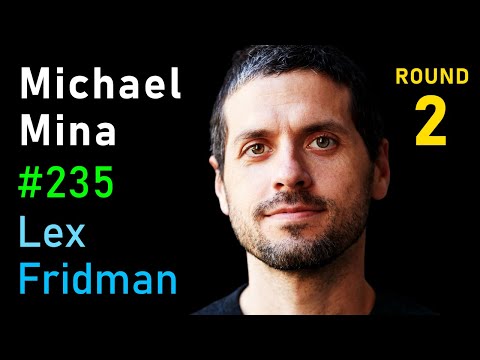
Michael Mina: Rapid COVID Testing | Lex Fridman Podcast #235
Lex Fridman (host), Michael Mina (guest), Narrator
In this episode of Lex Fridman Podcast, featuring Lex Fridman and Michael Mina, Michael Mina: Rapid COVID Testing | Lex Fridman Podcast #235 explores michael Mina argues rapid at-home tests are COVID’s missing solution Lex Fridman and epidemiologist Michael Mina argue that cheap, rapid at-home COVID tests are the most underused but powerful tool for controlling the pandemic. Mina explains that antigen tests are highly accurate at detecting infectiousness—what matters for stopping spread—even if they are less sensitive than PCR at detecting tiny residual viral fragments. He criticizes U.S. regulatory and institutional failures, especially the FDA’s insistence on treating these as traditional medical devices instead of public health tools, which blocks mass deployment. They outline how dynamic, frequent at-home testing, paired with smart policy and minimal privacy intrusion, could have drastically reduced deaths, economic damage, and anxiety—and still could if rapidly scaled.
Michael Mina argues rapid at-home tests are COVID’s missing solution
Lex Fridman and epidemiologist Michael Mina argue that cheap, rapid at-home COVID tests are the most underused but powerful tool for controlling the pandemic. Mina explains that antigen tests are highly accurate at detecting infectiousness—what matters for stopping spread—even if they are less sensitive than PCR at detecting tiny residual viral fragments. He criticizes U.S. regulatory and institutional failures, especially the FDA’s insistence on treating these as traditional medical devices instead of public health tools, which blocks mass deployment. They outline how dynamic, frequent at-home testing, paired with smart policy and minimal privacy intrusion, could have drastically reduced deaths, economic damage, and anxiety—and still could if rapidly scaled.
Key Takeaways
Focus testing on infectiousness, not just infection.
Rapid antigen tests are nearly 100% sensitive at high viral loads—the period when people are most contagious—making them ideal public health tools even if they miss low, non-infectious viral remnants that PCR still detects.
Get the full analysis with uListen AI
Regulatory framing is blocking mass deployment of good tests.
Because the FDA evaluates at-home antigen tests as medical devices compared to ultra-sensitive PCR, many effective tests fail to meet arbitrary sensitivity thresholds at low viral loads, slowing authorization and limiting supply.
Get the full analysis with uListen AI
Create a separate ‘public health test’ category and pathway.
Mina argues the President could, via executive action, designate rapid antigen tests used for community screening as public health tools, shifting oversight to agencies like the CDC that can evaluate them on speed, scalability, and ability to detect infectious people.
Get the full analysis with uListen AI
Use dynamic, community-level testing instead of permanent daily testing.
He proposes that households keep tests on hand, use wastewater and local data as early warning, and ramp up testing frequency only in affected areas to quickly crush emerging outbreaks, then scale back when transmission subsides.
Get the full analysis with uListen AI
Vaccines reduce severe disease but do not reliably stop transmission.
Because vaccines were authorized on prevention of disease, not transmission, and protection wanes while variants emerge, relying on vaccines alone cannot end spread; ongoing rapid testing remains essential to control outbreaks.
Get the full analysis with uListen AI
Testing must respect privacy while allowing verification where needed.
Verified at-home testing (e. ...
Get the full analysis with uListen AI
Information reduces fear and unnecessary disruption.
He frames lockdowns and blanket quarantines as ‘information problems’: when we don’t know who is infectious, we shut everything down; rapid tests give individuals and institutions the data needed to act surgically instead of blindly.
Get the full analysis with uListen AI
Notable Quotes
““These tests are infectiousness indicators. They shouldn’t be compared to PCR.””
— Michael Mina
““This isn’t a pandemic of the unvaccinated. This is a pandemic of a fucking virus.””
— Michael Mina
““If everyone glowed green when they were infectious, we would’ve never had to close down any society.””
— Michael Mina
““Quarantine is not a biological problem; it’s an information problem.””
— Michael Mina
““I shouldn’t have to pay to keep you safe. Testing is a public health good.””
— Michael Mina
Questions Answered in This Episode
What concrete steps would it take—politically and administratively—for the U.S. to create a formal ‘public health test’ category and bypass the current FDA bottleneck?
Lex Fridman and epidemiologist Michael Mina argue that cheap, rapid at-home COVID tests are the most underused but powerful tool for controlling the pandemic. ...
Get the full analysis with uListen AI
How can public health leaders rebuild trust with vaccine-hesitant populations while also promoting widespread voluntary testing and data sharing?
Get the full analysis with uListen AI
What are the most realistic privacy-preserving models for verified at-home testing that satisfy employers and schools without creating centralized health surveillance?
Get the full analysis with uListen AI
If dynamic rapid testing had been deployed at national scale in mid-2020, what specific outcomes (deaths, hospitalizations, economic losses) does Mina believe could have been averted?
Get the full analysis with uListen AI
How might the lessons from the testing failures of COVID-19 reshape global preparedness for future, potentially more lethal pandemics?
Get the full analysis with uListen AI
Transcript Preview
The following is a conversation with Michael Mina, his second time on the podcast. He's a professor at Harvard doing research on infectious disease and immunology. In my view, the most powerful, doable, and obvious solution to COVID-19 from the very beginning is rapid at-home testing. This is what Michael has been talking about and writing about since the beginning of the pandemic. The accuracy of these tests is high for the task of detecting contagiousness, which is what matters. Hundreds of millions can be manufactured quickly and relatively cheaply, privacy and individual freedoms are preserved. I believe that if you give people the power of information, information about whether they are contagious or not, they will do the right thing, at scale, all while respecting their freedom and minimizing the destructive effects of the pandemic on our health and our economy. This solution was obvious in May of 2020. It was obvious when Michael and I spoke the first time a year ago, and it is obvious today. We talk about why it has not yet been done and how we can still do it. This is the Lex Fridman Podcast. To support it, please check out our sponsors in the description. And now, here's my conversation with Michael Mina. We spoke a year ago about rapid at-home testing, and I think, you think, it should have been, still should be a big part of the solution to COVID. So let's recap. Where do things stand today in terms of rapid at-home testing?
Well, (laughs) it's, uh, it's certainly something that, uh, you're right. I do think we should have them today. We've now had almost 20 months of living in anxiety, uncertainty, uh, being afraid for our health, for our family's health, for our friends', you know, shutdowns, economic instability. Everything has been uncertain because of this virus. And then there's this little test, and it's the first time for many people that they are, they're using it and they're feeling empowered. They're feeling like they can control their little slice of this pandemic. So as these tests have come out and more and more and more Americans have had an opportunity to go and buy them from, you know, CVS or Walgreens or wherever they're at, I think that it's really shifting the tenor of the discussion. For a long time, all of 2020, it was like, I often felt like it was me and a few other people against the world, you know?
Mm-hmm.
These tests should be public health tools. These tests are infectiousness indicators. They shouldn't be compared to PCR. You know, all of the, these different things, and we could of course go through and recap (laughs) what those, what the benefits and the, and the, and the metrics are that we should be looking at. But the point is, last year and most of this year was about educating scientists, educating public health leaders, educating physicians to get them to understand that there is a different reason to test in a pandemic than purely diagnostics, and transmission blockade and severing transmission chain is the big one. So now I think we're at a point where people are now understanding. And they're understanding because they are feeling it, they're holding it, and they're doing it and they're seeing, they're feeling the delight of seeing a negative and saying, "I feel more comfortable. It's not perfect, but it's pretty darn close to perfect to allowing me to go and see my mom without mistakenly infecting her." You know, or whatever the story might be. And now that that's happening, I think all of a sudden we're seeing a massive change, uh, politically for these tests. Uh, Biden just came out with the COVID-19 action plan the other day, and one of the main pillars of it was testing, and in particular bringing rapid tests, uh, scaling them up. So on that front, I think finally there is success. People are actually understanding. And, you know, I haven't stopped beating this drum for far too long, and I, like, hate rapid tests now. (laughs)
Install uListen to search the full transcript and get AI-powered insights
Get Full TranscriptGet more from every podcast
AI summaries, searchable transcripts, and fact-checking. Free forever.
Add to Chrome