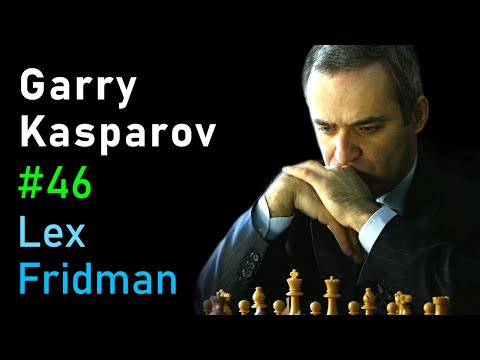
Garry Kasparov: Chess, Deep Blue, AI, and Putin | Lex Fridman Podcast #46
Lex Fridman (host), Garry Kasparov (guest), Lex Fridman (host)
In this episode of Lex Fridman Podcast, featuring Lex Fridman and Garry Kasparov, Garry Kasparov: Chess, Deep Blue, AI, and Putin | Lex Fridman Podcast #46 explores kasparov on genius, machines, dictatorship, and the limits of AI Garry Kasparov reflects on his chess career, explaining that beyond loving victory or hating defeat, his core drive was the passion to create something new and make a difference, both on and off the board.
Kasparov on genius, machines, dictatorship, and the limits of AI
Garry Kasparov reflects on his chess career, explaining that beyond loving victory or hating defeat, his core drive was the passion to create something new and make a difference, both on and off the board.
He dissects his battles with IBM’s Deep Blue, arguing that chess was wrongly treated as the pinnacle of human intellect and that machines dominate closed systems simply by making fewer mistakes, not by being ‘smarter’.
Kasparov contrasts closed games like chess and Go with open-ended domains, emphasizing that humans remain uniquely capable of asking the right questions and directing machine power, which defines the future of human–AI collaboration.
He also discusses the failures of totalitarianism, Putin’s regime, Russian interference in Western democracies, and his own political activism in exile, expressing confidence that dictatorships fall suddenly and that he will eventually return to a post-Putin Russia.
Key Takeaways
Top performance is driven less by fear or glory than by a desire to create.
Kasparov says his main motivation was neither loving victory nor hating defeat, but the passion to introduce new ideas and make a difference—first in chess theory, later in politics and human–machine discourse.
Get the full analysis with uListen AI
Fear of mistakes guarantees mistakes; decisive confidence is a key separator at the top.
He notes that great players can choose a direction without full clarity of consequences, trusting their preparation and intuition instead of being paralyzed by the possibility of error.
Get the full analysis with uListen AI
Machines dominate closed systems by reducing errors, not by ‘understanding’ like humans.
Chess, Go, shogi, and similar games are bounded-rule environments where computers win by playing more consistently and making fewer mistakes, not by solving the game or achieving human-like insight.
Get the full analysis with uListen AI
Human strength in AI collaboration lies in asking the right questions and knowing when not to interfere.
Kasparov argues that in open-ended domains (medicine, strategy, policy), humans must supply direction and judgment while letting machines handle the heavy computation, rather than competing with them.
Get the full analysis with uListen AI
AI systems inevitably amplify societal biases; the fix is social, not technical alone.
He likens AI to a mirror: if data and institutions are biased, the system will reflect and even magnify those injustices. ...
Get the full analysis with uListen AI
Autonomous systems should be judged on relative error rates, not impossible perfection.
On self-driving cars and similar tech, he insists the realistic standard is whether machines make fewer mistakes than humans, not whether they reach 100% safety, which no system can achieve.
Get the full analysis with uListen AI
Dictatorships eventually collapse suddenly, but the timing is unknowable—even to dictators.
Drawing on Soviet history and his critique of Putin, Kasparov says authoritarian regimes are structurally doomed because they suppress innovation and human initiative, and their fall typically appears abrupt.
Get the full analysis with uListen AI
Notable Quotes
“Fear of mistake guarantees mistakes.”
— Garry Kasparov
“The idea that we can compete with computers in so‑called intellectual fields was wrong from the very beginning.”
— Garry Kasparov
“Machines don’t know how to ask the right questions.”
— Garry Kasparov
“You cannot expect machines to improve the ills of our society. It’s like looking in the mirror and complaining about what you see.”
— Garry Kasparov
“There’s no absolute good. But there’s an absolute evil.”
— Garry Kasparov
Questions Answered in This Episode
How far can machine-generated knowledge, like AlphaZero’s, truly go in open-ended domains beyond games?
Garry Kasparov reflects on his chess career, explaining that beyond loving victory or hating defeat, his core drive was the passion to create something new and make a difference, both on and off the board.
Get the full analysis with uListen AI
What practical frameworks should we adopt to define the right human role in high-stakes human–AI collaborations (e.g., medicine, warfare, policy)?
He dissects his battles with IBM’s Deep Blue, arguing that chess was wrongly treated as the pinnacle of human intellect and that machines dominate closed systems simply by making fewer mistakes, not by being ‘smarter’.
Get the full analysis with uListen AI
How can democratic societies realistically address systemic bias so that AI systems stop amplifying existing injustices?
Kasparov contrasts closed games like chess and Go with open-ended domains, emphasizing that humans remain uniquely capable of asking the right questions and directing machine power, which defines the future of human–AI collaboration.
Get the full analysis with uListen AI
What specific warning signs should the world watch for that indicate a dictatorship like Putin’s is approaching sudden collapse?
He also discusses the failures of totalitarianism, Putin’s regime, Russian interference in Western democracies, and his own political activism in exile, expressing confidence that dictatorships fall suddenly and that he will eventually return to a post-Putin Russia.
Get the full analysis with uListen AI
If you were a young prodigy today, would you choose chess again—or a different field to ‘make a difference’ in the age of AI?
Get the full analysis with uListen AI
Transcript Preview
The following is a conversation with Garry Kasparov. He's considered by many to be the greatest chess player of all time. From 1986, until his retirement in 2005, he dominated the chess world, ranking world number one for most of those 19 years. While he has many historical matches against human chess players, in the long arc of history, he may be remembered for his match against a machine, IBM's Deep Blue. His initial victories and eventual loss to Deep Blue captivated the imagination of the world of what role artificial intelligence systems may play in our civilization's future. That excitement inspired an entire generation of AI researchers, including myself, to get into the field. Garry is also a pro-democracy political thinker and leader, a fearless human rights activist, and author of several books, including How Life Imitates Chess, which is a book on strategy and decision-making, Winter Is Coming, which is a book articulating his opposition to the Putin regime, and Deep Thinking, which is a book on the role of both artificial intelligence and human intelligence in defining our future. This is the Artificial Intelligence podcast. If you enjoy it, subscribe on YouTube, give it five stars on iTunes, support it on Patreon, or simply connect with me on Twitter @lexfridman, spelled F-R-I-D-M-A-N. And now, here's my conversation with Garry Kasparov. As perhaps the greatest chess player of all time, when you look introspectively at your psychology throughout your career, what was the bigger motivator, the love of winning or the hatred of losing?
Tough question. I have to confess, I never heard it before, which is ... again, congratulations. It's quite an accomplishment. (laughs)
(laughs)
Um, losing was always painful. For me, it was almost like a physical pain, because I knew that if I lost a game it's just because I made a mistake. So it ... I always believed that the r- the result of the game, uh, had to be decided by the quality of my play. Okay, you may say it s- sounds arrogant, but it helped me to move forward because I always knew that there was room for improvement, so it's the ...
Was there the fear of the mistake?
Actually, fear of mistake guarantees mistakes. And the difference between, uh, top players, the very top, is that it's the ability to make a decision-
Yeah.
... without predictable consequences. You don't know what's happening. It starts intuitively. I could go this way or that way and, uh, there are always hesitations. You know, people are like, "You're, you are just, you know, at a crossroad. You can go right, you can go left, you can go straight. You can turn and go back, and the consequences are just un- uh, very uncertain." Just, you have certain ideas what happens on the right or on the left or on the just, you know, if you go straight, but it's not enough to make well-calculated choice, and, uh, when you play chess at the very top, it's, it's, it's, it's about your inner strength. So I can make this decision, I will stand firm, and I'm not going to waste my time because I have full confidence that I will go through. Um, going back to your original question is I would say neither. It's just it's the, it's lo- love for winning, hate for losing, they were important elements, psychological elements, but the key element, it's the, I would say the, the driving force was always my passion for, for making a di- making a difference. It's just I can move forward and I can always, it's, I can always enjoy not just playing but creating something new.
Install uListen to search the full transcript and get AI-powered insights
Get Full TranscriptGet more from every podcast
AI summaries, searchable transcripts, and fact-checking. Free forever.
Add to Chrome