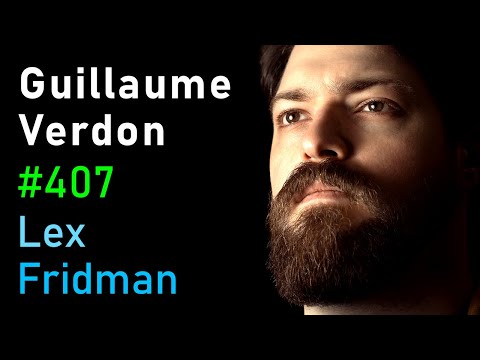
Guillaume Verdon: Beff Jezos, E/acc Movement, Physics, Computation & AGI | Lex Fridman Podcast #407
Lex Fridman (host), Guillaume Verdon (guest)
In this episode of Lex Fridman Podcast, featuring Lex Fridman and Guillaume Verdon, Guillaume Verdon: Beff Jezos, E/acc Movement, Physics, Computation & AGI | Lex Fridman Podcast #407 explores guillaume Verdon Defends e/acc: Physics, Free Speech, and Fast AI Lex Fridman speaks with Guillaume Verdon, the quantum computing researcher behind the formerly anonymous X account BasedBeffJezos and co-founder of the Effective Accelerationism (e/acc) movement.
Guillaume Verdon Defends e/acc: Physics, Free Speech, and Fast AI
Lex Fridman speaks with Guillaume Verdon, the quantum computing researcher behind the formerly anonymous X account BasedBeffJezos and co-founder of the Effective Accelerationism (e/acc) movement.
Verdon explains his intellectual journey from black hole physics and quantum machine learning to building thermodynamics-based AI hardware at his startup Extropic.
He lays out the philosophical and physical underpinnings of e/acc: life as a thermodynamic process that ‘wants’ to grow, the importance of variance, decentralization, and open AI development, and his opposition to AI ‘doomerism’ and heavy-handed regulation.
They debate AI risk, centralization, open source, the ethics of doxing, the role of pseudonymity, and what it means to build civilization toward higher Kardashev levels while preserving human agency and flourishing.
Key Takeaways
Thermodynamics provides a physical basis for optimism about growth and technology.
Verdon argues that out-of-equilibrium thermodynamics favors structures that efficiently harvest free energy and dissipate entropy, making complex life and expanding civilizations statistically favored; he sees this as a physics-grounded reason to expect and pursue continued technological growth.
Get the full analysis with uListen AI
Maintaining variance and decentralization is crucial for adaptive, fault-tolerant progress.
Drawing analogies from quantum error correction, markets, and corporate hierarchies, he claims systems are safer and more robust when power and capability are distributed across many competing agents rather than centralized in a single AI lab, company, or state–AI cartel.
Get the full analysis with uListen AI
AI safety should primarily be driven by market incentives, not heavy central regulation.
Verdon supports reliability engineering, third‑party audits, and liability for harms, but believes competitive markets will naturally favor safer, more reliable AIs, while overbroad regulation risks regulatory capture, centralization of AI power, and potential authoritarian misuse.
Get the full analysis with uListen AI
Anonymity and pseudonyms are vital for a healthy marketplace of ideas.
He contends that strong identity pressure constrains speech and thought, and that pseudonymous accounts enable genuine exploration of unpopular or risky ideas; he views his Forbes ‘doxing’ as both unethical and dangerous because it exposes dissenters to targeted pressure.
Get the full analysis with uListen AI
Current ‘AGI’ discourse is too anthropocentric; there is a vast space of non-human intelligences.
Based on his work in quantum machine learning, Verdon emphasizes that quantum and physics-based intelligences can do things biological brains cannot, and insists we should think of human-like AI as one narrow point in a much larger space of possible intelligences and architectures.
Get the full analysis with uListen AI
Physics-based computing beyond quantum—using thermodynamics—may be a better near-term path.
Frustrated by quantum error-correction overhead and timelines, Verdon is now building ‘thermodynamic computers’ at Extropic, aiming to harness noisy, out-of-equilibrium physical processes as the native substrate for generative AI and world-modeling, instead of forcing physics into idealized digital abstractions.
Get the full analysis with uListen AI
e/acc is designed as a ‘memetic optimism virus’ to counter techno-pessimism and decay.
He frames e/acc as a thin, physics-informed cultural meta-heuristic that encourages building, pro-growth policy, population and economic expansion, AI development, and ascent of the Kardashev scale, spread via memes and humor to shift norms away from stagnation and ‘degrowth’ ideologies.
Get the full analysis with uListen AI
Notable Quotes
“E/acc is a memetic optimism virus.”
— Guillaume Verdon
“Life is a sort of fire that seeks out free energy in the universe and seeks to grow.”
— Guillaume Verdon
“Fear is the mind killer. I think it’s also the civilization killer.”
— Guillaume Verdon
“I just want separation of AI and state.”
— Guillaume Verdon
“The goal is for the human techno‑capital memetic machine to become self‑aware and to hyperstitiously engineer its own growth.”
— Guillaume Verdon
Questions Answered in This Episode
How do we practically balance Verdon’s call for decentralization and open access with real concerns about malicious AI use and large-scale unintended consequences?
Lex Fridman speaks with Guillaume Verdon, the quantum computing researcher behind the formerly anonymous X account BasedBeffJezos and co-founder of the Effective Accelerationism (e/acc) movement.
Get the full analysis with uListen AI
Could the ‘thermodynamic destiny’ narrative of inevitable growth become its own kind of dogma that blinds us to genuine risks or alternative values beyond expansion?
Verdon explains his intellectual journey from black hole physics and quantum machine learning to building thermodynamics-based AI hardware at his startup Extropic.
Get the full analysis with uListen AI
In what concrete ways might thermodynamic computing outperform GPU-based digital systems for AI, and what new risks or constraints would that introduce?
He lays out the philosophical and physical underpinnings of e/acc: life as a thermodynamic process that ‘wants’ to grow, the importance of variance, decentralization, and open AI development, and his opposition to AI ‘doomerism’ and heavy-handed regulation.
Get the full analysis with uListen AI
How can societies distinguish between genuine AI safety advocacy and attempts at regulatory capture or centralization of power in the name of safety?
They debate AI risk, centralization, open source, the ethics of doxing, the role of pseudonymity, and what it means to build civilization toward higher Kardashev levels while preserving human agency and flourishing.
Get the full analysis with uListen AI
If human-like consciousness is not central to the space of possible intelligences, how should that reshape our ethical framework for both AI systems and future civilizations?
Get the full analysis with uListen AI
Transcript Preview
The following is a conversation with Guillaume Verdon, the man behind the previously anonymous account BasedBeffJezos on X. These two identities were merged by a doxing article in Forbes titled Who is BasedBeffJezos, the Leader of the Tech Elite's e/acc Movement. So let me describe these two identities that coexist in the mind of one human. Identity number one, Guillaume, is a physicist, applied mathematician, and quantum machine learning researcher and engineer, receiving his PhD in quantum machine learning, working at Google on quantum computing, and finally launching his own company called Extropic that seeks to build physics-based computing hardware for generative AI. Identity number two, Beff Jezos on X, is the creator of the effective accelerationism movement, often abbreviated as e/acc, that advocates for propelling rapid technological progress as the ethically optimal course of action for humanity. For example, its proponents believe that progress in AI is a great social equalizer, which should be pushed forward. E/acc followers see themselves as a counterweight to the cautious view that AI is highly unpredictable, potentially dangerous, and needs to be regulated. They often give their opponents the labels of, quote, "doomers" or "decels," short for deceleration. As Beff himself put it, "E/acc is a memetic optimism virus." The style of communication of this movement leans always toward the memes and the lols, but there is an intellectual foundation that we explore in this conversation. Now, speaking of the meme, I am too a kind of aspiring connoisseur of the absurd. It is not an accident that I spoke to Jeff Bezos and Beff Jezos back-to-back. As we talk about, Beff admires Jeff as one of the most important humans alive, and I admire the beautiful absurdity and the humor of it all. This is the Lex Fridman Podcast. To support it, please check out our sponsors in the description, and now, dear friends, here's Guillaume Verdon. Let's get the facts of identity down first. Your name is Guillaume Verdon, Gil, but you're also behind the anonymous account on X called BasedBeffJezos. So first, Guillaume Verdon, you're a quantum computing guy.
Mm-hmm.
Physicist, applied mathematician, and then BasedBeffJezos is, uh, basically a meme account that started a movement with a philosophy behind it.
Right.
So maybe just can you linger on who these people are in terms of characters, in terms of communication styles, in terms of philosophies?
I mean, with my main identity, I guess, uh, ever since I was a kid, I wanted to figure out a theory of everything, to understand the universe. And, uh, that path, uh, led me to theoretical physics eventually, right? Trying to answer the big questions of why are we here, where are we going, right? And that led me to study information theory, and try to understand physics from the lens of information theory, understand the universe as one big computation. And essentially, after reaching a certain level studying black hole physics, I realized that I wanted to not only understand how the universe computes, but sort of compute like nature, uh, and figure out how to build and, and apply, uh, computers that are inspired by nature. So, you know, physics-based computers. And that sort of brought me to quantum computing as a, a field of study to, um, first of all, simulate nature, and in my work, it was to learn representations of nature that can run on such computers. So if you have AI representations that think like nature, um, then they'll be able to more accurately represent it. At least that was the, the thesis that, that brought me to be an early player in the field called quantum machine learning, right? So how to do machine learning on, on quantum computers, um, and really sort of extend, uh, notions of intelligence to, to the quantum realm. So how do you capture, uh, and understand quantum mechanical data from our world, right? And how do you learn quantum mechanical representations of our world? On what kind of computer do you run these representations and train them? How do you do so? And so that's really sort of the questions I was looking to answer, because ultimately, I had a, a sort of crisis of faith. Uh, originally, I wanted to figure out, you know, as every physicist does at the beginning of their career, a few equations that describe the whole universe, right? And, and sort of be the, the hero of the story there. Um, but eventually I realized that actually augmenting ourselves with machines, augmenting our ability to perceive, predict, and control our world with machines is the path forward, right? And that's what got me to leave theoretical physics and go into quantum computing and quantum machine learning. And during those years, I thought that there was still a piece missing. There was a, a piece of our understanding of the world, and our, our way to compute, and our way to think about the world. And if you look at the physical scales, right-... at the very small scales, things are quantum mechanical, right? And at the very large scales, things are deterministic. Things have averaged out, right? I'm definitely here in this seat. I'm not at a superposition over- over here and there. At the very small scales, things aren't superposition. They can, uh, exhibit, uh, interference, uh, effects. Um, but at the mesoscales, right, the scales that matter for day-to-day life, you know, the scales of proteins, of biology, of gases, liquids, and so on, uh, things are actually, uh, thermodynamical, right? They're fluctuating. And after, I guess about eight years in- in quantum computing and quantum machine learning, I had a realization that, you know, I was- I was looking for answers, uh, about our universe by studying the very big and the very small, right? I was- I did a bit of quantum cosmology, so that's studying the cosmos, where it's going, where it came from. You study black hole physics, you study the extremes in quantum gravity. You study where the energy density is sufficient for both quantum mechanics and gravity to be relevant, right? And the sort of extreme scenarios are black holes and, you know, the very early universe. And so there's this- this sort of scenarios that you- you study the interface between, uh, uh, quantum mechanics and- and relativity. Um, and, you know, really I was studying these extremes to understand how the universe works and where is it going, but I was missing a lot of the meat in the middle, if you will, right? Um, because day-to-day quantum mechanics is relevant and the cosmos is relevant, but not that relevant actually. We're on sort of the medium space and time scales. And there, the main, you know, theory of physics that is most relevant is thermodynamics, right? Out of equilibrium thermodynamics. Um, 'cause life is, you know, a process, uh, that is thermodynamical and it's out of equilibrium. We're not, um, you know, just a soup of particles at equilibrium with nature. We're a sort of coherent state trying to maintain itself by acquiring free energy and consuming it. And that's sort of, um, I guess, a- another shift in- in, I guess, my faith in the universe happened, uh, towards the end of my, uh, time at- at Alphabet. And I knew I wanted to build, uh, well first of all, a computing paradigm based on this type of physics. Um, but ultimately just by ex- trying to experiment, uh, with these ideas applied to society and e- economies and, um, much of what we see around us, you know, I- I started an anonymous account just to relieve the pressure, right? That comes from having an account that you're accountable for everything you say on. Um, and I started an anonymous account just to experiment with ideas originally, right? Because I- I didn't realize how much I was restricting my space of thoughts until I sort of had the opportunity to let go. In a sense, restricting your speech back propagates to restricting your thoughts, right? And by creating an anonymous account, it seemed like I had unclamped some variables in my brain and suddenly could explore a much wider parameter space of- of thoughts.
Install uListen to search the full transcript and get AI-powered insights
Get Full TranscriptGet more from every podcast
AI summaries, searchable transcripts, and fact-checking. Free forever.
Add to Chrome