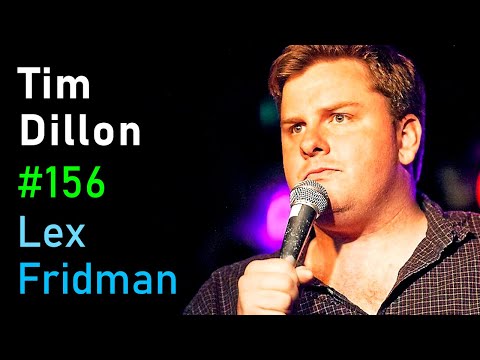
Tim Dillon: Comedy, Power, Conspiracy Theories, and Freedom | Lex Fridman Podcast #156
Lex Fridman (host), Tim Dillon (guest), Narrator
In this episode of Lex Fridman Podcast, featuring Lex Fridman and Tim Dillon, Tim Dillon: Comedy, Power, Conspiracy Theories, and Freedom | Lex Fridman Podcast #156 explores tim Dillon Skewers Power, Censorship, Conspiracies, and Meaningful Madness Lex Fridman and comedian Tim Dillon explore comedy as a way to confront power, hypocrisy, and the absurdity of modern life. They dive into conspiracy thinking (from QAnon to Epstein and JFK), the influence and dangers of tech platforms as gatekeepers, and the chilling effects of deplatforming figures like Alex Jones and Donald Trump. Tim reflects on his own path—addiction, coming out, his mother’s schizophrenia, and finding comedy as salvation—while arguing most people are misled by advice like “follow your dreams.”
Tim Dillon Skewers Power, Censorship, Conspiracies, and Meaningful Madness
Lex Fridman and comedian Tim Dillon explore comedy as a way to confront power, hypocrisy, and the absurdity of modern life. They dive into conspiracy thinking (from QAnon to Epstein and JFK), the influence and dangers of tech platforms as gatekeepers, and the chilling effects of deplatforming figures like Alex Jones and Donald Trump. Tim reflects on his own path—addiction, coming out, his mother’s schizophrenia, and finding comedy as salvation—while arguing most people are misled by advice like “follow your dreams.”
Throughout, they debate the deep state, AI, social media algorithms, and why anger, boredom, and powerlessness are fertile ground for extremism. The conversation ends on mortality, love, and the idea that laughter, properly understood, is a form of love and possibly the deepest answer to the meaning of life.
Key Takeaways
Comedy works best when it attacks hypocrisy, not as moral instruction.
Dillon insists his primary job is to be funny, not to be correct or to tell people who to vote for; the best comedy makes you think while mocking everyone—left, right, and center—without turning into a sermon.
Get the full analysis with uListen AI
“Follow your dreams” can be terrible mass advice.
He argues that telling everyone they can be anything breeds delusion and resentment; instead, people should honestly assess their aptitudes, figure out where they feel most alive, and build around that rather than chasing fantasy careers sold by gurus.
Get the full analysis with uListen AI
Platform power and opaque algorithms are quietly reshaping speech.
From YouTube throttling a video over the word “knife” in a title to Parler being dropped by AWS and Trump’s bans, Dillon and Fridman highlight how a handful of tech companies, and algorithms even their employees barely understand, now function as the real gatekeepers of public discourse.
Get the full analysis with uListen AI
Conspiracy theories thrive because some real conspiracies exist and trust is low.
Dillon points to JFK, 9/11 questions, Epstein, and clusters of protected abusers as examples that make people feel lied to, creating a vacuum that entertainers like Alex Jones fill—mixing occasional truths with damaging fantasies like Sandy Hook denial or metastasizing movements like QAnon.
Get the full analysis with uListen AI
Anger and powerlessness are driving people toward extremes and mob behavior.
They argue that economic precarity, lack of healthcare, and feelings of political irrelevance push people online to vent about violence and join conspiratorial movements; ignoring this underlying suffering while simply censoring outputs risks more radicalization, not less.
Get the full analysis with uListen AI
Deplatforming without transparent due process is a dangerous precedent.
While acknowledging real harms (e. ...
Get the full analysis with uListen AI
Humor and love are intertwined and may be central to a meaningful life.
Dillon frames laughter as a form of love and connection; he sees his life’s purpose as entertaining people in a bleak, absurd world, and suggests that if, at the end, you can say your time was well spent and you helped people feel less alone, that’s close to the “meaning” of life.
Get the full analysis with uListen AI
Notable Quotes
“You can leave Earth and still be a problem.”
— Tim Dillon
“The two worst things in the world are not getting what you want and getting it.”
— Tim Dillon (paraphrasing a film quote)
“I don’t believe in lone pedophiles anymore.”
— Tim Dillon
“If you’re not going to give people health insurance, you’ve got to give them something… You have to let people in this country enjoy the deaths of their enemies.”
— Tim Dillon
“The power of choice has been elevated in our society to an unhealthy degree.”
— Tim Dillon
Questions Answered in This Episode
Where should platforms draw a clear, consistent line between dangerous speech and provocative satire, and who should enforce it?
Lex Fridman and comedian Tim Dillon explore comedy as a way to confront power, hypocrisy, and the absurdity of modern life. ...
Get the full analysis with uListen AI
How can societies address the underlying economic and psychological conditions that make movements like QAnon so appealing?
Throughout, they debate the deep state, AI, social media algorithms, and why anger, boredom, and powerlessness are fertile ground for extremism. ...
Get the full analysis with uListen AI
Is it possible to design algorithms and social platforms that actively foster empathy, nuance, and redemption rather than outrage and flattening?
Get the full analysis with uListen AI
To what extent are presidents genuinely constrained by intelligence agencies, defense contractors, and other ‘deep state’ actors?
Get the full analysis with uListen AI
How can individuals realistically distinguish between legitimate investigative skepticism and destructive conspiracy thinking in a low-trust world?
Get the full analysis with uListen AI
Transcript Preview
The following is a conversation with Tim Dillon, a stand-up comedian who's fearless in challenging the norms of modern day social and political discourse. A quick mention of our sponsors: NetSuite business management software, Athletic Greens all-in-one nutrition drink, Magic Spoon low carb cereal, BetterHelp online therapy, and Rev speech-to-text service. So, the choice is business, health, sanity, or transcripts. Choose wisely, my friends. And if you wish, click the sponsor links below to get a discount and to support this podcast. As a side note, let me say that I will continue talking to scientists, engineers, historians, mathematicians, and so on. But I will also talk to the people who Jack Kerouac called the mad ones in his book, On the Road. That is one of my favorite books. He wrote, "The only people for me are the mad ones, the ones who are mad to live, mad to talk, mad to be saved, desirous of everything at the same time, the ones who never yawn or say a commonplace thing, but burn, burn like fabulous yellow Roman candles exploding like spiders across the stars. And in the middle you see the blue center light pop and everybody goes, 'Ah.'" Some of these conversations will be a bit of a gamble, in that I have no idea how they will turn out. But I'm willing to risk it for a chance at a bit of an adventure, and I'm happy and honored that, uh, Tim, this time, wanted to take a chance as well. If you enjoy this thing, subscribe on YouTube, review it on Apple Podcasts, follow on Spotify, support it on Patreon, or connect with me on Twitter @LexFridman. And now, here's my conversation with Tim Dillon. What would you like your tombstone to read? It's a good way to summarize the, uh, essence of a human being.
I would like it to say, "This has not been paid for."
(laughs) Yeah.
And I want, I want my, my living relatives to struggle to, to pay for it, and I think-
(laughs)
... I would like them to be hounded every day. I would like people to call and go, "Listen, we don't wanna ever excavate a body, but we will-"
(laughs) Yeah.
"... because this has not been paid for."
Okay.
I, I love the idea of leaving the w- like, debt, leaving the world in, in lots of debt that other people-
Yeah.
... have to deal with.
Yeah.
I, and I, I know people that have done that, and I know people that have been in families where that's happened, where someone has to sit and, and just curse the sky because they, they don't have a physical person anymore to be angry at-
(laughs)
... and they, but they (laughs) still have to deal with the decisions that person made. And that's deeply tragic, but that's always struck me as very funny.
Install uListen to search the full transcript and get AI-powered insights
Get Full TranscriptGet more from every podcast
AI summaries, searchable transcripts, and fact-checking. Free forever.
Add to Chrome