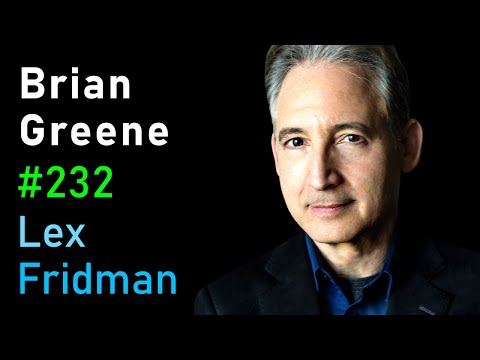
Brian Greene: Quantum Gravity, The Big Bang, Aliens, Death, and Meaning | Lex Fridman Podcast #232
Lex Fridman (host), Brian Greene (guest), Narrator, Narrator
In this episode of Lex Fridman Podcast, featuring Lex Fridman and Brian Greene, Brian Greene: Quantum Gravity, The Big Bang, Aliens, Death, and Meaning | Lex Fridman Podcast #232 explores brian Greene Explores Time, Consciousness, Free Will, and Our Cosmic Fate Brian Greene and Lex Fridman discuss how modern physics frames questions of meaning, life, and consciousness in a universe destined for entropy and eventual heat death. Greene argues that while the cosmos is purposeless at a fundamental level, humans create genuine meaning locally through our brief pockets of order and complexity. They explore the nature of life and consciousness as emergent phenomena, the status of string theory and quantum gravity, and open puzzles about time, the Big Bang, and cosmology. The conversation closes with reflections on alien life, space colonization, and how the fear of death shapes human culture, creativity, and even future AI.
Brian Greene Explores Time, Consciousness, Free Will, and Our Cosmic Fate
Brian Greene and Lex Fridman discuss how modern physics frames questions of meaning, life, and consciousness in a universe destined for entropy and eventual heat death. Greene argues that while the cosmos is purposeless at a fundamental level, humans create genuine meaning locally through our brief pockets of order and complexity. They explore the nature of life and consciousness as emergent phenomena, the status of string theory and quantum gravity, and open puzzles about time, the Big Bang, and cosmology. The conversation closes with reflections on alien life, space colonization, and how the fear of death shapes human culture, creativity, and even future AI.
Key Takeaways
Meaning is not discovered in the cosmos; it is constructed by us.
Greene emphasizes that physics shows a universe indifferent to human concerns, so searching for an objective, universal meaning is misguided; instead, individuals and cultures legitimately create their own purposes within a purposeless cosmos.
Get the full analysis with uListen AI
Life and consciousness likely form a continuum rather than sharp thresholds.
There is no clear, rigorous line that separates non-life from life, or unconscious from conscious; both arise from increasing complexity, metabolism, and information processing, making strict definitions and boundaries elusive.
Get the full analysis with uListen AI
Consciousness is deeply mysterious now but may eventually seem mundane.
Although current physics offers no hint why matter assembled in certain ways should produce inner experience, Greene predicts that with better neuroscience and artificial conscious systems, consciousness will be seen as a standard emergent feature of complex physical organization.
Get the full analysis with uListen AI
Traditional free will conflicts with deterministic (or law-governed) physics, but a real sense of freedom remains.
If all particles obey laws, there is no room for being an uncaused originator of choices; yet humans are “freer” than rocks because evolution has endowed us with vastly richer repertoires of behavior in response to stimuli.
Get the full analysis with uListen AI
String theory is powerful, mathematically rich, and progressing, but still unverified.
It elegantly unifies gravity and quantum mechanics and predicts extra dimensions, yet lacks experimental confirmation; Greene suggests it’s better viewed as a “string hypothesis” until empirical signatures—like effects of extra dimensions—are found.
Get the full analysis with uListen AI
Our understanding of cosmology is strong after the first microseconds, but the very beginning remains unsettled.
Inflationary cosmology explains many observations (e. ...
Get the full analysis with uListen AI
The fear of death quietly shapes culture, ambition, and possibly future AI.
Drawing on Ernest Becker and Terror Management Theory, they suggest much human behavior manages mortality anxiety; Lex speculates that instilling some analogue of mortality or scarcity in AI might be important for creating human-like, socially compatible intelligence.
Get the full analysis with uListen AI
Notable Quotes
““We are these exquisitely ordered configurations of particles that only will last for a blink of an eye in cosmological terms, and the fact that we're here and we can do what we do—that inspires gratitude and wonder.””
— Brian Greene
““There is no fundamental answer. It's what you make of it. However much that may sound like a Hallmark card, this really is the deep lesson of physics and science over the past few hundred years.””
— Brian Greene
““Nowhere in our list of particles and laws is there even a hint that when you put those particles together in the right way, an inner world should turn on. And it's insane that it does.””
— Brian Greene
““The freedom that we have is not from the control of physical law. The freedom that we have is from the constrained behavior that has long since governed inanimate objects.””
— Brian Greene
““On the scales of eternity, any finite duration however large is effectively zero. Once you know that you are not eternal, the timescale hardly matters.””
— Brian Greene
Questions Answered in This Episode
If the universe is fundamentally purposeless, what criteria should individuals or societies use to decide which constructed meanings are worth pursuing?
Brian Greene and Lex Fridman discuss how modern physics frames questions of meaning, life, and consciousness in a universe destined for entropy and eventual heat death. ...
Get the full analysis with uListen AI
How would our ethics and legal systems change if the physics-based critique of free will became widely accepted and taken seriously?
Get the full analysis with uListen AI
What kinds of experiments or observations would most plausibly provide the first decisive evidence for or against string theory and extra dimensions?
Get the full analysis with uListen AI
Could a future scientific account of consciousness ever fully capture the subjective feel of experience, or will there always be an explanatory gap from the first-person point of view?
Get the full analysis with uListen AI
If mortality anxiety really underlies so much of human culture, how might near-immortality (biological or digital) transform art, science, religion, and our drive to explore space?
Get the full analysis with uListen AI
Transcript Preview
The following is a conversation with Brian Greene, theoretical physicist at Columbia and author of many amazing books on physics, including his latest, Until the End of Time: Mind, Matter, and Our Search For Meaning In An Evolving Universe. This is the Lex Fridman Podcast. To support it, please check out our sponsors in the description, and now, here's my conversation with Brian Greene. In your most recent book, Until The End of Time, you quote Bertrand Russell from a debate he had about God in 1948. He says, quote, (laughs) "So far as scientific evidence goes, the universe has crawled by slow stages to a somewhat pitiful result on this Earth and is going to crawl by still more pitiful stages to a condition of universal death. If this is to be taken as evidence of purpose, I can only say that the purpose is one that does not appeal to me. I see no reason, therefore, to believe in any sort of God." That's quite, uh, a depressing statement. As you say, this is a bleak outlook on our universe and the emergence of human consciousness. So, let me ask, what is a more hopeful perspective to take on this story?
Well, I think the more hopeful perspective is to more fully understand, um, what was driving Bertrand Russell to this perspective, and then to see it within a broader context, and really that's, in some sense, what- what my book Until the End of Time is all about. But, in brief, I would say that there's a lot of truth to what Bertrand Russell was saying there. When you look at the second law of thermodynamics, which is the underlying scientific idea that's driving this notion that everything's gonna wither, decay, fall apart, yeah, that's true. Second law of thermodynamics establishes that disorder, entropy, in aggregate is always on the rise, and that is indeed interpretable as disintegration and destruction over sufficiently long time scales. But my view is, when you recognize how special that makes us, that we are these exquisitely ordered configurations of particles that only will last for a blink of an eye in cosmological time-like terms, the fact that we're here and we can do what we do, to me, that's just really something that inspires gratitude, and wonder, and- and a sense of- of deep purpose by virtue of being these unique collections of entities that happen to rise up, look around, and try to figure out where we are and what the heck we should do with our time. So, it's not that I would disagree with Bertrand Russell in terms of the basic physics and the basic unfolding, but I think it's really a matter of the slant that you take on what it means for us.
(sighs) So, maybe we'll skip around a bit, but let me ask the biggest possible question then. You said purpose. So, what's the meaning of it all then? Is, uh, is there a meaning to life that we can take from this, from this brief emergence of complexity that arises from simple things and then goes into a- a heat death that is, once again, returns to simple things as the march of the second law of ther- thermodynamics goes on?
Install uListen to search the full transcript and get AI-powered insights
Get Full TranscriptGet more from every podcast
AI summaries, searchable transcripts, and fact-checking. Free forever.
Add to Chrome