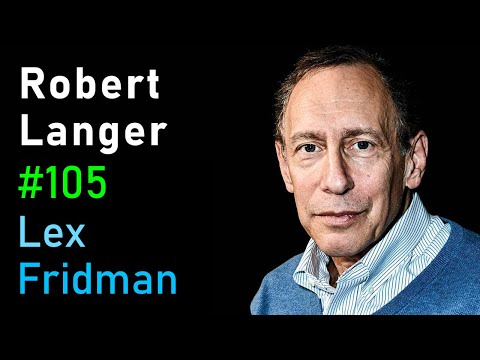
Robert Langer: Edison of Medicine | Lex Fridman Podcast #105
Lex Fridman (host), Robert (Bob) Langer (guest), Narrator
In this episode of Lex Fridman Podcast, featuring Lex Fridman and Robert (Bob) Langer, Robert Langer: Edison of Medicine | Lex Fridman Podcast #105 explores robert Langer on Engineering Drugs, Tissues, and Scientific Failure Lex Fridman interviews MIT professor Robert Langer, one of the most cited engineers in history, about his pioneering work in drug delivery, tissue engineering, and biotech entrepreneurship.
Robert Langer on Engineering Drugs, Tissues, and Scientific Failure
Lex Fridman interviews MIT professor Robert Langer, one of the most cited engineers in history, about his pioneering work in drug delivery, tissue engineering, and biotech entrepreneurship.
Langer explains how fundamental discoveries in controlled-release polymers and blood-vessel growth inhibitors led to blockbuster cancer drugs and opened entire fields in bioengineering.
They discuss the complexity of the human body, challenges of drug development and clinical trials, and the promise of future technologies like smart delivery systems, CRISPR, organs-on-chips, and regenerative medicine.
Langer also reflects on failure, funding, patents, building companies, leading a large lab, and why he sees his students’ success as his greatest achievement.
Key Takeaways
Transformative science often starts with rejection and uncertainty.
Langer’s early landmark papers on blood-vessel inhibitors and controlled-release polymers were rejected by top journals, forcing him to clarify and improve his explanations while maintaining belief in the underlying science.
Get the full analysis with uListen AI
Drug delivery is as critical as the drug itself.
Creating polymers that can release molecules slowly and locally over months enabled entirely new therapies, such as angiogenesis inhibitors for cancer and eye disease, illustrating that engineering the delivery mechanism can unlock biological breakthroughs.
Get the full analysis with uListen AI
Bringing a new drug to patients is long, expensive, and high‑risk.
Developing a drug typically costs over $2 billion, with the most expensive part being human clinical trials that must carefully prove safety and efficacy through phased studies in hundreds or thousands of patients.
Get the full analysis with uListen AI
Tissue engineering is moving from concept to clinic.
Engineered tissues like skin are already FDA‑approved for burns and diabetic ulcers, and advanced trials are underway for blood vessels and other tissues, showing that scaffold-plus-cells strategies are clinically viable.
Get the full analysis with uListen AI
Future therapies will blend biology, engineering, and intelligence.
Langer envisions smart drug-delivery systems, microchips, and eventually nano‑scale “robots” inside the body, potentially guided by AI that learns from large chemical and biological datasets to optimize design and response.
Get the full analysis with uListen AI
Patents and strong business leadership are essential to translate science.
Without IP protection, investors would not fund multi‑billion‑dollar developments, and Langer emphasizes that the success of his 40+ startups depends as much on great business teams and strategic choices as on the underlying platform technologies.
Get the full analysis with uListen AI
Mentorship and lab culture multiply scientific impact.
Langer views his greatest legacy as the nearly 1,000 trainees who have become leading academics, CEOs, and innovators, arguing that giving researchers important problems and a sense of purpose fuels both happiness and high performance.
Get the full analysis with uListen AI
Notable Quotes
“Nothing great, I think, is ever achieved without failure.”
— Robert Langer
“Drug delivery is getting a drug to go where you want it at the level you want it in a safe way.”
— Robert Langer
“I think of a scaffold as a canvas on which cells can grow.”
— Robert Langer (paraphrasing and endorsing Lex Fridman’s analogy)
“At a high level, it is amazing. I mean, evolution’s amazing… the fact that we have evolved the way we’ve done is pretty remarkable.”
— Robert Langer
“My students… they’re not my children, but they’re close to my children in a way.”
— Robert Langer
Questions Answered in This Episode
How should society balance the need for patents to fund innovation with the goal of making life-saving drugs affordable and globally accessible?
Lex Fridman interviews MIT professor Robert Langer, one of the most cited engineers in history, about his pioneering work in drug delivery, tissue engineering, and biotech entrepreneurship.
Get the full analysis with uListen AI
What concrete steps could dramatically reduce the time and cost of clinical trials without compromising patient safety?
Langer explains how fundamental discoveries in controlled-release polymers and blood-vessel growth inhibitors led to blockbuster cancer drugs and opened entire fields in bioengineering.
Get the full analysis with uListen AI
Which tissues or organs do you expect will be routinely engineered or regenerated in patients within the next 20 years, and which will remain out of reach?
They discuss the complexity of the human body, challenges of drug development and clinical trials, and the promise of future technologies like smart delivery systems, CRISPR, organs-on-chips, and regenerative medicine.
Get the full analysis with uListen AI
How can AI be integrated more deeply into drug discovery and delivery design without over-relying on opaque “black box” models?
Langer also reflects on failure, funding, patents, building companies, leading a large lab, and why he sees his students’ success as his greatest achievement.
Get the full analysis with uListen AI
What changes in academic and funding structures would make it easier for unconventional, cross‑disciplinary researchers like Langer’s younger self to thrive today?
Get the full analysis with uListen AI
Transcript Preview
The following is a conversation with Bob Langer, professor at MIT and one of the most cited researchers in history, specializing in biotechnology fields of drug delivery systems and tissue engineering. He has bridged theory and practice by being a key member and driving force in launching many successful biotech companies out of MIT. This conversation was recorded before the outbreak of the coronavirus pandemic. His research and companies are at the forefront of developing treatment for COVID-19, including a promising vaccine candidate. Quick summary of the ads. Two sponsors: Cash App and Masterclass. Please consider supporting the podcast by downloading Cash App and using code LEXPODCAST and signing up on masterclass.com/lex. Click on the links, buy the stuff. It really is the best way to support this podcast and, in general, the journey I'm on in my research and startup. This is The Artificial Intelligence Podcast. If you enjoy it, subscribe on YouTube, review it with five stars on Apple Podcasts, support it on Patreon, or connect with me on Twitter @LexFridman. As usual, I'll do a few minutes of ads now and never any ads in the middle that can break the flow of the conversation. This show is presented by Cash App, the number one finance app in the App Store. When you get it, use code LEXPODCAST. Cash App lets you send money to friends, buy Bitcoin, and invest in the stock market with as little as $1. Since Cash App allows you to send and receive money digitally, let me mention a surprising fact related to physical money. Of all the currency in the world, roughly 8% of it is actual physical money. The other 92% of money only exists digitally. So again, if you get Cash App from the App Store or Google Play and use the code LEXPODCAST, you get $10 and Cash App will also donate $10 to FIRST, an organization that is helping to advance robotics and STEM education for young people around the world. This show is sponsored by Masterclass. Sign up at masterclass.com/lex to get a discount and to support this podcast. When I first heard about Masterclass, I thought it was too good to be true. For $180 a year, you get an all-access pass to watch courses from, to list some of my favorites, Chris Hadfield on space exploration, Neil deGrasse Tyson on scientific thinking and communication, Will Wright, creator of SimCity and Sims, on game design, Carlos Santana on guitar, Europa is probably one of the most beautiful guitar instrumentals ever, Garry Kasparov on chess, Daniel Negreanu on poker, and many more. Chris Hadfield explaining how rockets work and the experience of being launched into space alone is worth the money. You can watch it on basically any device. Once again, sign up on masterclass.com/lex to get a discount and to support this podcast. And now here's my conversation with Bob Langer. You have a bit of a love for magic. Do you see a connection between magic and science?
Install uListen to search the full transcript and get AI-powered insights
Get Full TranscriptGet more from every podcast
AI summaries, searchable transcripts, and fact-checking. Free forever.
Add to Chrome