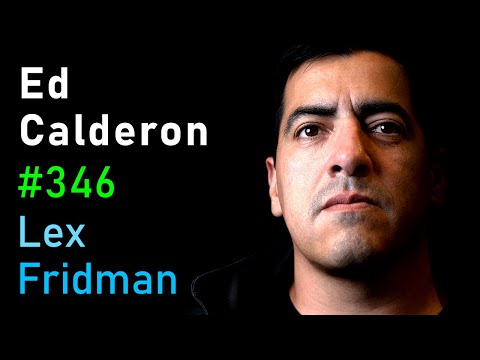
Ed Calderon: Mexican Drug Cartels | Lex Fridman Podcast #346
Ed Calderon (guest), Lex Fridman (host), Lex Fridman (host), Lex Fridman (host), Lex Fridman (host)
In this episode of Lex Fridman Podcast, featuring Ed Calderon and Lex Fridman, Ed Calderon: Mexican Drug Cartels | Lex Fridman Podcast #346 explores inside Mexico’s Cartel Wars: Corruption, Violence, Faith, and Survival Lex Fridman interviews Ed Calderon, a former Mexican counter‑narcotics officer from Tijuana, about the inner workings of Mexican drug cartels, the culture of corruption, and the blurred moral lines between criminals, cops, and politicians.
Inside Mexico’s Cartel Wars: Corruption, Violence, Faith, and Survival
Lex Fridman interviews Ed Calderon, a former Mexican counter‑narcotics officer from Tijuana, about the inner workings of Mexican drug cartels, the culture of corruption, and the blurred moral lines between criminals, cops, and politicians.
Ed explains how cartels gain power, leverage poverty and youth, weaponize social media and terror, and intertwine with politics, military, and foreign actors like China in the fentanyl trade.
He describes kidnapping tradecraft, counter‑ambush thinking, improvised weapons, protection work for high‑value targets, and the practical mindset needed to survive violence.
The conversation is also deeply personal: Ed talks about trauma, PTSD, alcoholism, immigration to the U.S., spirituality around death, and how service and honest self‑examination shape a meaningful life after war.
Key Takeaways
Corruption is systemic and driven by need, not simple greed.
Ed stresses that in Mexico “anyone can be got” because financial hardship, family pressure, or threats create cracks in even seemingly incorruptible people; the culture normalizes small bribes (mordidas), which scales up into deep police–cartel–political collusion.
Get the full analysis with uListen AI
Cartels are fragmented, adaptive enterprises deeply embedded in society.
Rather than a few monoliths, Mexico has dozens of groups from small town militias to federations like Sinaloa and CJNG, which run drugs, extortion, protection rackets, and even build roads, schools, and hospitals to act as de facto governments and win local support.
Get the full analysis with uListen AI
Modern cartel violence is designed as media‑driven terror.
Beheadings, chainsaw executions, cannibalism, and mutilations are filmed and spread via blogs, WhatsApp, Telegram, and TikTok as psychological warfare, much like ISIS, to intimidate rivals, control populations, and recruit thrill‑seeking or desperate youth.
Get the full analysis with uListen AI
Understanding ambush and tradecraft is essential to real self‑defense.
Ed argues that most real violence is ambush (not fair duels), so effective preparation means studying adversarial thinking—how criminals scout, profile, restrain, and attack—then learning counter‑ambush tactics, medical skills (TCCC), and how to recognize pre‑attack behaviors.
Get the full analysis with uListen AI
Kidnapping and captivity are industrialized, but restraints are never absolute.
From zip ties and duct tape to handcuffs and rope, cartels and abusive partners use restraints to project hopeless control; Ed teaches that every cage can be escaped by understanding mechanisms, improvising tools (e. ...
Get the full analysis with uListen AI
The fentanyl crisis is a trilateral problem involving U.S. demand, Mexican logistics, and Chinese supply.
As prescription opioids and marijuana markets shifted, cartels turned to fentanyl precursors and pill presses largely sourced from China, with Chinese money brokers laundering proceeds—making the overdose epidemic a transnational, not purely domestic, issue.
Get the full analysis with uListen AI
Spirituality and myth are powerful tools in cartel culture and community control.
Narco‑saints like Jesús Malverde, Santa Muerte, and even figures like El Chapo function as folk deities and symbols of rebellion; cartels and some police alike use these icons for psychological strength, legitimacy, and to align with a population that venerates death differently.
Get the full analysis with uListen AI
A meaningful life after violence requires honesty, service, and confronting your own demons.
Ed’s transition from war‑zone cop to immigrant instructor involved untreated PTSD, heavy drinking, his mother’s death, marital collapse, and finally sobriety; he emphasizes travel, community service, radical honesty about weakness, and using hard‑earned skills to protect others.
Get the full analysis with uListen AI
Notable Quotes
“Nobody’s against you, Ed. They’re for themselves.”
— Ed Calderon (quoting his mother)
“All restraints are temporary. Even marriage.”
— Ed Calderon
“If you find yourself in an ambush, it wasn’t a successful ambush.”
— Ed Calderon
“Mexico is a country that has industrialized body disposal.”
— Ed Calderon
“You can’t pickpocket a naked man, so just get naked.”
— Ed Calderon (quoting a friend on being open about alcoholism)
Questions Answered in This Episode
To what extent should cartels be treated as terrorist organizations versus criminal enterprises, given their political influence and use of terror tactics?
Lex Fridman interviews Ed Calderon, a former Mexican counter‑narcotics officer from Tijuana, about the inner workings of Mexican drug cartels, the culture of corruption, and the blurred moral lines between criminals, cops, and politicians.
Get the full analysis with uListen AI
How could U.S.–Mexico relations be reshaped to address shared responsibility for guns, drugs, and migration without feeding nationalist backlash on either side?
Ed explains how cartels gain power, leverage poverty and youth, weaponize social media and terror, and intertwine with politics, military, and foreign actors like China in the fentanyl trade.
Get the full analysis with uListen AI
Is there an ethical way for journalists or researchers to engage directly with cartel leaders without becoming tools of their propaganda?
He describes kidnapping tradecraft, counter‑ambush thinking, improvised weapons, protection work for high‑value targets, and the practical mindset needed to survive violence.
Get the full analysis with uListen AI
How can societies balance the need to understand and teach real-world violence and tradecraft without inadvertently empowering the very predators they fear?
The conversation is also deeply personal: Ed talks about trauma, PTSD, alcoholism, immigration to the U. ...
Get the full analysis with uListen AI
What role should spirituality and folk beliefs play in rehabilitation and community rebuilding in regions where narco‑cultures and saints are deeply entrenched?
Get the full analysis with uListen AI
Transcript Preview
... when it's quiet, that's when it hits you. That's what, uh, I think that's what a lot of people experience when they come back from a conflict zone. You know, the, uh, everything that was life and death, everything that mattered, all the noise, all the chaos, all the people that are around you that would die for you, kill for you, you would kill for them, uh, all the millions of dollars worth of equipment and stuff like that you were responsible for, now all- are all gone and it's just you.
The following is a conversation with Ed Calderon, a security specialist who has worked for many years on counter-narcotics and organized crime investigation in the northern border region of Mexico. I highly recommend you follow the writing and courses on his Patreon and website, edsmanifesto.com. This is the Lex Fridman podcast. To support it, please check out our sponsors in the description, and now, dear friends, here's Ed Calderon. What does your experience in counter-narcotics, investigating the Mexican drug cartel teach you about human nature?
Well, I mean, first off, anybody can be got. Uh, anybody can be corrupted. Uh, you know, you, you work in that field and you, you... Realistically, the training we got and profiling and investigation and stuff li- stuff like that was basically you learn from the older guys there, and some of those guys were already corrupted from the, from the start. So, trust no one. I remember seeing that X-Files episode where that was stated. You quickly learn that even if you are somebody that, uh, to your own, uh, mind appears incorruptible, you know, small changes happen around you, wheels get greased, money gets put in front of you and/or things get threatened, like your life. And, uh, sometimes a payment for some of this corruption is just to continue on living. You encounter people that seem incorruptible that, uh, go through FBI background checks, that go through all of the, uh, the sec- the security measures that all of us were put throu- through. Um, you know, polygraph tests, and then later on, you know, it turns out they were on the take, or they became somebody that was corrupted. I think what I found out is that anybody, at any level, uh, they could be a very strong, hard-to-get person right now, but, uh, people get corrupted through their families, uh, through need. Uh, Mexico is a place where a lot of, uh, instability occurs. Um, so financial needs, health.
So a crack could form through the wall of integrity and then over time, it seeps in somehow.
Mexico has a culture of corruption. Like, you know, you have your kid that goes to school, at public school, and you want him to be in the morning, not in the afternoon school, uh, time period. So, you go off and, uh, grease the wheels with the, uh, director of the school. People hearing this in Mexico will nod their heads, because this is something that happens from early on. So there's systemic thi- there's a systemic and cultural thing to it, you know, as far as getting around rules. And this k- happens because, you know, the people are in charge in Mexico, the government, is, you know... Their, their tandem amount is trust, uh, between criminals and the cartels down there for a lot of the culture. So people don't trust the government, and much less, uh, criminality, so.
Install uListen to search the full transcript and get AI-powered insights
Get Full TranscriptGet more from every podcast
AI summaries, searchable transcripts, and fact-checking. Free forever.
Add to Chrome