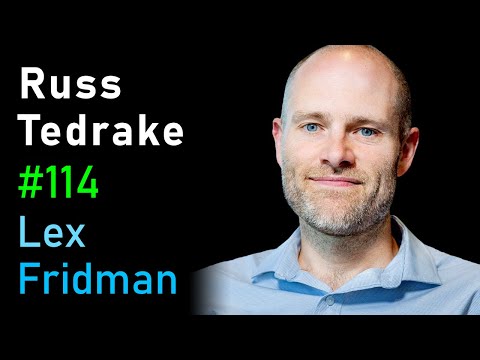
Russ Tedrake: Underactuated Robotics, Control, Dynamics and Touch | Lex Fridman Podcast #114
Lex Fridman (host), Russ Tedrake (guest), Narrator
In this episode of Lex Fridman Podcast, featuring Lex Fridman and Russ Tedrake, Russ Tedrake: Underactuated Robotics, Control, Dynamics and Touch | Lex Fridman Podcast #114 explores let Physics Work: Russ Tedrake on Robots, Control, and Touch Lex Fridman and MIT roboticist Russ Tedrake explore how control theory, dynamics, and contact shape the behavior of both robots and animals, from passive dynamic walkers to fish surfing vortices and humans running barefoot.
Let Physics Work: Russ Tedrake on Robots, Control, and Touch
Lex Fridman and MIT roboticist Russ Tedrake explore how control theory, dynamics, and contact shape the behavior of both robots and animals, from passive dynamic walkers to fish surfing vortices and humans running barefoot.
They dig into underactuated robotics—systems with more degrees of freedom than actuators—and why embracing, rather than fighting, physics leads to more elegant, robust, and efficient robot behavior.
Tedrake recounts lessons from the DARPA Robotics Challenge, the difficulty of contact-rich manipulation and simulation, and the role of deep learning versus rigorous mathematical thinking in robotics.
The conversation closes with discussion of soft robotics, tactile sensing, home robots for elder care, societal fears about robots, and advice for young people on thinking deeply and building things that matter.
Key Takeaways
Leverage physics instead of fighting it.
Passive dynamic walkers and trout surfing vortices show that if you design mechanics well and stop trying to cancel out the world with motors and control, you can get stable, natural, and efficient motion with minimal actuation.
Get the full analysis with uListen AI
Underactuated systems demand optimization and careful control design.
Most real systems, including humans, have more degrees of freedom than actuators; optimal control and trajectory optimization let you exploit these dynamics rather than pretend everything is fully actuated and simple.
Get the full analysis with uListen AI
Contact is both essential and computationally hard.
Making and breaking contact introduces discontinuities and combinatorial explosion in possible contact configurations, which breaks many classic smooth-control assumptions and makes both simulation and planning for manipulation fundamentally challenging.
Get the full analysis with uListen AI
Rigorous thinking still matters in the age of deep learning.
While deep learning enables fast progress, Tedrake argues that clear mathematical models, analysis, and classical control tools are irreplaceable for safety-critical, complex robotic systems and to avoid over-relying on black-box function approximators.
Get the full analysis with uListen AI
Robust robotics requires disciplined testing and rare-event search.
The DARPA Robotics Challenge revealed that you cannot simply run a single robot more often; you need systematic testing, unit and integration tests, good simulators, and active methods to expose rare but catastrophic failure modes.
Get the full analysis with uListen AI
Soft bodies and rich touch sensing can simplify hard problems.
Soft robotics changes contact mechanics (from point to patch contact) and makes it easier to handle fragile or complex objects, while embedded tactile sensing provides crucial information exactly where cameras are occluded—at the hand–world interface.
Get the full analysis with uListen AI
Deep understanding comes from focused, long-term engagement with ideas.
In an era of information overload, Tedrake emphasizes reading a few great books and papers deeply, teaching and explaining concepts to others, and building and breaking real systems as the path to genuine expertise.
Get the full analysis with uListen AI
Notable Quotes
“Maybe instead of trying to take the forces imparted to you by the world and replacing them, what we should be doing is letting the world push us around and we go with the flow.”
— Russ Tedrake
“What if Newton and Galileo had deep learning and just said, ‘Here are the weights of the neural network’? I don’t think we’d be as far as we are today.”
— Russ Tedrake
“The world gives us underactuated robots, whether we like it or not.”
— Russ Tedrake
“We’re building robots wrong. Robots are afraid of touching the world all over their body.”
— Russ Tedrake
“What a luxury to have something that you want to spend all your time on.”
— Russ Tedrake
Questions Answered in This Episode
How far can we realistically push passive and underactuated designs before active control and heavy computation become unavoidable?
Lex Fridman and MIT roboticist Russ Tedrake explore how control theory, dynamics, and contact shape the behavior of both robots and animals, from passive dynamic walkers to fish surfing vortices and humans running barefoot.
Get the full analysis with uListen AI
What new mathematical or representational tools are needed to handle the state of deformable, compositional objects like shirts or chopped vegetables in manipulation?
They dig into underactuated robotics—systems with more degrees of freedom than actuators—and why embracing, rather than fighting, physics leads to more elegant, robust, and efficient robot behavior.
Get the full analysis with uListen AI
How should robotics education change to balance deep theoretical rigor with the practical power of modern deep learning and large-scale experimentation?
Tedrake recounts lessons from the DARPA Robotics Challenge, the difficulty of contact-rich manipulation and simulation, and the role of deep learning versus rigorous mathematical thinking in robotics.
Get the full analysis with uListen AI
What governance, design, or cultural choices would best address public fear of robots while still enabling aggressive innovation in autonomous systems?
The conversation closes with discussion of soft robotics, tactile sensing, home robots for elder care, societal fears about robots, and advice for young people on thinking deeply and building things that matter.
Get the full analysis with uListen AI
In home and elder-care settings, how much should robots be engineered to evoke emotional attachment versus being transparent, tool-like machines?
Get the full analysis with uListen AI
Transcript Preview
The following is a conversation with Russ Tedrake, a roboticist and professor at MIT, and vice president of robotics research at Toyota Research Institute, or TRI. He works on control of robots in interesting, complicated, underactuated, stochastic, difficult to model situations. He's a great teacher and a great person. One of my favorites at MIT. We'll get into a lot of topics in this conversation, from his time leading MIT's DARPA Robotics Challenge Team, to the awesome fact that he often runs close to a marathon a day to and from work barefoot. For a world-class roboticist interested in elegant efficient control of underactuated dynamical systems like the human body, this fact makes Russ one of the most fascinating people I know. Quick summary of the ads. Three sponsors. Magic Spoon Cereal, BetterHelp, and Express VPN. Please consider supporting this podcast by going to magic spoon.com/lex and using code Lex at checkout, going to better help.com/lex and signing up at express vpn.com/lexpod. Click the links in the description, buy the stuff, get the discount. It really is the best way to support this podcast. If you enjoy this thing, subscribe on YouTube, review it with five stars on Apple Podcast, support it on Patreon, or connect with me on Twitter @lexfridman. As usual, I'll do a few minutes of ads now and never any ads in the middle that can break the flow of the conversation. This episode is supported by Magic Spoon, low-carb, keto-friendly cereal. I've been on a mix of keto/carnivore diet for a very long time now. That means eating very little carbs. I used to love cereal. Obviously most have crazy amounts of sugar, which is terrible for you, so I quit years ago. But Magic Spoon is a totally new thing. Zero sugar, 11 grams of protein, and only three net grams of carbs. It tastes delicious. It has a bunch of flavors. They're all good, but if you know what's good for you, you'll go with cocoa. My favorite flavor and the flavor of champions. Click the magic spoon.com/lex link in the description, use code Lex at checkout to get the discount and to let them know I sent you. So buy all of their cereal. It's delicious and good for you. You won't regret it. This show is also sponsored by Better Help, spelled H-E-L-P help. Check it out at better help.com/lex. They figure out what you need and match you with a licensed professional therapist in under 48 hours. It's not a crisis line, it's not self-help, it is professional counseling done securely online. As you may know, I'm a bit from the David Goggins line of creatures and so have some demons to contend with, usually on long runs or all-nighters full of self-doubt. I think suffering is essential for creation, but you can suffer beautifully in a way that doesn't destroy you. For most people, I think a good therapist can help in this, so it's at least worth a try. Check out the reviews. They're all good. It's easy, private, affordable, available worldwide. You can communicate by text anytime and schedule weekly audio and video sessions. Check it out at better help.com/lex. This show is also sponsored by Express VPN. Get it at express vpn.com/lexpod to get a discount and to support this podcast. Have you ever watched The Office? If you have, you probably know it's based on a UK series also called The Office. Not to stir up trouble, but I personally think the British version is actually more brilliant than the American one, but both are amazing. Anyway, there are actually nine other countries with their own version of The Office. You can get access to them with no geo restriction when you use Express VPN. It lets you control where you want sites to think you're located. You can choose from nearly 100 different countries, getting you access to content that isn't available in your region. So again, get it on any device at express vpn.com/lexpod to get an extra three months free and to support this podcast. And now here's my conversation with Russ Tedrake. What is the most beautiful motion of a animal or robot that you've ever seen?
Install uListen to search the full transcript and get AI-powered insights
Get Full TranscriptGet more from every podcast
AI summaries, searchable transcripts, and fact-checking. Free forever.
Add to Chrome