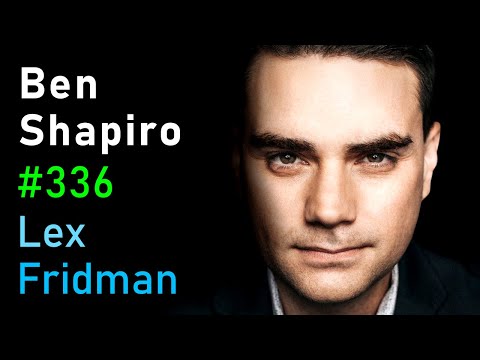
Ben Shapiro: Politics, Kanye, Trump, Biden, Hitler, Extremism, and War | Lex Fridman Podcast #336
Ben Shapiro (guest), Lex Fridman (host), Narrator
In this episode of Lex Fridman Podcast, featuring Ben Shapiro and Lex Fridman, Ben Shapiro: Politics, Kanye, Trump, Biden, Hitler, Extremism, and War | Lex Fridman Podcast #336 explores ben Shapiro and Lex Fridman Examine Evil, Speech, Power, Responsibility Lex Fridman and Ben Shapiro have a long-form conversation covering anti‑Semitism, extremism, historical evil, free speech, media power, abortion, and the war in Ukraine. Shapiro argues that evil is a universal human potential, not a separate class of people, drawing lessons from Nazi Germany, Stalinism, and current political polarization. They examine Kanye West’s anti‑Semitic comments, the dangers of jumping from individual grievance to group hatred, and parallel questions about how Shapiro criticizes “the left.”
Ben Shapiro and Lex Fridman Examine Evil, Speech, Power, Responsibility
Lex Fridman and Ben Shapiro have a long-form conversation covering anti‑Semitism, extremism, historical evil, free speech, media power, abortion, and the war in Ukraine. Shapiro argues that evil is a universal human potential, not a separate class of people, drawing lessons from Nazi Germany, Stalinism, and current political polarization. They examine Kanye West’s anti‑Semitic comments, the dangers of jumping from individual grievance to group hatred, and parallel questions about how Shapiro criticizes “the left.”
The discussion also delves into free speech online, Elon Musk’s Twitter takeover, deplatforming figures like Trump and Alex Jones, and whether violent acts inspired by political content are the responsibility of speakers. Shapiro outlines his pro‑life stance, the limits of state power, and his skepticism of centralized control over information, while acknowledging personal fallibility, audience capture risks, and his own past mistakes.
Later, they explore U.S. foreign policy and the Ukraine war, arguing for realistic endgames and off‑ramps to reduce nuclear risk. The conversation ends with more personal topics: Shapiro’s daily routine, intellectual process, religious views, role‑based ethics, family life, mentors, and what it means to live a good, meaningful life grounded in demanding personal roles.
Key Takeaways
Evil is a human capacity, not a separate category of people.
Shapiro stresses that atrocities like Nazism or slavery were enabled by ordinary people and elites making incremental compromises, so the best protection against evil is recognizing the same potential within ourselves and constantly asking, “Am I participating in evil?”
Get the full analysis with uListen AI
Bigotry often comes from extrapolating personal grievances to entire groups.
Using Kanye West’s anti‑Semitic statements as an example, Shapiro describes the faulty logic of “a Jew wronged me, therefore Jews are bad,” arguing that leaping from individual wrongdoing to condemning whole groups is the core mechanism of racism and anti‑Semitism.
Get the full analysis with uListen AI
Criticizing ideas or states is different from condemning ethnic or religious groups.
He distinguishes between criticizing Israel’s policies and denying Israel’s right to exist; the former is legitimate political debate, the latter mirrors anti‑Semitic double standards where Jews alone are denied national self‑determination others enjoy.
Get the full analysis with uListen AI
Free speech should be the default, even for disturbing or false voices.
Shapiro argues that banning figures like Trump or Alex Jones from major platforms “unpersons” them from the digital town square and empowers unaccountable gatekeepers; he prefers open debate and social pushback over preemptive censorship, except where speech explicitly incites violence or breaks the law.
Get the full analysis with uListen AI
Online rhetoric is rarely morally equivalent to the violence some individuals commit.
In discussing a Quebec mosque shooter who consumed his content, Shapiro insists individual agency and mental state are primary; unless a commentator explicitly advocates violence, blaming them for a follower’s crimes risks eroding free speech by equating speech with violence.
Get the full analysis with uListen AI
Abortion debates hinge on where we locate moral status and competing rights.
He frames the pro‑life position as starting at conception with a distinct human life that has its own interest in continuing, making bodily autonomy an insufficient justification to end it, while acknowledging many Americans intuitively place the moral threshold at some later developmental stage.
Get the full analysis with uListen AI
Political and media systems are vulnerable to audience capture and narrative control.
Shapiro warns that both legacy media and social platforms can selectively suppress stories (e. ...
Get the full analysis with uListen AI
Realistic foreign policy demands clear endgames and risk-aware compromises.
On Ukraine, he argues the U. ...
Get the full analysis with uListen AI
Meaningful life comes from fulfilling demanding roles, not abstract virtues alone.
Shapiro’s emerging “role theory” holds that being a good parent, spouse, citizen, creator, or community member is how humans actually experience meaning; institutions should protect these roles and the liberty to exercise them, rather than promising limitless, undefined freedom.
Get the full analysis with uListen AI
Notable Quotes
“The best protection against evil is recognizing that it lies in every human heart and the possibility that it takes you over.”
— Ben Shapiro
“Anti‑Semitism tends to be a conspiracy theory about the levers of power being controlled by a shadowy cadre of people who are getting together behind closed doors to control things.”
— Ben Shapiro
“The town square is online. Banning people from the town square is unpersoning them.”
— Ben Shapiro
“You can only do the best that a human being can do, but yeah, I spend an inordinate amount of time reflecting on whether I’m doing the right thing.”
— Ben Shapiro
“Politics is Veep, it is not House of Cards… If you assume that there must be some rationale behind it, you have to come up with increasingly convoluted conspiracy theories to explain just why people are acting the way that they’re acting.”
— Ben Shapiro
Questions Answered in This Episode
Where should society draw the line between protecting vulnerable groups from harmful rhetoric and protecting robust free speech for unpopular or offensive views?
Lex Fridman and Ben Shapiro have a long-form conversation covering anti‑Semitism, extremism, historical evil, free speech, media power, abortion, and the war in Ukraine. ...
Get the full analysis with uListen AI
How can individuals who hold strong political or religious convictions regularly test whether they are, in Shapiro’s words, ‘participating in evil’ without becoming paralyzed by self‑doubt?
The discussion also delves into free speech online, Elon Musk’s Twitter takeover, deplatforming figures like Trump and Alex Jones, and whether violent acts inspired by political content are the responsibility of speakers. ...
Get the full analysis with uListen AI
To what extent do social media algorithms and business models, rather than individual bad actors, drive the spread of extremism and conspiracy thinking?
Later, they explore U. ...
Get the full analysis with uListen AI
If we adopted Shapiro’s ‘role theory’ of meaning, how would that change the way we design laws, education systems, and social safety nets?
Get the full analysis with uListen AI
In conflicts like Ukraine, who should ultimately decide when peace terms involve painful compromises—the affected population, external allies funding the war, or some negotiated combination?
Get the full analysis with uListen AI
Transcript Preview
The great lie we tell ourselves is that people who are evil are not like us. They're, they're a class apart. But everybody in history who has sinned is a person who's very different from me. Robert George, the philosopher over at Princeton, he's, he's fond of doing a, a sort of thought experiment in his classes where he asks people to raise their hand if they had lived in Alabama in 1861. "How many of you would be abolitionists?" And everybody raises their hand. And he says, "Of course that's not true. Of course that's not true." Right? The, the, the best protection against evil is recognizing that it lies in every human heart and the possibility that it takes you over.
Do you ever sit back, you know, in the quiet of your mind and think, "Am I participating in evil?" The following is a conversation with Ben Shapiro, a conservative political commentator, host of the Ben Shapiro Show, co-founder of The Daily Wire, and author of several books, including The Authoritarian Moment, The Right Side of History, and Facts Don't Care About Your Feelings. Whatever your political leanings, I humbly ask that you try to put those aside and listen with an open mind, trying to give the most charitable interpretation of the words we say. This is true in general for this podcast, whether the guest is Ben Shapiro or Alexandria Ocasio-Cortez, Donald Trump or Barack Obama. I will talk to everyone from every side, from the far left to the far right, from presidents to prisoners, from artists to scientists, from the powerful to the powerless, because we are all human, all capable of good and evil, all with fascinating stories and ideas to explore. I seek only to understand, and in so doing, hopefully add a bit of love to the world. This is the Lex Fridman Podcast. To support it, please check out our sponsors in the description. And now, dear friends, here's Ben Shapiro. Let's start with a difficult topic. What do you think about the comments made by Ye, formerly known as Kanye West, about Jewish people?
They're awful and anti-Semitic. And they seem to get worse over time. They started off with the bizarre Death Con 3 tweet, and then they went into even more stereotypical garbage about Jews and Jews being sexual manipulators, I think that was the Pete Davidson/Kim Kardashian stuff, and then Jews running all of the media, Jews being in charge of the financial sector, Jewish people... I mean, there's no, I mean, I, I called it on my show they're Sturmer Nazism, and it is. I mean, it's like, right From Protocols of the Elders of Zion type stuff.
Do you think those words come from pain? Where do they come from?
I mean, you know, it's, it's always hard to try and read somebody's mind. You know, w- what, what he looks like to me, just having experience in my own family, people who are bipolar, is he seems like a bipolar personality. He, he seems like somebody who is in the middle of a manic episode. And when you're manic, you tend to say a lot of things that, that you shouldn't say, and you tend to believe that they're the most brilliant things ever said. The Washington Post did an entire piece speculating about how bipolarism played into the kind of stuff that, that Ye was saying. And, um, it's hard for me to think that it's not playing into it, especially because even if he is an anti-Semite, and I have no reason to suspect he's not, given all of his comments, if he had an ounce of common sense, he would stop at a certain point. And bipolarism tends to drive you well past the, the point where common sense applies. So, I mean, I, I would imagine it's coming from that. I mean, I, I... From his comments, I would also imagine that he's doing the logical mistake that, that a lot of anti-Semites or racists or bigots do, which is, "Somebody hurt me. That person is a Jew. Therefore, all Jews are bad." And that, that jump from, "A person did something to me I don't like who's a member of a particular race or class, and therefore everybody of that race or class is bad," I mean, that's textbook bigotry, and that's pretty obviously what Ye is engaging in here.
Install uListen to search the full transcript and get AI-powered insights
Get Full TranscriptGet more from every podcast
AI summaries, searchable transcripts, and fact-checking. Free forever.
Add to Chrome