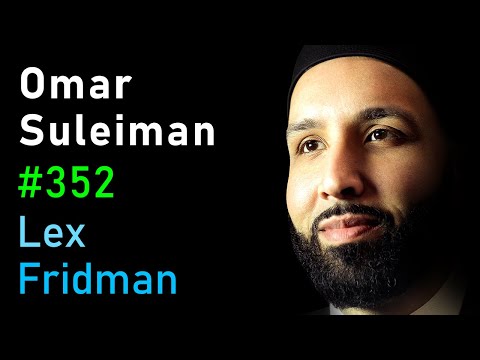
Omar Suleiman: Islam | Lex Fridman Podcast #352
Omar Suleiman (guest), Lex Fridman (host), Narrator
In this episode of Lex Fridman Podcast, featuring Omar Suleiman and Lex Fridman, Omar Suleiman: Islam | Lex Fridman Podcast #352 explores omar Suleiman on Islam, Suffering, and Hope in a Divided World Lex Fridman and Imam Dr. Omar Suleiman explore core Islamic beliefs, including the nature of God, the purpose of life, death, and suffering, and the role of prayer and Ramadan in cultivating inner peace and intentional living. Omar shares deeply personal stories about his mother’s illness and death and how they shaped his faith, as well as his experiences facing Islamophobia, from armed protests at mosques to the Colleyville synagogue hostage crisis. They discuss how dehumanization fuels hatred against Muslims and Jews, drawing parallels between Islamophobia and antisemitism, and how small encounters and sincere curiosity can radically change people’s views. The conversation closes with a candid, politically charged segment on Israel–Palestine, apartheid and occupation, and Omar’s insistence that justice for Palestinians is a political, not religious, question, grounded in universal human dignity.
Omar Suleiman on Islam, Suffering, and Hope in a Divided World
Lex Fridman and Imam Dr. Omar Suleiman explore core Islamic beliefs, including the nature of God, the purpose of life, death, and suffering, and the role of prayer and Ramadan in cultivating inner peace and intentional living. Omar shares deeply personal stories about his mother’s illness and death and how they shaped his faith, as well as his experiences facing Islamophobia, from armed protests at mosques to the Colleyville synagogue hostage crisis. They discuss how dehumanization fuels hatred against Muslims and Jews, drawing parallels between Islamophobia and antisemitism, and how small encounters and sincere curiosity can radically change people’s views. The conversation closes with a candid, politically charged segment on Israel–Palestine, apartheid and occupation, and Omar’s insistence that justice for Palestinians is a political, not religious, question, grounded in universal human dignity.
Key Takeaways
Islam presents God as perfectly transcendent yet radically accessible.
In Islam, God is one, unlike creation, beyond imagination, and free of partners or images, yet ‘closer than your jugular vein’ through sincere supplication, without clergy as intermediaries.
Get the full analysis with uListen AI
Submission to God is framed as liberation, not subjugation.
Omar argues that humans often want to ‘be their own gods’; Islam instead invites people to surrender control to an all‑wise planner, which can transform anxiety and ego into serenity and trust.
Get the full analysis with uListen AI
Every act can become worship through intention and awareness.
From sleep and work to eating and earning money, Islam ties everything to intention: mundane acts gain meaning and spiritual reward when done consciously for God and in service of others.
Get the full analysis with uListen AI
Encounter and empathy can rapidly dismantle entrenched hatred.
The BBC ‘United States of Hate’ segment shows an armed anti‑Muslim protester moved to remorse after meeting Omar and a Syrian refugee family, illustrating how humanization challenges bigotry more effectively than argument alone.
Get the full analysis with uListen AI
Suffering is not denied but contextualized within a hereafter and limited human understanding.
Islam distinguishes between what God commands and what He allows, insisting we cannot see the ‘full picture’ of trials; belief in a just afterlife and ultimate recourse underpins Omar’s view of his mother’s illness and global injustices.
Get the full analysis with uListen AI
Islamophobia is both a media narrative and a policy architecture.
From disproportionate coverage of Muslim violence to the Patriot Act, surveillance, and the Trump travel ban, Omar describes a climate where Muslims are securitized and collectively blamed, even as mass violence in America is mostly non‑Muslim.
Get the full analysis with uListen AI
The Israel–Palestine crisis is primarily political and legal, not a religious feud.
Omar stresses that terms like apartheid, occupation, and ethnic cleansing have concrete legal definitions, and that many Jews oppose Israeli policies; he sees U. ...
Get the full analysis with uListen AI
Notable Quotes
“You’re trying to make sense of a pixel when you can’t see the bigger picture.”
— Omar Suleiman
“We are souls with bodies, not bodies with souls.”
— Omar Suleiman
“Don’t let the way people treat you shape who you’re going to be in the world.”
— Omar Suleiman
“Muslims are terrorized because they are falsely depicted as terrorists.”
— Omar Suleiman
“It’s not a religious conflict. This is not Jews and Muslims who don’t like each other; it’s an occupation.”
— Omar Suleiman
Questions Answered in This Episode
How can individuals differentiate between sincere criticism of a state’s policies and bigotry toward a religious or ethnic group?
Lex Fridman and Imam Dr. ...
Get the full analysis with uListen AI
What practical steps can non‑Muslims take to move beyond media narratives and understand Islam from within its own sources and communities?
Get the full analysis with uListen AI
In societies polarized by fear and dehumanization, what kinds of encounters or institutions are most effective at building genuine empathy across divides?
Get the full analysis with uListen AI
How should people of faith balance trust in divine wisdom with the moral urgency to resist injustice here and now?
Get the full analysis with uListen AI
If you had to redesign counterterrorism and security policy to avoid demonizing an entire faith, what would it look like in practice?
Get the full analysis with uListen AI
Transcript Preview
... so the BBC reached out and said, "We want to interview you," and they said, "We've got this idea. We want to take you to a park and have you meet one of the protestors, who's been wielding his gun outside your mosque, and talk to him." It was really interesting because they'd interviewed him before meeting me, and the things that he was able to utter before meeting me and before meeting Syrian refugees was just awful. I mean, the most dehumanizing rhetoric that you can imagine. But then at the park, he meets me, talks to me, he meets a Syrian refugee family, uh, one of the girls whose leg had been blown off in an airstrike, and he said, "I feel like an idiot." I mean, he expressed all sorts of regret, and was teary-eyed that he could dehumanize people the way that he was. And so my whole thing was, and is, come inside the mosque, put your gun down, disarm yourself, (laughs) and learn, and you'll be surprised what you'll walk away with. And it only took one meeting with him to completely shift his world view at the time, which was made up of heroes and villains, the Muslims unfortunately being the villains that had to be wiped off the face of the earth so that the earth could continue.
The following is a conversation with Imam Dr. Omar Suleiman. He's a Muslim scholar, civil rights leader, founder and president of the Yaqeen Institute for Islamic Research, and he's a professor of Islamic studies at Southern Methodist University. He's one of the most influential Muslims in the world, and is a fearless, kindhearted human being who I'm now proud to call friend. As a side note, allow me to say a few words about Israel and Palestine. While this conversation with Omar Suleiman was mostly exploring the history and beauty of Islam and the Muslim community, we did delve briefly into the topic of Israel and Palestine. This topic is an extremely challenging one, and an extremely important one. It has deep roots and implications in US politics, in global geopolitics, in military and religious conflicts, wars and atrocities, and basic struggle of all human beings to survive, to protect their loved ones, and to flourish as individuals and as communities. I did not want to cover this topic in a solely scholarly fashion. Much like with the war in Ukraine, it is not simply a story of history, politics, religion, and national identity. It is also a deeply human story. To cover this topic in a way that my gut and my heart says to do it, I have to talk to everyone, to leaders and people on all sides, Muslim and Jewish, Israeli and Palestinian, from refugees to soldiers, from scholars to extremists. I'm not sure if that's possible, or wise, but like Forrest Gump said, "I'm not a smart man," and maybe you know how the rest of that goes. I just like to follow my heart to whatever place it leads. I ask the Muslim and the Jewish communities for your patience and support as I explore this topic. I will make many mistakes, and I'll be listening to all voices so I can learn and do better. I've become distinctly aware that my approach of talking to people from all walks of life with empathy and compassion, but with backbone, can create enemies on all sides. I don't quite yet understand why this is, but I'm learning to accept it is the reality of the world. Hopefully, in the end, whatever happens, whatever silly thing I do has a chance of adding a bit of love to the world. Thanks for going along with me on this journey. This is the Lex Fridman Podcast. To support it, please check out our sponsors in the description, and now, dear friends, here's Omar Suleiman. Assalamu alaikum, Omar. We've been trying to do this-
Install uListen to search the full transcript and get AI-powered insights
Get Full TranscriptGet more from every podcast
AI summaries, searchable transcripts, and fact-checking. Free forever.
Add to Chrome