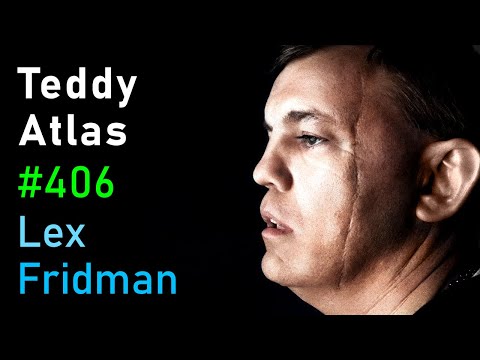
Teddy Atlas: Mike Tyson, Cus D'Amato, Boxing, Loyalty, Fear & Greatness | Lex Fridman Podcast #406
Teddy Atlas (guest), Lex Fridman (host), Lex Fridman (host), Lex Fridman (host), Lex Fridman (host), Lex Fridman (host), Lex Fridman (host), Lex Fridman (host)
In this episode of Lex Fridman Podcast, featuring Teddy Atlas and Lex Fridman, Teddy Atlas: Mike Tyson, Cus D'Amato, Boxing, Loyalty, Fear & Greatness | Lex Fridman Podcast #406 explores teddy Atlas on fear, loyalty, betrayal, and the cost of greatness Teddy Atlas and Lex Fridman move far beyond boxing technique into a raw, autobiographical exploration of fear, loyalty, betrayal, and redemption. Atlas recounts his violent youth, near‑death stabbing, and the influence of his stoic, selfless father and mentor Cus D’Amato. He tells the full, painful story of training young Mike Tyson, pulling a gun on him after an incident with Atlas’s niece, and being cast out by Cus in favor of protecting Tyson’s future. Throughout, Atlas dissects how fear drives both greatness and cowardice, why loyalty is humanity’s lifeblood, and how learning to forgive others is inseparable from learning to forgive yourself.
Teddy Atlas on fear, loyalty, betrayal, and the cost of greatness
Teddy Atlas and Lex Fridman move far beyond boxing technique into a raw, autobiographical exploration of fear, loyalty, betrayal, and redemption. Atlas recounts his violent youth, near‑death stabbing, and the influence of his stoic, selfless father and mentor Cus D’Amato. He tells the full, painful story of training young Mike Tyson, pulling a gun on him after an incident with Atlas’s niece, and being cast out by Cus in favor of protecting Tyson’s future. Throughout, Atlas dissects how fear drives both greatness and cowardice, why loyalty is humanity’s lifeblood, and how learning to forgive others is inseparable from learning to forgive yourself.
Key Takeaways
Fear is not weakness; it is the precondition for bravery and greatness.
Atlas argues that anyone in a truly dangerous situation who claims not to be afraid is either lying or broken; fear is what gives meaning to courage, because only in the presence of fear can you choose to be brave.
Get the full analysis with uListen AI
Loyalty is the “lifeblood of humanity,” but it is inherently painful.
Being loyal often means accepting discomfort, danger, and sacrifice; people usually betray not out of malice but because disloyalty is more convenient than enduring that pain.
Get the full analysis with uListen AI
Regret is a “solitary sentence” and more terrifying than pain in the moment.
Atlas repeatedly chose to face physical danger rather than act in ways that would leave him feeling cowardly or compromised, because living with self‑contempt and regret is, to him, a worse lifelong punishment.
Get the full analysis with uListen AI
True friendship and character are only revealed when they are tested.
Both on the street and in the ring, Atlas says you don’t know who someone is until it becomes dangerous, uncomfortable, or costly to stand by you; tests under pressure expose whether loyalty and toughness are real.
Get the full analysis with uListen AI
Greatness in boxing requires more than talent; it requires overcoming adversity.
Atlas distinguishes between being sensational and being truly great: he believes Tyson was an extraordinary talent and “meteor,” but notes that in fights where there was something substantial to overcome, Tyson did not find a way through.
Get the full analysis with uListen AI
Forgiving others is tied to the ongoing work of forgiving yourself.
Atlas explains that understanding his own weaknesses and past betrayals (of his father and others) made it easier to eventually forgive Cus and partially reconcile his feelings toward Tyson, recognizing that everyone fails their own ideals.
Get the full analysis with uListen AI
Success changes the nature of fear—from fear of failure to fear of losing what you’ve gained.
He describes how training fighters once felt like striving upward with nothing to lose, but later felt like “death row” because he was now terrified of failing those who trusted him and tarnishing his own hard‑earned reputation.
Get the full analysis with uListen AI
Notable Quotes
“Without fear, we couldn’t be great, because fear allows you to be brave.”
— Teddy Atlas
“Regret is the worst thing in the world because it’s a solitary sentence.”
— Teddy Atlas
“The lifeblood of humanity for me is loyalty. Without loyalty, we’re ghost ships.”
— Teddy Atlas
“No matter what a man says, it’s what he does in the end that he intended to do all along.”
— Cus D’Amato (as quoted by Teddy Atlas)
“He gave me more than he took from me. If I can’t acknowledge that and be grateful, what kind of man am I?”
— Teddy Atlas on forgiving Cus D’Amato
Questions Answered in This Episode
How do you practically train yourself, day by day, to “submit less” to fear and convenience the way Atlas describes?
Teddy Atlas and Lex Fridman move far beyond boxing technique into a raw, autobiographical exploration of fear, loyalty, betrayal, and redemption. ...
Get the full analysis with uListen AI
Can someone be considered truly great—whether in sports or life—if their greatness depends heavily on others’ weaknesses rather than on overcoming their own adversity?
Get the full analysis with uListen AI
Where is the line between admirable loyalty and self‑destructive loyalty, and how do you know when crossing it becomes a betrayal of yourself?
Get the full analysis with uListen AI
Does Atlas’s standard for Tyson’s greatness seem fair, or is it too bound to his personal history and definition of what a ‘fight’ really is?
Get the full analysis with uListen AI
How can people who’ve experienced deep betrayal realistically learn to trust again without becoming either cynical or naive?
Get the full analysis with uListen AI
Transcript Preview
... that's all that matters, that he got there, that he got to the place to act like a fighter, to, to do what we want him to do, to be ready to persevere, to go beyond the comfort level.
Mm-hmm.
To do another round.
Mm-hmm.
He didn't want to. Damn right he didn't want to. But he knew we want him to, and he knew in order to pass the test, he had to do it.
Mm-hmm.
He goes, "Now it's gonna be your job to get him in the gym, make him mentally stronger, make him face things, and teach him how to slip punches, and create holes, and fill those freaking holes with devastating punches." This is Cus. "With punches with bad intentions."
The following is a conversation with Teddy Atlas, a legendary, and at times controversial, boxing trainer and commentator. When I was going to this conversation with Teddy, I was ready to talk boxing. Styles, matches, techniques, tactics, and his analysis of individual fighters like Mike Tyson, Michael Moorer, Klitschkos, Usyk, Povetkin, Lomachenko, Triple G, Canelo, Muhammad Ali, Sugar Ray Leonard, Hagler, Duran, Floyd, and on and on and on. Like I said, I came ready to talk boxing. But I stayed for something even bigger, the Shakespearean human story of Teddy Atlas, Cus D'Amato, and Mike Tyson. It's a story about loyalty, betrayal, fear, and greatness. It's a story where nobody is perfect and everybody is human. To summarize, in the early '80s, young trainer Teddy Atlas worked with his mentor, Cus D'Amato, in training the young boxing protégé, now a boxing legend, Mike Tyson. Mike was a troubled youth, arrested over 40 times. And at age 15 he was sexually inappropriate with Teddy's 11-year-old niece. In response to this, Teddy put a .38 caliber handgun to Tyson's ear and told him to never touch his family again or he would kill him if he did. For this, Cus D'Amato kicked Teddy out. Why? Well, that's complicated. In part, I think, to help minimize the chance of Mike Tyson, who Cus legally adopted, uh, would be taken away by the state, and with him, the dream of developing one of the greatest boxers of all time. Of course, that summary doesn't capture the full complexity of human nature and human drama involved here. For that, you have to listen to this conversation, the things said, and the things left unsaid, the pain in Teddy's voice, the contradictions of love and anger that permeate his stories and his philosophy on life. Like I said, I came to talk about boxing and stayed to talk about life. This conversation will stay with me for a long time. The people close to you, the people you trust, the people you love are everything. And if they betray you and break your heart, forgive them. Forgive yourself and try again. Happy holidays, everyone. I love you all. This is the Lex Friedman Podcast. To support it, please check out our sponsors in the description. And now, dear friends, here's Teddy Atlas. You wrote in the book that your father had a big influence on your life. What lessons have you learned about life from your father?
Install uListen to search the full transcript and get AI-powered insights
Get Full TranscriptGet more from every podcast
AI summaries, searchable transcripts, and fact-checking. Free forever.
Add to Chrome