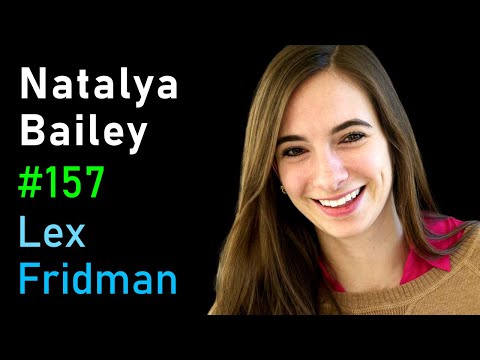
Natalya Bailey: Rocket Engines and Electric Spacecraft Propulsion | Lex Fridman Podcast #157
Lex Fridman (host), Natalya Bailey (guest)
In this episode of Lex Fridman Podcast, featuring Lex Fridman and Natalya Bailey, Natalya Bailey: Rocket Engines and Electric Spacecraft Propulsion | Lex Fridman Podcast #157 explores rocket Scientist Natalya Bailey Redefines Space Travel With Electric Propulsion Lex Fridman and rocket propulsion engineer Natalya Bailey explore the engineering and philosophy of moving humans and robots through space, focusing on electric and ion-based propulsion systems. They contrast chemical rockets used for launch with efficient in-space electric engines such as ion thrusters and Bailey’s own colloid electrospray technology. The discussion widens to include extraterrestrial life, colonizing Mars, nuclear power in space, and long-term visions for interstellar travel. Bailey also reflects on startups, culture, and the deeper meaning of scientific work as building humanity’s collective knowledge.
Rocket Scientist Natalya Bailey Redefines Space Travel With Electric Propulsion
Lex Fridman and rocket propulsion engineer Natalya Bailey explore the engineering and philosophy of moving humans and robots through space, focusing on electric and ion-based propulsion systems. They contrast chemical rockets used for launch with efficient in-space electric engines such as ion thrusters and Bailey’s own colloid electrospray technology. The discussion widens to include extraterrestrial life, colonizing Mars, nuclear power in space, and long-term visions for interstellar travel. Bailey also reflects on startups, culture, and the deeper meaning of scientific work as building humanity’s collective knowledge.
Key Takeaways
Electric propulsion trades raw thrust for extreme fuel efficiency in space.
Chemical rockets are noisy and powerful but burn a lot of propellant quickly, making them ideal for launch; once in orbit, electric systems like ion or colloid thrusters provide tiny but continuous thrust that can reach very high speeds over time with far less fuel.
Get the full analysis with uListen AI
Colloid (electrospray) engines use charged particles from liquids, not gas.
Bailey’s technology pulls ions from ionic liquids at nano-scale Taylor cones formed on microfabricated tips, then accelerates them with electric fields—enabling very compact, mass-producible thrusters suited for small satellites.
Get the full analysis with uListen AI
Power, not propulsion physics, is now a major bottleneck for deep-space missions.
Electric engines could do much more if spacecraft carried denser, more compact power sources; solar panels and batteries are limiting, so safe, small nuclear reactors in space would unlock higher-thrust, still-efficient missions.
Get the full analysis with uListen AI
Orbital traffic and debris already require active maneuvering and better norms.
Satellites in low earth orbit perform multiple collision-avoidance maneuvers per year, while many cheaper small sats can’t maneuver at all—raising the risk of debris cascades and underscoring the need for propulsion and responsible end-of-life plans.
Get the full analysis with uListen AI
Cost compression in space hardware forces radically different engineering approaches.
Where traditional ion engines cost tens of millions, new-space customers may only pay around $10,000, so companies like Accion rely on semiconductor-style batch fabrication instead of bespoke, hand-built hardware to stay viable.
Get the full analysis with uListen AI
A strong, authentic vision and culture are critical to surviving startup turbulence.
Bailey emphasizes that a compelling mission is what gets teams through inevitable setbacks, and that culture is shaped by founders’ everyday behavior, not by later “slapped-on” HR fixes—founders must invest early in people and self-awareness.
Get the full analysis with uListen AI
Bailey sees humanity’s meaning in knowledge creation and kindness, not mere survival.
She argues we’ve moved beyond being just reproductive ‘bacteria in a Petri dish’; what justifies our existence is expanding and preserving understanding of the universe and improving the human condition through cooperation and empathy.
Get the full analysis with uListen AI
Notable Quotes
“The basic principle is conservation of momentum: you throw stuff out the back of the engine and that pushes the rocket in the other direction.”
— Natalya Bailey
“I almost wonder, are we putting unnecessary obstacles, like very finicky biological things, in the way of more robotic or silicon-based exploration?”
— Natalya Bailey
“Electric propulsion I find much more refreshingly poorly understood… that’s what I’m going to work on.”
— Natalya Bailey
“We’re just kind of at the very starting point of space exploration and science and understanding, so we should be spending more money there and not less.”
— Natalya Bailey
“In my day-to-day, [meaning] just boils down to the pursuit of knowledge or improving the human condition and being kind.”
— Natalya Bailey
Questions Answered in This Episode
How far can current electric propulsion and nuclear power concepts realistically take crewed missions in our lifetime, and what specific breakthroughs would be most transformative?
Lex Fridman and rocket propulsion engineer Natalya Bailey explore the engineering and philosophy of moving humans and robots through space, focusing on electric and ion-based propulsion systems. ...
Get the full analysis with uListen AI
What governance and ethical principles should guide decisions about permanently colonizing Mars or other worlds, given Bailey’s skepticism about spreading fragile human biology?
Get the full analysis with uListen AI
Could colloid and other micro-scale thrusters eventually enable fully autonomous, self-healing satellite swarms that manage debris and traffic without human intervention?
Get the full analysis with uListen AI
Where is the line between “legitimate long-shot physics” and pseudoscience when it comes to propellantless propulsion and faster-than-light travel ideas?
Get the full analysis with uListen AI
How can early-stage deep-tech founders practically balance big, inspiring visions with brutal cost pressures and the need to build a healthy culture from day one?
Get the full analysis with uListen AI
Transcript Preview
The following is a conversation with Natalia Bailey, a rocket scientist and spacecraft propulsion engineer previously at MIT, and now the founder and CTO of Axion Systems, specializing in efficient space propulsion engines for satellites and spacecraft. So, these are not the engines that get us from the ground on Earth out to space, but rather the engines that move us around in space once we get out there. Quick mention of our sponsors: Munk Pack low-carb snacks; Four Sigmatic mushroom coffee; Blinkist, an app that summarizes books; and Sunbasket, meal delivery service. So, the choice is snacks, caffeine, knowledge, or a delicious meal. Choose wisely, my friends. And if you wish, click the sponsor links below to get a discount and to support this podcast. As a side note, let me say something about Natalia's story. She has talked about how when she was young, she would often look up at the stars and dream of alien intelligences that one day we could communicate with. This moment of childlike cosmic curiosity is at the core of my own interest in space, in extraterrestrial life, and in general, in artificial intelligence, science, and engineering. Amid the meetings and the papers and the career rat race and all the awards, let's not let ourselves lose that childlike wonder. Sadly, we're on Earth for only a very short time, so let's have fun solving some of the biggest puzzles in the universe while we're here. If you enjoy this thing, subscribe on YouTube, review it on Apple Podcasts, follow on Spotify, support on Patreon, or connect with me on Twitter @lexfridman. And now, here's my conversation with Natalia Bailey. You said that you spent your whole life dreaming about space, and also pondering the big existential question of whether there is or isn't intelligent life, intelligent alien civilizations out there. So, what do you think? Do you think there's life out there? Intelligent life?
Intelligent life. That's trickier. I- I think looking at, you know, the- the likelihood of a self-replicating organism, given how much time the universe has exi- existed, and how many stars with planets, I think it's likely that there's other life. Intelligent life, I'm hopeful. You know, I'm a little discouraged that we haven't yet been in touch.
Uh, allegedly.
I remain hopeful.
I mean, d- it's also-
On the- in- in our dimensions-
Right.
... and so on, yeah.
It's also possible that, uh, they have been in touch and we just haven't ... we're too dumb to realize they're communicating with us, in whichever is the- it's the S- Carl Sagan idea that they may be communicating at a timescale that's totally different.
Yeah.
Like, their- their signals are on a totally different timescale, or on a, like, a totally different kind of medium of communication. It could be- it could be our own- it could be the birth of, like, human beings, like, that th- the- whatever the magic that makes us who we are, the collective intelligence thing, that could be aliens themselves. That could be the medium of communication. Like, the nature of our consciousness and intelligence itself is the medium of communication. And when-
Install uListen to search the full transcript and get AI-powered insights
Get Full TranscriptGet more from every podcast
AI summaries, searchable transcripts, and fact-checking. Free forever.
Add to Chrome