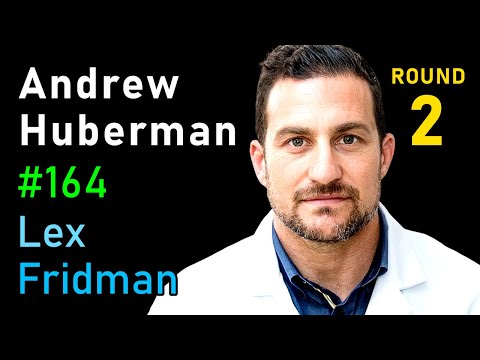
Andrew Huberman: Sleep, Dreams, Creativity, Fasting, and Neuroplasticity | Lex Fridman Podcast #164
Lex Fridman (host), Andrew Huberman (guest), Narrator, Narrator, Narrator, Narrator, Narrator
In this episode of Lex Fridman Podcast, featuring Lex Fridman and Andrew Huberman, Andrew Huberman: Sleep, Dreams, Creativity, Fasting, and Neuroplasticity | Lex Fridman Podcast #164 explores huberman Explains Sleep, Stress, Fasting, Plasticity, and Pushing Limits Andrew Huberman and Lex Fridman dive deeply into the neuroscience of sleep, circadian rhythms, temperature regulation, and how these systems evolved to optimize human health and performance.
Huberman Explains Sleep, Stress, Fasting, Plasticity, and Pushing Limits
Andrew Huberman and Lex Fridman dive deeply into the neuroscience of sleep, circadian rhythms, temperature regulation, and how these systems evolved to optimize human health and performance.
They connect sleep architecture, REM dreams, and non-sleep deep rest to learning, emotional processing, and recovery, while also challenging overly rigid cultural narratives about “perfect” sleep.
The conversation broadens into fasting, nutrition, hormones, breathing, and stress, linking concrete mechanisms (dopamine, serotonin, acetylcholine, testosterone, cortisol) to subjective experiences like effort, happiness, anger, and creativity.
They repeatedly circle back to practical applications: how to better structure sleep, naps, focus, training, and even extreme challenges (like David Goggins’ 4x4x48 run) to leverage neuroplasticity and sustain high performance.
Key Takeaways
Align sleep with circadian temperature rhythms and morning light.
Sleep pressure builds via adenosine the longer you’re awake, but how sleepy you feel depends strongly on where you are in your 24‑hour body-temperature cycle. ...
Get the full analysis with uListen AI
Cooler environments and strategic naps or NSDR significantly deepen recovery.
Dropping core and brain temperature by 2–3°F facilitates sleep onset and deep sleep; cooler rooms with warm covers often work best. ...
Get the full analysis with uListen AI
Don’t obsess over perfect sleep; anxiety about sleep often does more harm than missing an hour.
Huberman argues that cultural messaging has over-pathologized imperfect sleep. ...
Get the full analysis with uListen AI
REM dreams help detach emotion from memories; chronically losing REM makes you irritable and emotionally rigid.
Slow-wave sleep early in the night supports physical repair and certain learning, whereas REM later in the night replays experiences with low adrenaline, allowing you to ‘re-experience’ intense events without full bodily stress. ...
Get the full analysis with uListen AI
Happiness, purpose, and gratitude are powerful performance chemicals, not just feel‑good slogans.
Dopamine is biochemically upstream of adrenaline; enjoying what you’re doing increases dopamine, which in turn replenishes your capacity for effort. ...
Get the full analysis with uListen AI
Fasting and low‑carb windows heighten alertness; big mixed meals bias you toward sleepiness.
Fasting increases epinephrine and alertness to drive food‑seeking behavior, which many people experience as mental clarity. ...
Get the full analysis with uListen AI
Breath control offers a moment‑to‑moment lever on heart rate and effort.
Inhaling speeds heart rate; exhaling slows it. ...
Get the full analysis with uListen AI
Neuroplasticity in adults hinges on focused attention plus specific neuromodulators like acetylcholine.
Basal forebrain acetylcholine release flags specific events as important and drives re‑wiring in cortex, enabling rapid, sometimes single‑trial learning. ...
Get the full analysis with uListen AI
Notable Quotes
“Plasticity is a state within which you can direct neurology.”
— Andrew Huberman
“When effort feels good, life just gets way better.”
— Andrew Huberman
“There’s no IRS for sleep, so what does it mean to be in debt for sleep?”
— Andrew Huberman
“Better living through chemistry still requires better living.”
— Andrew Huberman, quoting a physician colleague
“You can’t trick the system. You can’t pretend that you’re grateful for something. But if you can identify or attach yourself to some larger goal... that’s accessing the deepest components of your nervous system.”
— Andrew Huberman
Questions Answered in This Episode
How much should individuals prioritize strict sleep schedules versus adapting dynamically to life demands while using tools like naps and NSDR?
Andrew Huberman and Lex Fridman dive deeply into the neuroscience of sleep, circadian rhythms, temperature regulation, and how these systems evolved to optimize human health and performance.
Get the full analysis with uListen AI
Could non-hallucinogenic psychedelics or targeted neurostimulation plus behavioral protocols become standard tools for accelerating learning and treating trauma?
They connect sleep architecture, REM dreams, and non-sleep deep rest to learning, emotional processing, and recovery, while also challenging overly rigid cultural narratives about “perfect” sleep.
Get the full analysis with uListen AI
What are the ethical and safety boundaries around using pharmacology (e.g., nicotinic agents, hormones) deliberately to enhance plasticity and performance in healthy people?
The conversation broadens into fasting, nutrition, hormones, breathing, and stress, linking concrete mechanisms (dopamine, serotonin, acetylcholine, testosterone, cortisol) to subjective experiences like effort, happiness, anger, and creativity.
Get the full analysis with uListen AI
How can everyday people practically monitor and leverage their own circadian temperature minimum and light exposure to combat jet lag, shift work, or chronic fatigue?
They repeatedly circle back to practical applications: how to better structure sleep, naps, focus, training, and even extreme challenges (like David Goggins’ 4x4x48 run) to leverage neuroplasticity and sustain high performance.
Get the full analysis with uListen AI
To what extent can psychological framing—gratitude, purpose, anger, competition—be systematically harnessed like a ‘training protocol’ to change our baseline capacity for effort and resilience?
Get the full analysis with uListen AI
Transcript Preview
The following is a conversation with Andrew Huberman, his second time on the podcast. He's a neuroscientist at Stanford, a world-class researcher and educator, and now, he has a new podcast on YouTube and all the usual places called Huberman Lab that I can't recommend highly enough. Quick mention of our sponsors, Masterclass Online Courses, Four Sigmatic Mushroom Coffee, Magic Spoon Low Carb Cereal, and BetterHelp Online Therapy. Click the sponsor links to get a discount. By the way, Masterclass is testing to see if they want to support this podcast long-term, so if you're on the fence, now is the time to sign up. And I'm pretty sure Andrew will have a neuroscience masterclass on there soon enough, though his podcast is basically a weekly masterclass in itself. As a side note, let me say that Andrew is a friend and a new collaborator. We're working on a paper together about a topic we're both really passionate about, at the intersection of neuroscience and machine learning. But that's probably many months away from being published. Still, I'm really excited about this work. He's one of the smartest and kindest people I have the pleasure of talking to on this podcast, so I hope we'll talk many more times in the future. If you enjoy this thing, subscribe on YouTube, review it on Apple Podcasts, follow on Spotify, support me on Patreon, or connect with me on Twitter @LexFridman. And now, here's my conversation with Andrew Huberman. Why do humans need sleep? Let's, let's go with the big first question.
Okay well, the answer I'll start with is the one that I always default to when there's a why question, which is, uh, I wasn't consulted at the design phase.
(laughs)
So, (laughs) so, so I wriggle my way out of giving a absolute answer, right? But there's one mechanism that's very clear that's super important, which is that the longer we are awake, the more adenosine accumulates in our brain. And adenosine binds to adenosine receptors, no surprise there, and it creates the feeling of sleepiness, independent of time of day or night. So, there are two mechanisms. One is we get sleepy as adenosine accumulates. The longer we've been awake, the more adenosine has accumulated in our system. But how sleepy we get for a given amount of adenosine depends on where we are in this so-called circadian cycle. And the circadian cycle is just this very, very well-conserved oscillation. It's a temperature oscillation, where you go from a low point, typically if you're awake during the day and you're asleep at night, you'll, your lowest temperature point will be like 3:00 AM, 4:00 AM, and then your temperature will start to creep up as you wake up in the morning, and then it'll peak in the late afternoon, and then it'll start to drop again toward the evening and then you get s- sleep again. That oscillation in temperature takes 24 hours, plus or mi-
Install uListen to search the full transcript and get AI-powered insights
Get Full TranscriptGet more from every podcast
AI summaries, searchable transcripts, and fact-checking. Free forever.
Add to Chrome