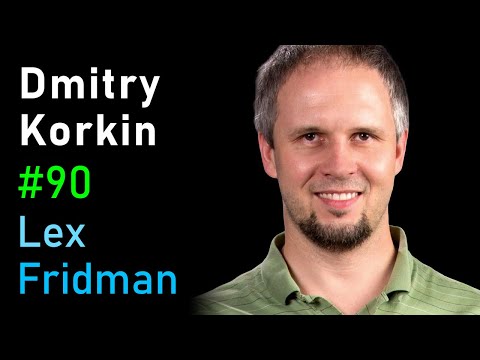
Dmitry Korkin: Computational Biology of Coronavirus | Lex Fridman Podcast #90
Lex Fridman (host), Dmitry Korkin (guest)
In this episode of Lex Fridman Podcast, featuring Lex Fridman and Dmitry Korkin, Dmitry Korkin: Computational Biology of Coronavirus | Lex Fridman Podcast #90 explores decoding Coronavirus: Computational Maps, Viral Evolution, and Pandemic Control Lex Fridman talks with computational biologist Dmitry Korkin about how bioinformatics and structural genomics are being used to understand SARS-CoV-2 and related viruses.
Decoding Coronavirus: Computational Maps, Viral Evolution, and Pandemic Control
Lex Fridman talks with computational biologist Dmitry Korkin about how bioinformatics and structural genomics are being used to understand SARS-CoV-2 and related viruses.
Korkin explains how his team rapidly modeled the 3D structures and interactions of coronavirus proteins using the viral genome and existing structural data, highlighting conserved drug-binding regions and mutation patterns.
They discuss the biology of viral infection, protein folding, prospects for antivirals and universal vaccines, and how open data and global scientific collaboration have accelerated COVID-19 research.
The conversation also touches on agent‑based epidemic simulations, the role of asymptomatic spread, the ethics and risks of engineered viruses, and reflections on human fragility in the face of simple yet powerful pathogens.
Key Takeaways
Computational models can rapidly map the structure of new viruses using existing data.
Once the genome of SARS-CoV-2 was released, Korkin’s group could infer 3D structures for many of its 29 proteins by homology to known coronavirus proteins, identifying functional sites and interaction patterns long before full experimental structures were available.
Get the full analysis with uListen AI
Many key drug-binding sites in SARS-CoV-2 are conserved from SARS, enabling drug repurposing.
By comparing sequences and projected structures, they found that regions where known small molecules bind in SARS and MERS are largely unchanged in SARS-CoV-2, suggesting existing antivirals (e. ...
Get the full analysis with uListen AI
Viral evolution is highly uneven across the genome, focusing on specific proteins and regions.
The team observed that some viral proteins are almost identical to their SARS/bat counterparts while others are heavily mutated, and that in 3D these mutations often cluster at functional or interaction sites, offering clues about changes in infectivity or host range.
Get the full analysis with uListen AI
Asymptomatic and pre-symptomatic transmission fundamentally changes epidemic control.
COVID-19’s long incubation and significant asymptomatic shedding make traditional containment (based mainly on symptom screening and isolation) much less effective, underscoring the importance of masks, distancing, and models that explicitly account for this phase.
Get the full analysis with uListen AI
Agent-based models that include explicit pathogen behavior can test intervention strategies.
Korkin’s group built multi-agent simulations (originally on cruise ships) where both humans and the virus are modeled as agents with behaviors (shedding rates, surface survival, transmission modes), allowing scenario testing for different diseases and control policies.
Get the full analysis with uListen AI
Open data resources and preprints greatly accelerate scientific progress during crises.
Shared infrastructures like the Protein Data Bank and rapid preprint posting allow global teams to build on each other’s structural, functional, and epidemiological findings in near real time, shifting focus from journal prestige to knowledge dissemination.
Get the full analysis with uListen AI
Viruses are simple but extraordinarily efficient evolutionary machines, not autonomous life.
Korkin describes viruses as ‘intelligent machines’ whose power lies in doing a lot with very little information, hijacking host machinery instead of carrying their own; this simplicity makes them fragile yet evolutionarily agile and hard to suppress permanently.
Get the full analysis with uListen AI
Notable Quotes
““The virus itself… it’s not a living organism. It’s a machine… an intelligent machine.””
— Dmitry Korkin
““We should benefit tremendously by understanding the mechanisms by which the virus can jump… because all these answers would eventually lead to designing better vaccines. Hopefully universal vaccines.””
— Dmitry Korkin
““If you take this new virus and you take the closest relatives… the evolution is not occurring uniformly across the entire viral genome, but actually targets very specific proteins.””
— Dmitry Korkin
““Our understanding of the molecular mechanisms will allow us to have more efficient designs of vaccines. However, once you design the vaccine, it needs to be tested.””
— Dmitry Korkin
““It certainly makes me realize how fragile the human life is… we are fragile. We have to bond together as a society.””
— Dmitry Korkin
Questions Answered in This Episode
How might the conserved and mutated regions in SARS-CoV-2 influence which antivirals ultimately succeed or fail?
Lex Fridman talks with computational biologist Dmitry Korkin about how bioinformatics and structural genomics are being used to understand SARS-CoV-2 and related viruses.
Get the full analysis with uListen AI
What are the main technical and ethical barriers to developing a truly ‘universal’ vaccine for influenza or coronaviruses?
Korkin explains how his team rapidly modeled the 3D structures and interactions of coronavirus proteins using the viral genome and existing structural data, highlighting conserved drug-binding regions and mutation patterns.
Get the full analysis with uListen AI
In what ways could agent-based models with explicit pathogen agents improve real-time public health decision-making during future outbreaks?
They discuss the biology of viral infection, protein folding, prospects for antivirals and universal vaccines, and how open data and global scientific collaboration have accelerated COVID-19 research.
Get the full analysis with uListen AI
How do you balance the scientific value of studying gain-of-function mutations in viruses against the biosecurity risks they pose?
The conversation also touches on agent‑based epidemic simulations, the role of asymptomatic spread, the ethics and risks of engineered viruses, and reflections on human fragility in the face of simple yet powerful pathogens.
Get the full analysis with uListen AI
Given the success of open datasets like the Protein Data Bank, what should the permanent ‘post-COVID’ infrastructure for global biomedical data sharing look like?
Get the full analysis with uListen AI
Transcript Preview
The following is a conversation with Dmitry Korkin. He's a professor of bioinformatics and computational biology at WPI, Worcester Polytechnic Institute, where he specializes in bioinformatics of complex diseases, computational genomics, systems biology, and biomedical data analytics. I came across Dmitry's work when in February, his group used the viral genome of the COVID-19 to reconstruct the 3D structure of its major viral proteins and their interaction with the human proteins, in effect, creating a structural genomics map of the coronavirus and making this data open and available to researchers everywhere. We talked about the biology of COVID-19, SARS, and viruses in general, and how computational methods can help us understand their structure and function in order to develop antiviral drugs and vaccines. This conversation was recorded recently in the time of the coronavirus pandemic. For everyone feeling the medical, psychological, and financial burden of this crisis, I'm sending love your way. Stay strong. We're in this together. We'll beat this thing. This is the Artificial Intelligence Podcast. If you enjoy it, subscribe on YouTube, review it with five stars in Apple Podcasts, support it on Patreon, or simply connect with me on Twitter @lexfridman, spelled F-R-I-D-M-A-N. This show is presented by Cash App, the number one finance app in the App Store. When you get it, use code LEXPODCAST. Cash App lets you send money to friends, buy Bitcoin, and invest in the stock market with as little as one dollar. Since Cash App allows you to buy Bitcoin, let me mention that cryptocurrency in the context of the history of money is fascinating. I recommend A Cent of Money as a great book on this history. Debits and credits on ledgers started around 30,000 years ago, the U.S. dollar, created over 200 years ago, and Bitcoin, the first decentralized cryptocurrency, released just over 10 years ago. So given that history, cryptocurrency is still very much in its early days of development, but it's still aiming to, and just might, redefine the nature of money. So again, if you get Cash App from the App Store or Google Play, and use the code LEXPODCAST, you get ten dollars, and Cash App will also donate ten dollars to FIRST, an organization that is helping to advance robotics and STEM education for young people around the world. And now, here's my conversation with Dmitry Korkin. Do you find viruses terrifying or fascinating?
When I think about viruses, I think about them... I mean, I imagine them as those villains that do their work so perfectly well that's, that is impossible not to be fascinated with them.
So what do you imagine when you think about a virus? Do you imagine the individual, sort of these 100 nanometer particle things? Or do you imagine the whole pandemic, like society level? The... When you say, "The efficiency at which they do their work," do you think of viruses as the millions that im- in... that occupy a human body or a living organism, society level, like spreading as a pandemic, or do you think of the individual little guy?
Install uListen to search the full transcript and get AI-powered insights
Get Full TranscriptGet more from every podcast
AI summaries, searchable transcripts, and fact-checking. Free forever.
Add to Chrome