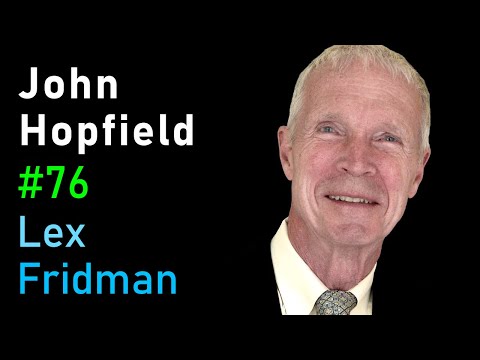
John Hopfield: Physics View of the Mind and Neurobiology | Lex Fridman Podcast #76
Lex Fridman (host), John Hopfield (guest), Narrator
In this episode of Lex Fridman Podcast, featuring Lex Fridman and John Hopfield, John Hopfield: Physics View of the Mind and Neurobiology | Lex Fridman Podcast #76 explores physicist John Hopfield on brains, networks, consciousness, and complexity’s laws John Hopfield and Lex Fridman explore how a physicist’s mindset can illuminate the brain, cognition, and artificial intelligence. Hopfield contrasts messy, evolution-shaped biological neural networks with today’s clean, simplified artificial networks, emphasizing feedback, rhythms, and collective dynamics that current AI largely ignores. He explains associative memory and attractor networks as physically grounded metaphors for robust computation, while stressing that his famous Hopfield networks model recall, not realistic learning. The conversation extends to consciousness, free will, brain-computer interfaces, and whether elegant, higher-level “equations of thought” might someday bridge molecules and mind.
Physicist John Hopfield on brains, networks, consciousness, and complexity’s laws
John Hopfield and Lex Fridman explore how a physicist’s mindset can illuminate the brain, cognition, and artificial intelligence. Hopfield contrasts messy, evolution-shaped biological neural networks with today’s clean, simplified artificial networks, emphasizing feedback, rhythms, and collective dynamics that current AI largely ignores. He explains associative memory and attractor networks as physically grounded metaphors for robust computation, while stressing that his famous Hopfield networks model recall, not realistic learning. The conversation extends to consciousness, free will, brain-computer interfaces, and whether elegant, higher-level “equations of thought” might someday bridge molecules and mind.
Key Takeaways
Biological brains exploit messy hardware and collective phenomena that AI ignores.
Evolution turns molecular and cellular ‘glitches’ (like oscillations and synchrony) into useful computational features, whereas most artificial networks use idealized units without rhythms, spikes, or rich biophysical quirks.
Get the full analysis with uListen AI
Feedback and dynamics are central to real cognition, beyond pure feedforward nets.
Hopfield argues that thought involves ongoing internal dynamics, multiple clock cycles, and mental exploration (e. ...
Get the full analysis with uListen AI
Associative memory can be understood as energy-minimizing attractor dynamics.
Hopfield networks show how partial, noisy cues can reliably retrieve full memories by relaxing into stable attractor states, providing a physical metaphor (energy landscapes and valleys) for robust recall and pattern completion.
Get the full analysis with uListen AI
Current deep learning is powerful but fundamentally constrained by its training distribution.
Modern networks interpolate within their training data; they generally fail to infer ‘outside the distribution’ events (like a child following a ball into the street), highlighting a gap between pattern fitting and genuine understanding.
Get the full analysis with uListen AI
Real learning in the brain likely involves continuous synaptic change, not separate phases.
Unlike AI systems that alternate between training and inference, biological networks adjust synapses on overlapping time scales with neural activity, meaning learning and computation are intertwined processes.
Get the full analysis with uListen AI
A physics-style ‘understanding’ of mind seeks higher-level laws, not every detail.
Hopfield hopes for analogues of Navier–Stokes for the brain—equations describing collective neural behavior (like attractors and rhythms) that sit between molecular detail and full psychological description.
Get the full analysis with uListen AI
Consciousness may be a narrative overlay rather than the core of cognition.
Echoing views like Minsky’s, Hopfield notes that most heavy cognitive lifting appears non-conscious, and consciousness might be our post-hoc effort to explain actions already initiated by underlying neural processes.
Get the full analysis with uListen AI
Notable Quotes
“Adaptation is everything when you get down to it.”
— John Hopfield
“Understanding is more than just an enormous lookup table.”
— John Hopfield
“There are no collective properties used in artificial neural networks, in AI.”
— John Hopfield
“What I have done in science relies entirely on experimental and theoretical studies by experts… Experts are good at answering questions. If you’re brash enough, ask your own.”
— John Hopfield (quoted by Lex Fridman from Hopfield’s article ‘Now What?’
“I can only dream physics dreams.”
— John Hopfield
Questions Answered in This Episode
If we deliberately injected biological-style ‘messiness’—spikes, rhythms, and collective modes—into artificial networks, what new capabilities or failure modes might emerge?
John Hopfield and Lex Fridman explore how a physicist’s mindset can illuminate the brain, cognition, and artificial intelligence. ...
Get the full analysis with uListen AI
How could we design AI systems that can recognize when they are ‘out of distribution’ and respond cautiously, more like humans do?
Get the full analysis with uListen AI
What would a practical, physics-like ‘equation of mind’ look like, and how could we empirically discover its variables and dynamics?
Get the full analysis with uListen AI
Are there concrete experimental paths to test whether brain rhythms and synchrony are computationally essential or mostly epiphenomenal?
Get the full analysis with uListen AI
To what extent should future brain-computer interfaces aim to read and write at the level of collective patterns rather than individual neurons?
Get the full analysis with uListen AI
Transcript Preview
The following is a conversation with John Hopfield, professor at Princeton whose life's work weaved beautifully through biology, chemistry, neuroscience, and physics. Most crucially, he saw the messy world of biology through the piercing eyes of a physicist. He's perhaps best known for his work on associative neural networks, now known as Hopfield networks. They were one of the early ideas that catalyzed the development of the modern field of deep learning. As his 2019 Franklin Medal in Physics award states, "He applied concepts of theoretical physics to provide new insights on important biological questions in a variety of areas, including genetics and neuroscience with significant impact on machine learning." And as John says in his 2018 article titled Now What, his accomplishments (laughs) have often come about by asking that very question, "Now what?" And often responding by a major change of direction. This is the Artificial Intelligence podcast. If you enjoy it, subscribe on YouTube, give it five stars on Apple Podcast, support it on Patreon, or simply connect with me on Twitter, @lexfridman, spelled F-R-I-D-M-A-N. As usual, I'll do one or two minutes of ads now and never any ads in the middle that can break the flow of the conversation. I hope that works for you and doesn't hurt the listening experience. This show is presented by Cash App, the number one finance app in the App Store. When you get it, use code LEXPODCAST. Cash App lets you send money to friends, buy Bitcoin, and invest in the stock market with as little as $1. Since Cash App does fractional share trading, let me mention that the order execution algorithm that works behind the scenes to create the abstraction of fractional orders is, to me, an algorithmic marvel. So big props to the Cash App engineers for solving a hard problem that in the end provides an easy interface that takes a step up the next layer of abstraction over the stock market, making trading more accessible for new investors and diversification much easier. So again, if you get Cash App from the App Store or Google Play and use code LEXPODCAST, you'll get $10 and Cash App will also donate $10 to FIRST, one of my favorite organizations that is helping advance robotics and STEM education for young people around the world. And now here's my conversation with John Hopfield. What difference between biological neural networks and artificial neural networks is most captivating and profound to you? At the higher philosophical level. Let's not get technical just yet.
One of the things that very much intrigues me is the fact that neurons have all kinds of components, properties to them, and in evolutionary biology, if you have some little quirk in how y- y- how a molecule works or how a cell works, and it can be made use of, evolution will sharpen it up and make it into a f- a useful feature rather than a glitch. And so you expect in neurobiology for evolution to have captured all kinds of possibilities of getting neurons, of like how you get neurons to do things for you, and that aspect has been completely suppressed in artificial neural networks.
Install uListen to search the full transcript and get AI-powered insights
Get Full TranscriptGet more from every podcast
AI summaries, searchable transcripts, and fact-checking. Free forever.
Add to Chrome