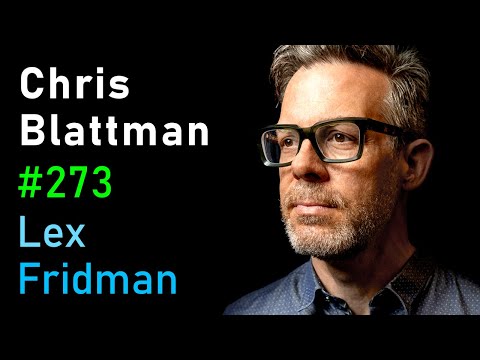
Chris Blattman: War and Violence | Lex Fridman Podcast #273
Lex Fridman (host), Chris Blattman (guest), Narrator, Narrator, Narrator, Narrator
In this episode of Lex Fridman Podcast, featuring Lex Fridman and Chris Blattman, Chris Blattman: War and Violence | Lex Fridman Podcast #273 explores why War Is Rare, Irrational, and Sometimes Tragically Chosen Anyway Lex Fridman and political economist Chris Blattman discuss why war is generally an irrational, costly last resort, and why, despite strong incentives to avoid it, societies still sometimes choose prolonged violent conflict.
Why War Is Rare, Irrational, and Sometimes Tragically Chosen Anyway
Lex Fridman and political economist Chris Blattman discuss why war is generally an irrational, costly last resort, and why, despite strong incentives to avoid it, societies still sometimes choose prolonged violent conflict.
Blattman outlines his five-part framework for the roots of war—three strategic (unchecked leaders, uncertainty, commitment problems) and two psychological (intangible values, misperceptions)—and applies it to contemporary and historical cases.
They analyze the Russia–Ukraine war, World War II, civil wars, gang and cartel violence in places like Medellín, and the Israel–Palestine conflict, emphasizing how often rival groups actually “loathe in peace” rather than fight.
The conversation also explores how institutions, interdependence, accountable leadership, and better information can reduce the risk of war, including nuclear war, and how personal choices and vocations intersect with studying violence and peace.
Key Takeaways
War is usually an inefficient, avoidable outcome, not the human norm.
Blattman stresses that for most rival groups, the costs of prolonged violence vastly outweigh the benefits, so they typically find ways to bargain, threaten, and ‘loathe in peace’ rather than actually fight; wars are the rare breakdowns we need to explain.
Get the full analysis with uListen AI
Five main forces override incentives for peace and push groups into war.
He groups causes into five ‘buckets’: unchecked leaders who don’t bear full costs, uncertainty and bad information, commitment problems (fearing future power shifts), deeply held values or principles that outweigh material costs, and misperceptions or irrational judgments.
Get the full analysis with uListen AI
Unchecked, unaccountable power is a meta‑cause behind much violence.
Autocrats and narrow elites can externalize war’s costs and pursue private goals (regime security, glory, ideological projects), which narrows the space for peaceful bargains and magnifies the impact of misperceptions, propaganda, and bad information.
Get the full analysis with uListen AI
Noble resistance and intransigence can rationally choose costly war.
Cases like Ukraine’s refusal to submit to Russian demands or Churchill’s Britain standing up to Nazi Germany show that when principles like sovereignty or liberty are valued enough, groups may ‘rationally’ choose to fight despite near‑certain suffering.
Get the full analysis with uListen AI
Uncertainty and signaling games explain many short, revealing wars.
Because each side has incentives to bluff about its strength and resolve, and limited incentives to reveal the truth, conflicts can resemble poker: sometimes war becomes the (tragically) optimal way to find out who is actually prepared to fight and at what cost.
Get the full analysis with uListen AI
Institutions and interdependence can mitigate the roots of war.
Constitutions, international organizations, sanctions, mediation, and economic/social interdependence all help address unchecked power, commitment problems, and uncertainty—though imperfectly—reducing both the likelihood and expected duration of wars.
Get the full analysis with uListen AI
Gang and cartel ‘governance’ mirrors international politics in miniature.
Blattman’s work in Medellín shows how mafia umbrellas and prison‑based ‘councils’ coordinate local gangs, enforce deals, and sometimes broker peace—using tools analogous to UN Security Council politics, sanctions, and peacekeeping, but in illicit markets.
Get the full analysis with uListen AI
Notable Quotes
“We overestimate how likely it is sides are going to fight. Most of the time, they just loathe in peace.”
— Chris Blattman
“Fighting is just politics by other means—and it’s inefficient, costly, brutal, devastating means.”
— Chris Blattman
“If I had to say the fundamental cause of most violence in the world, I think it’s unaccountable power.”
— Chris Blattman
“Maybe I’d like to think I’d make that same decision, but that is the answer: Ukrainians weren’t willing to give Russia the thing that their power said they ‘deserved.’”
— Chris Blattman
“The fact that [the risk of nuclear war] is not zero should deeply, deeply scare us all, and we should devote a lot of energy to making it zero again.”
— Chris Blattman
Questions Answered in This Episode
How far should a people go in sacrificing lives and wellbeing to defend principles like sovereignty or liberty before compromise becomes the more ethical choice?
Lex Fridman and political economist Chris Blattman discuss why war is generally an irrational, costly last resort, and why, despite strong incentives to avoid it, societies still sometimes choose prolonged violent conflict.
Get the full analysis with uListen AI
Given Blattman’s five root causes of war, which are most tractable to policy intervention, and what concrete reforms would meaningfully reduce the risk of great‑power conflict?
Blattman outlines his five-part framework for the roots of war—three strategic (unchecked leaders, uncertainty, commitment problems) and two psychological (intangible values, misperceptions)—and applies it to contemporary and historical cases.
Get the full analysis with uListen AI
Are there cases where ‘noble intransigence’ has clearly made a situation worse in the long run, and how can societies distinguish between courageous resistance and destructive stubbornness?
They analyze the Russia–Ukraine war, World War II, civil wars, gang and cartel violence in places like Medellín, and the Israel–Palestine conflict, emphasizing how often rival groups actually “loathe in peace” rather than fight.
Get the full analysis with uListen AI
What practical steps could global institutions or major powers take now to lower the nonzero probability of nuclear war that Blattman finds so troubling?
The conversation also explores how institutions, interdependence, accountable leadership, and better information can reduce the risk of war, including nuclear war, and how personal choices and vocations intersect with studying violence and peace.
Get the full analysis with uListen AI
How can insights from gang and cartel conflict management—like third‑party enforcement and credible sanctions—be ethically adapted to interstate disputes without empowering the wrong actors?
Get the full analysis with uListen AI
Transcript Preview
What are your thoughts on the ongoing war in Ukraine? How do you analyze it within your framework about war?
How far would they go to hang onto power when push came to shove, is I think the thing that worries me the most, and is plainly what worries most people about the risk of nuclear war. Like, at what point does that unchecked leadership decide that this is worth it? Especially if they can emerge from the rubble still on top.
The following is a conversation with Chris Blattman, professor at the University of Chicago, studying the causes and consequences of violence and war. This he explores in his new book called Why We Fight: The Roots of War and the Paths to Peace. The book comes out on April 19th, so you should pre-order it to support Chris and his work. This is the Lex Fridman podcast. To support it, please check out our sponsors in the description, and now, dear friends, here's Chris Blattman. In your new book, titled Why We Fight: The Roots of War and the Paths for Peace, you write, quote, "Let me be clear what I mean when I say 'war.' I don't just mean countries duking it out. I mean any kind of prolonged, violent struggle between groups. That includes villages, clans, gangs, ethnic groups, religious sects, political factions, and nations. Wildly different as these may be, their origins have much in common. We'll see that the Northern Irish zealots, Colombian cartels, European tyrants, Liberian rebels, Greek oligarchs, Chicago gangs, Indian mobs, Rwandan genocidaires..." A new word I learned, thank you to you.
(laughs)
Those are people who administer genocide. "English soccer hooligans, and American invaders." So first, let me ask, what is war? In saying that war is a prolonged violent struggle between groups, what do the words "prolonged," "groups," and "violent" mean?
I sit at this sort of intersection of economics and political science, and I, I also dwell a little bit in psychology, but that's partly because I'm married to a psychologist, sometimes do research with her. All these things are really different. So if you're a political scientist, you spend a lot of time just classifying a really narrow kind of conflict, and studying that. And that's, that's an important way to make progress, uh, as a social scientist. But I'm not trying to make progress. I'm trying to sort of help everybody step back and say, "You know what? There's, like, some common things that we know from these disciplines that, uh, relate to a really wide range of phenomena." Basically, we, we can talk about them in a very similar way, and we can get really similar insights. So I wanted to actually bring them together, but I still had to, like, say, "Let's hold out individual violence," which, you know, has a lot in common, but, but individuals choose to engage in violence for more and sometimes different reasons. So let's just put that aside so that we can focus a bit. And let's really put aside short incidents of violence, because those might have the same kind of things explaining them, but actually, there's a lot of other things that can explain short violence. Short violence can be really, uh, demonstrative. Like, you can just... I can use it to communicate information. The thing that all of it has in common is that it doesn't generally make sense. It's not your best option, most of the time. And so I wanted to say, "Let's take this thing that should be puzzling." We, we, we kind of think it's normal. We kind of think this is what all humans do. Uh, but let's point out that it's not normal, and then figure out why, and let's talk about why. And so that's... So I was trying to throw out the, the short violence. I was trying to thr- throw out the individual violence. I was also trying to throw out all the competition that happens that's not violent. That's, that's the normal, normal competition. I was trying to say, "Let's talk about violent competition," 'cause that's kind of the puzzle.
Install uListen to search the full transcript and get AI-powered insights
Get Full TranscriptGet more from every podcast
AI summaries, searchable transcripts, and fact-checking. Free forever.
Add to Chrome