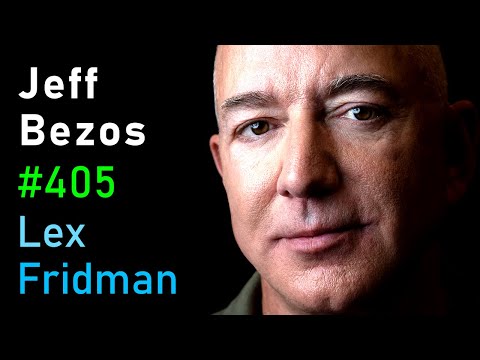
Jeff Bezos: Amazon and Blue Origin | Lex Fridman Podcast #405
Lex Fridman (host), Jeff Bezos (guest), Narrator
In this episode of Lex Fridman Podcast, featuring Lex Fridman and Jeff Bezos, Jeff Bezos: Amazon and Blue Origin | Lex Fridman Podcast #405 explores jeff Bezos on invention, rockets, and building for 10,000 years Jeff Bezos reflects on his formative childhood on a Texas ranch, crediting his grandfather’s extreme resourcefulness with shaping his problem‑solving mindset and self‑reliance. He lays out his long‑term vision for space: trillions of humans living in O’Neill colonies, heavy industry moved off‑Earth, and Blue Origin as infrastructure that enables future entrepreneurs. He dives into the technical and organizational challenges of building reusable rockets and lunar landers, emphasizing cost reduction, rate manufacturing, and decisive, truth‑seeking cultures. Beyond space, Bezos discusses Amazon’s ‘Day One’ philosophy, memo‑driven decision‑making, AI’s promise and risks, long‑term thinking symbolized by a 10,000‑year clock, and how he now spends his time pushing Blue Origin to move much faster.
Jeff Bezos on invention, rockets, and building for 10,000 years
Jeff Bezos reflects on his formative childhood on a Texas ranch, crediting his grandfather’s extreme resourcefulness with shaping his problem‑solving mindset and self‑reliance. He lays out his long‑term vision for space: trillions of humans living in O’Neill colonies, heavy industry moved off‑Earth, and Blue Origin as infrastructure that enables future entrepreneurs. He dives into the technical and organizational challenges of building reusable rockets and lunar landers, emphasizing cost reduction, rate manufacturing, and decisive, truth‑seeking cultures. Beyond space, Bezos discusses Amazon’s ‘Day One’ philosophy, memo‑driven decision‑making, AI’s promise and risks, long‑term thinking symbolized by a 10,000‑year clock, and how he now spends his time pushing Blue Origin to move much faster.
Key Takeaways
Cultivate extreme resourcefulness and self‑reliance to build problem‑solving confidence.
Bezos’ grandfather built tools, repaired a dead bulldozer from mail‑order parts, and refused to ‘just call someone’—teaching that most hard problems yield to persistence, ingenuity, and a willingness to figure things out yourself.
Get the full analysis with uListen AI
Separate invention from incremental improvement, and deliberately allow ‘wandering’.
He distinguishes real lateral invention from routine optimization, arguing that breakthrough ideas require time and permission to wander, group ‘whiteboard’ sessions, and protecting fragile early ideas from being killed by obvious objections.
Get the full analysis with uListen AI
Design your organization around two‑way vs one‑way door decisions.
Most decisions are reversible and should be made quickly by small, decentralized teams; only a minority are hard‑to‑reverse ‘one‑way doors’ that deserve slow, heavyweight processes and executive attention.
Get the full analysis with uListen AI
Use written narratives and truth‑seeking rituals to improve decision quality.
Amazon and Blue Origin use six‑page narrative memos read in silent ‘study hall’ at the start of meetings, forcing clear thinking from authors and enabling deeper, less sales‑driven discussion than slide decks.
Get the full analysis with uListen AI
Treat metrics as proxies, not reality, and constantly re‑validate them against anecdotes.
Bezos warns that organizations drift into managing to outdated metrics; when data and customer anecdotes conflict—like ‘short’ call wait times that were actually 10+ minutes—he says to doubt the metric and re‑examine what you measure.
Get the full analysis with uListen AI
To make space sustainable, drive costs down through reusability and rate manufacturing.
Technically reaching orbit is a solved problem; the frontier is drastically lowering cost via reusable stages (like New Glenn’s booster), smart materials, and factories capable of producing stages and engines at predictable high cadence.
Get the full analysis with uListen AI
Anchor strategy on what won’t change for your customers over decades.
For Amazon retail, Bezos focused relentlessly on enduring desires—low prices, fast delivery, and vast selection—arguing these stable truths deserve disproportionate investment compared to fads or short‑term optimizations.
Get the full analysis with uListen AI
Think in multi‑decade and even millennial timeframes to tackle ‘impossible’ problems.
He sees long‑term thinking as a force multiplier: a 10,000‑year clock is meant to nudge civilization toward longer horizons, which are necessary to justify building space infrastructure, moving industry off‑planet, and averting self‑destruction.
Get the full analysis with uListen AI
Notable Quotes
“There are a thousand ways to be smart.”
— Jeff Bezos
“Invention and efficiency are sort of at odds, because real invention requires wandering.”
— Jeff Bezos
“If I’m not ready to go [on New Shepard], then I wouldn’t want anyone to go.”
— Jeff Bezos
“Long‑term thinking is a giant lever. You can literally solve problems if you think long term that are impossible to solve if you think short term.”
— Jeff Bezos
“Be stubborn on vision, but flexible on the details.”
— Jeff Bezos
Questions Answered in This Episode
How realistic is Bezos’s vision of a trillion humans in O’Neill colonies, and what intermediate milestones would we need to hit in the next 50 years?
Jeff Bezos reflects on his formative childhood on a Texas ranch, crediting his grandfather’s extreme resourcefulness with shaping his problem‑solving mindset and self‑reliance. ...
Get the full analysis with uListen AI
Where is the line between acceptable risk and excessive risk for human spaceflight, especially in tourism versus exploration missions?
Get the full analysis with uListen AI
How transferable are Amazon’s cultural tools—like narrative memos and ‘disagree and commit’—to small startups or non‑tech organizations?
Get the full analysis with uListen AI
Given AI’s ‘bullshitting’ tendencies, what governance or technical safeguards are most urgent to ensure it becomes a net positive for humanity?
Get the full analysis with uListen AI
Does focusing on extremely long time horizons (like 10,000 years) meaningfully change present‑day decisions, or does it risk becoming symbolic rather than practical?
Get the full analysis with uListen AI
Transcript Preview
The following is a conversation with Jeff Bezos, founder of Amazon and Blue Origin. This is his first time doing a conversation of this kind and of this length. And as he told me, it felt like we could've easily talked for many more hours, and I'm sure we will. This is the Lex Fridman Podcast. And now, dear friends, here's Jeff Bezos. You spent a lot of your childhood with your grandfather on a ranch here in Texas.
Mm-hmm.
And I heard you had a, a lot of work to do around the ranch. So what's the coolest job you remember doing there?
Wow. Coolest? Um...
Most interesting.
(laughs)
Most memorable.
Most memorable.
Most impactful.
I mean, it was a, it was real, it's a real working ranch. Um, my gran... And I, I spent all my summers on that ranch from age four to 16. And my grandfather was really taking me those, in the summers. In the, in the early summers, he was letting me pretend to help on the ranch 'cause of course a four-year-old is a burden, not a help in real life. He'd been really just watching me and taking care of me. Um, uh, and he was doing that because my mom was so young. She had me when she was 17. And so he was sort of giving her a break. And my grandmother and my grandfather would take me for these summers. But as I got a little older, I actually was helpful on the ranch and I loved it. I was out there, like, my grandfather had a huge influence on me, huge factor in my life, and I did all the jobs you would do on a ranch. I've fixed windmills and laid fences and pipelines and, you know, done all the things that any rancher would do. Vaccinated the animals, everything. Um, uh, but we had a, you know, my grandfather... After my grandmother died, um, I was about 12, and I kept coming to the ranch. So it was, then it was just him and me, just the two of us. And he was completely addicted to the soap opera The Days of Our Lives.
Yeah. Mm-hmm.
And we would go back to the ranch house every day around 1:00 PM or so to watch Days of Our Lives. Uh, like sands through an hourglass, so are the days of our lives. (laughs)
Just the image of that, the two of you sitting there-
(laughs)
... watching a soap opera-
He had these-
... two ranchers.
... big, crazy dogs. It was really a very formative experience for me. But the key thing about it, for me, the thi- the great gift I got from it was that my grandfather was so resourceful, you know. He did everything himself. He made his own veterinary tools. He would make needles to suture the cattle up with. Like, he would find a little piece of wire and heat it up and pound it thin and drill a hole in it and sharpen it. So, you know, you learn different things, um, on a ranch than you would learn, you know, growing up in a city.
Install uListen to search the full transcript and get AI-powered insights
Get Full TranscriptGet more from every podcast
AI summaries, searchable transcripts, and fact-checking. Free forever.
Add to Chrome