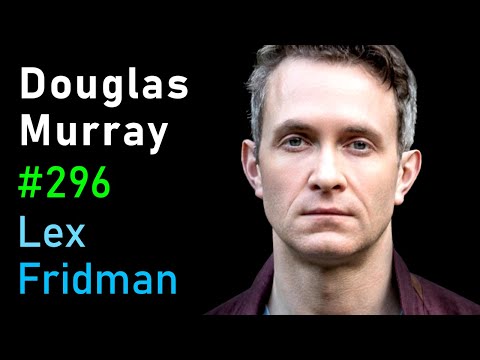
Douglas Murray: Racism, Marxism, and the War on the West | Lex Fridman Podcast #296
Douglas Murray (guest), Lex Fridman (host), Narrator, Narrator, Narrator, Narrator, Lex Fridman (host)
In this episode of Lex Fridman Podcast, featuring Douglas Murray and Lex Fridman, Douglas Murray: Racism, Marxism, and the War on the West | Lex Fridman Podcast #296 explores douglas Murray and Lex Fridman Clash Over Racism, Marxism, Meaning, Gratitude Lex Fridman and Douglas Murray explore the nature and values of Western civilization, arguing that its traditions of self-criticism, rule of law, and curiosity about the world are under coordinated cultural attack. Murray contends that contemporary anti‑racism and critical race theory often morph into a racialized moral hierarchy that uniquely condemns white people and deracinates Western history, clearing space for failed ideologies like Marxism to re‑emerge. They debate slavery, institutional racism, reparations, and antisemitism, and contrast the lessons (and non‑lessons) taken from fascism versus communism in the 20th century. The conversation ends on more personal terrain—resentment versus gratitude, love, reading, writing, and how individuals can resist crowd madness and find meaning in a fractured culture.
Douglas Murray and Lex Fridman Clash Over Racism, Marxism, Meaning, Gratitude
Lex Fridman and Douglas Murray explore the nature and values of Western civilization, arguing that its traditions of self-criticism, rule of law, and curiosity about the world are under coordinated cultural attack. Murray contends that contemporary anti‑racism and critical race theory often morph into a racialized moral hierarchy that uniquely condemns white people and deracinates Western history, clearing space for failed ideologies like Marxism to re‑emerge. They debate slavery, institutional racism, reparations, and antisemitism, and contrast the lessons (and non‑lessons) taken from fascism versus communism in the 20th century. The conversation ends on more personal terrain—resentment versus gratitude, love, reading, writing, and how individuals can resist crowd madness and find meaning in a fractured culture.
Key Takeaways
Western civilization has distinctive strengths that are being selectively forgotten.
Murray highlights rule of law, representative democracy, a ‘ravenous’ curiosity about other cultures, and a rare tradition of self‑criticism as core Western traits, arguing that these should be understood and preserved rather than dismissed as merely oppressive.
Get the full analysis with uListen AI
Slavery is a near‑universal human crime; the West’s uniqueness lies in abolishing it.
He stresses that many civilizations practiced slavery, but Western societies led the organized abolitionist movements; he warns that current discourse often erases this, framing slavery as an exclusively Western sin to justify contemporary moral condemnation.
Get the full analysis with uListen AI
Reparations and ‘hereditary guilt’ are practically unworkable and morally corrosive.
Murray argues current reparations proposals would amount to transferring wealth between people who merely resemble past oppressors and victims, entrenching racial resentment rather than addressing complex, multi‑factor inequities.
Get the full analysis with uListen AI
Critical race theory and activist ‘studies’ disciplines often prioritize ideology over truth-seeking.
He claims CRT began as an avowedly activist legal theory and spread into weak academic departments, incentivizing scholars to reinterpret everything through race and power rather than building knowledge, which undermines trust in academia.
Get the full analysis with uListen AI
Resentment is a powerful driver of political evil; gratitude is its antidote.
Drawing on Nietzsche and Dostoevsky, Murray sees resentment as the impulse to blame others for what you think you deserve, a sentiment that can fuel revolutions, racial politics, and personal stagnation; cultivating gratitude (individually and collectively) counters this rot.
Get the full analysis with uListen AI
We risk relearning only half the lessons of the 20th century.
Murray argues that while fascism and Nazism are widely taught and feared, communist atrocities (Mao, Stalin, etc. ...
Get the full analysis with uListen AI
A stable society needs shared facts, shared heroes, and honest debate about the past.
He warns that if Americans cannot agree on who won elections, or whether figures like Jefferson and Churchill were broadly admirable despite flaws, the national story fractures into warring narratives that make co‑existence and reform much harder.
Get the full analysis with uListen AI
Notable Quotes
“I will not have the entire landscape deracinated and then the worst ideas tried again.”
— Douglas Murray
“Resentment is one of the greatest drivers for people who want to destroy: blaming someone else for having something you believe you deserve more.”
— Douglas Murray
“You must spend an inordinate amount of your life trying to understand me personally… simultaneously, you’ll never understand me. This is not an attractive invitation.”
— Douglas Murray
“If you keep trying the same recipe and every time it comes out as shit, it’s that the recipe is shit.”
— Douglas Murray (on repeated Marxist experiments)
“Disagreement is not oppression. Argument is not assault. Words, even provocative and repugnant ones, are not violence. The answer to speech we do not like is more speech.”
— Douglas Murray (quoted by Lex Fridman at the end)
Questions Answered in This Episode
Where is the line between necessary self‑criticism of Western history and destructive cultural self‑hatred?
Lex Fridman and Douglas Murray explore the nature and values of Western civilization, arguing that its traditions of self-criticism, rule of law, and curiosity about the world are under coordinated cultural attack. ...
Get the full analysis with uListen AI
Can we design any form of reparations or redress that addresses historical injustice without creating new forms of racial resentment or ‘hereditary guilt’?
Get the full analysis with uListen AI
How should schools and universities teach about slavery, colonialism, fascism, and communism in a way that is both honest and non‑ideological?
Get the full analysis with uListen AI
Is it possible to preserve the insights of critical race theory (e.g., about structural bias) while discarding its most divisive or activist excesses?
Get the full analysis with uListen AI
What practical steps can individuals take to move from resentment toward gratitude in their own lives and political attitudes?
Get the full analysis with uListen AI
Transcript Preview
I think that some people are deliberately trying to completely clear the cultural landscape of our past in order to say there's nothing good, nothing you can hold onto, no one you should revere. You've got no heroes. The whole thing comes down. Who's left standing? Oh, we've also got this idea from the 20th century still about Marxism. And, and no, no. You, you, you, you w- I will not have the entire landscape deracinated and then the worst ideas tried again.
The following is a conversation with Douglas Murray, author of The Madness of Crowds: Gender, Race and Identity, and his most recent book, The War on the West: How to Prevail in the Age of Unreason. He's a brilliant, fearless, and often controversial thinker who points out and pushes back against what he sees as the madness of our modern world. I should note that the use of the word Marxism and the West in this conversation refers primarily to cultural Marxism and the cultural values of Western civilization respectively. This is in contrast to my previous conversation with Richard Wolff, where we focused on Marxism as primarily a critique of capitalism, and thus looking at it through the lens of economics and not culture. Nevertheless, these two episodes stand opposite of each other with very different perspectives on how we build a flourishing civilization together. I leave it to you, the listener, to think and to decide which is the better way. This is the Lex Fridman Podcast. To support it, please check out our sponsors in the description. And now, dear friends, here's Douglas Murray. You recently wrote the book titled The War on the West, which in part says that the values, ideas, and history of Western civilization are under attack. So, let's start with the basics. Historically and today, what are the ideas that represent Western civilization, the good, the bad, the ugly?
I actually don't get stuck on, um, definitions, precisely 'cause as you know, once you get stuck on definitions there's a possibility you'll never get off them.
Yes. (laughs)
Um, I'd say a few things. Firstly, uh, obviously the Western tradition is a specific tradition, a specific tradition of ideas, culture, well known to be perhaps easily defined by the combination of Athens and Jerusalem, the, the world of the Bible, and the world of ancient Greece and, and indeed Rome. Uh, effectively creates West, uh, creates European civilization, which itself spawns the rest of the Western civilizations: America, Canada, Australia, New Zealand, and others. Uh, but these are the main countries that we still refer to as, as the West. Um, so there's a specific tradition and all of the things that come from it. Uh, my shorthand cheat on this answer is to say, um, you know when you're not in it.
(laughs)
So if you've ever been to Beijing, Shanghai, it's like you know you're not in the West. You're somewhere else, but you know you're not in the West. When you're in Tokyo, you're somewhere extraordinary, but you know you're not in the West. Uh, obviously there are, um, let's say borderline questions, like is Russia in the West? Um, which I sort of leave open as a, as a question. Um, uh, possibly.
Install uListen to search the full transcript and get AI-powered insights
Get Full TranscriptGet more from every podcast
AI summaries, searchable transcripts, and fact-checking. Free forever.
Add to Chrome