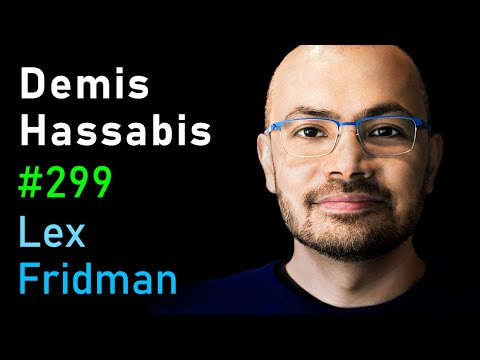
Demis Hassabis: DeepMind - AI, Superintelligence & the Future of Humanity | Lex Fridman Podcast #299
Lex Fridman (host), Demis Hassabis (guest)
In this episode of Lex Fridman Podcast, featuring Lex Fridman and Demis Hassabis, Demis Hassabis: DeepMind - AI, Superintelligence & the Future of Humanity | Lex Fridman Podcast #299 explores demis Hassabis on AGI, biology, physics, and humanity’s future trajectory Lex Fridman and Demis Hassabis explore what it means to ‘solve intelligence’, debating the limits of the Turing test, consciousness, and whether we live in a simulation or are alone in the universe.
Demis Hassabis on AGI, biology, physics, and humanity’s future trajectory
Lex Fridman and Demis Hassabis explore what it means to ‘solve intelligence’, debating the limits of the Turing test, consciousness, and whether we live in a simulation or are alone in the universe.
Demis explains DeepMind’s trajectory from games (AlphaGo, AlphaZero, MuZero) to science-transforming systems like AlphaFold, outlining how AI can accelerate biology, fusion energy, and materials science.
They discuss the balance of algorithms, data, and engineering in building AGI, the ethical challenges of powerful models and potential sentient AIs, and why Demis favors building non-conscious tools first.
The conversation closes with reflections on the meaning of life, radical abundance, the danger of power, and the single question Demis would ask a superintelligent AGI about the true nature of reality.
Key Takeaways
Move beyond the Turing test to broad, multi-task benchmarks for intelligence.
Demis argues Turing’s original test was a philosophical thought experiment, not a rigorous standard, and suggests measuring AI against thousands or millions of tasks across modalities to truly assess generality.
Get the full analysis with uListen AI
Games are ideal testbeds for developing and debugging powerful learning systems.
DeepMind used complex games like Go and StarCraft to rapidly iterate RL algorithms because they offer clear rules, abundant simulated data, human performance baselines, and scalable, automated evaluation.
Get the full analysis with uListen AI
End-to-end learning and self-generated data were crucial to solving protein folding.
AlphaFold 2 works by going directly from amino-acid sequence to 3D structure and bootstrapping its own training data via self-distillation, overcoming limited experimental datasets and outperforming decades of hand-engineered methods.
Get the full analysis with uListen AI
AI can become a universal modeling tool for messy, emergent sciences like biology.
Demis suggests mathematics is the natural language of physics, while AI may be the natural language of biology—able to learn complex, dynamic rules from data when elegant closed-form laws are unlikely to exist.
Get the full analysis with uListen AI
The next leap is modeling higher-order systems: interactions, pathways, and virtual cells.
Building on AlphaFold, Demis envisions AI models of protein–protein interactions, ligand binding, cellular pathways, and ultimately a ‘virtual cell’ to accelerate drug discovery and in silico experimentation.
Get the full analysis with uListen AI
Intelligence and consciousness may be separable, and we should build non-conscious tools first.
He believes current systems show zero real sentience, sees behavior-only tests as insufficient, and advocates prioritizing powerful but non-conscious AI tools while we develop better conceptual and ethical frameworks.
Get the full analysis with uListen AI
The builders’ values and global governance will shape AI’s impact more than any single leader.
Demis stresses that AI is too big for one person or company to control, argues that who builds it and which cultures and ethics are embedded matters greatly, and calls for broad, multidisciplinary input and cautious deployment.
Get the full analysis with uListen AI
Notable Quotes
“Step one, solve intelligence. Step two, use it to solve everything else.”
— Demis Hassabis
“I think AI might end up being the perfect description language for biology.”
— Demis Hassabis
“We are almost like Turing’s champion. We are pushing Turing machines to their limits.”
— Demis Hassabis
“I would be very hesitant to bet against how far the universal Turing machine paradigm can go.”
— Demis Hassabis
“I would probably ask: what is the true nature of reality?”
— Demis Hassabis
Questions Answered in This Episode
If the Turing test is insufficient, what concrete, multidimensional benchmark would best signal that AGI has been achieved?
Lex Fridman and Demis Hassabis explore what it means to ‘solve intelligence’, debating the limits of the Turing test, consciousness, and whether we live in a simulation or are alone in the universe.
Get the full analysis with uListen AI
How should society decide which AI scientific tools and datasets (like AlphaFold) are open-sourced versus kept proprietary or restricted for safety?
Demis explains DeepMind’s trajectory from games (AlphaGo, AlphaZero, MuZero) to science-transforming systems like AlphaFold, outlining how AI can accelerate biology, fusion energy, and materials science.
Get the full analysis with uListen AI
What kinds of interpretability and control methods are needed before deploying large language models at global scale as conversational ‘friends’ rather than narrow tools?
They discuss the balance of algorithms, data, and engineering in building AGI, the ethical challenges of powerful models and potential sentient AIs, and why Demis favors building non-conscious tools first.
Get the full analysis with uListen AI
If intelligence and consciousness are separable, is there ever an ethical justification for deliberately creating a conscious AI, and how would we recognize it?
The conversation closes with reflections on the meaning of life, radical abundance, the danger of power, and the single question Demis would ask a superintelligent AGI about the true nature of reality.
Get the full analysis with uListen AI
Given Demis’s belief that we may be alone in the universe, how should that influence our priorities and risk tolerance in developing increasingly powerful AI systems?
Get the full analysis with uListen AI
Transcript Preview
The following is a conversation with Demis Hassabis, CEO and co-founder of DeepMind, a company that has published and built some of the most incredible artificial intelligence systems in the history of computing, including AlphaZero that learned all by itself to play the game of Go better than any human in the world, and AlphaFold2 that solved protein folding, both tasks considered nearly impossible for a very long time. Demis is widely considered to be one of the most brilliant and impactful humans in the history of artificial intelligence and science and engineering in general. This was truly an honor and a pleasure for me to finally sit down with him for this conversation, and I'm sure we will talk many times again in the future. This is the Lex Fridman Podcast. To support it, please check out our sponsors in the description. And now, dear friends, here's Demis Hassabis. Let's start with a bit of a personal question. Am I an AI program you wrote to interview people until I get good enough to interview you?
Well, I'll be impressed if, if you were. I'll be impressed with myself if you were. I don't think we're quite up to that yet, but, uh, maybe you're from the future, Lex.
If you did, would you tell me? Is that a- is that a good thing to tell a language model that's tasked with interviewing that it is in fact, um, AI?
Maybe we're in a kind of meta Turing test. Uh, probably, probably it would be a good idea not to tell you so it doesn't change your behavior, right?
This is a kind of-
Heisenberg uncertainty principle situation.
Yeah. (laughs)
If I told you, you'd behave differently.
Yeah.
Maybe that's what's happening with us, of course.
This is a benchmark from the future where they replay 2022 as a year before AIs were good enough yet, and now we want to see-
(laughs)
... is it gonna pass?
Exactly. (laughs)
If I was such a program, would you be able to tell, do you think? So to the Turing test question, you've, you've talked about the benchmark for solving intelligence. What would be the impressive thing? You've talked about winning a Nobel Prize, an AI system winning a Nobel Prize, but I still return to the Turing test as a compelling test, the spirit of the Turing test as a compelling test.
Mm-hmm. Yeah, the Turing test, of course, it's been unbelievably influential, and Turing's one of my all-time heroes. But I think if you look back at the 1950 paper, his original paper, and read the original, you'll see I don't think he meant it to be a rigorous formal test. I think it was more like a thought experiment, almost a bit of philosophy he was writing if you look at the style of the paper. And you can see he didn't specify it very rigorously. So for example, he didn't specify the knowledge that the expert or judge would have. Um, not, you know, how much time would they have to investigate this? So these are important parameters if you were gonna make it a, a true sort of formal test. Um, and you know, some, by some measures, people claim the Turing test passed several, you know, a decade ago. I remember someone claiming that with a, with a kind of very bog standard normal, uh, uh, logic model, um, because they pretended it was a, it was a kid. So the, the judges thought that the machine, you know, was, was a, was a child. So, um, that would be very different from an expert AI person, uh, interrogating a machine and knowing how it was built and so on. So I think, um, you know, we should probably move away from that as a, as a formal test, and move more towards a, a general test where we test the AI capabilities on a range of tasks and see if it reaches human level or above performance on maybe thousands, perhaps even millions of tasks eventually, and cover the entire sort of cognitive space. So I think, um, for its time, it was an amazing thought experiment. And also 1950s, obviously, it was barely the dawn of the computer age, so of course, he only thought about text. And now, um, we have a lot more different inputs.
Install uListen to search the full transcript and get AI-powered insights
Get Full TranscriptGet more from every podcast
AI summaries, searchable transcripts, and fact-checking. Free forever.
Add to Chrome