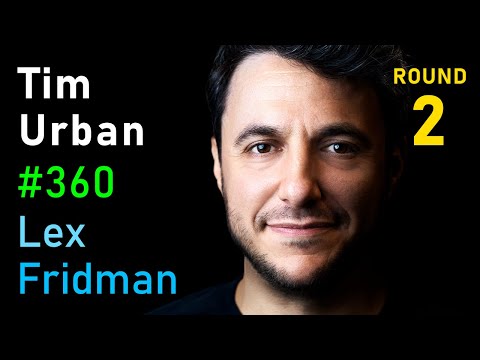
Tim Urban: Tribalism, Marxism, Liberalism, Social Justice, and Politics | Lex Fridman Podcast #360
Tim Urban (guest), Lex Fridman (host), Tim Urban's friend (guest, brief appearance) (guest), Tim Urban's partner / close friend (guest, brief appearance) (guest)
In this episode of Lex Fridman Podcast, featuring Tim Urban and Lex Fridman, Tim Urban: Tribalism, Marxism, Liberalism, Social Justice, and Politics | Lex Fridman Podcast #360 explores tim Urban dissects tribalism, wokeness, history, and saving liberalism Lex Fridman and Tim Urban use Urban’s new book, *What’s Our Problem?*, to explore human history, technological progress, and the fragile health of liberal democracy. They contrast “primitive mind” vs “higher mind” thinking, arguing that much of today’s political dysfunction stems from tribal, low-quality thought rather than particular left/right positions.
Tim Urban dissects tribalism, wokeness, history, and saving liberalism
Lex Fridman and Tim Urban use Urban’s new book, *What’s Our Problem?*, to explore human history, technological progress, and the fragile health of liberal democracy. They contrast “primitive mind” vs “higher mind” thinking, arguing that much of today’s political dysfunction stems from tribal, low-quality thought rather than particular left/right positions.
Urban outlines his “ladder” model (high-rung vs low-rung thinking), the difference between echo chambers and “idea labs,” and how social media, media incentives, and political polarization are eroding trust in institutions. He argues that a hybrid of Marxism and postmodernism underpins a new form of illiberal social justice activism that’s captured key institutions.
The conversation dives into conspiracy thinking, cancel culture, university speech norms, and the history of the Republican Party as examples of the larger dynamic: power games versus liberal games. Urban stresses that the core threat is not any one ideology but the breakdown of liberal norms and discourse needed to navigate exponential technologies.
They close by emphasizing awareness and courage at the individual and institutional level as the “immune system” of a liberal society, and Urban expresses cautious optimism about a future where technology could even conquer aging—if we stay wise enough to reach it.
Key Takeaways
Most of human history was static; our era is an explosive outlier.
Urban’s “1,000-page book” metaphor shows that almost all human existence was hunter‑gatherer stasis, with recorded history on the last ~25 pages and modern technological acceleration on the final page. ...
Get the full analysis with uListen AI
How we think (high‑rung vs low‑rung) matters more than what we think (left vs right).
Urban’s ladder contrasts higher-mind, evidence‑seeking, update‑friendly thinking with primitive‑mind, identity‑protecting, tribal thinking. ...
Get the full analysis with uListen AI
Good discourse cultures (idea labs) create collective intelligence; echo chambers create collective stupidity.
In an idea lab, people vigorously critique ideas while respecting people, leading to emergent “super-intelligence. ...
Get the full analysis with uListen AI
Cancel culture weaponizes social punishment, creating a gap between what people think and what they say.
Urban’s “King Mustache” and thought-pile/speech-curve models show how social sanctions (firings, pile‑ons) act like an “electric fence. ...
Get the full analysis with uListen AI
A new illiberal social justice ideology blends Marxism and postmodernism and has captured key institutions.
Urban distinguishes liberal social justice (MLK-style: using liberal principles to expand rights) from “social justice fundamentalism,” which views liberalism, science, and even reason as tools of oppression. ...
Get the full analysis with uListen AI
Media and political incentives reward outrage and loyalty, not truth and nuance.
From legacy TV to social platforms, institutions are rarely penalized for inaccuracy; they’re punished for deviating from their tribe’s orthodoxy. ...
Get the full analysis with uListen AI
Preserving liberal “games” is prerequisite to surviving exponential technologies.
Urban sees liberal democracy as a delicate machinery of institutions and trust that enables us to solve complex problems. ...
Get the full analysis with uListen AI
Awareness plus courage at small scales can reset cultural norms.
Urban argues individuals should (1) audit their own thinking and tribalism, (2) stop saying things they don’t believe, and (3) speak honestly—first in small groups, then publicly. ...
Get the full analysis with uListen AI
Universities risk training zealots on ‘Child’s Hill’ instead of thinkers on ‘Grownup Mountain.’
Ideally, college destabilizes overconfidence, pushes students into an ‘insecure canyon’ where they realize how little they know, and then helps them rebuild deeper understanding. ...
Get the full analysis with uListen AI
Notable Quotes
“A liberal democracy is a bunch of institutions crafted over hundreds of years that all rely on trust and a certain feeling of unity.”
— Tim Urban
“What matters way more than where you stand is how you got there.”
— Tim Urban
“People are respected in an idea lab and ideas are disrespected.”
— Tim Urban
“The dumbest thing we can do is get cocky and think, ‘Well, the last couple generations everything’s been fine.’”
— Tim Urban
“You’re so free in the US you’re actually free to be unfree if you choose.”
— Tim Urban
Questions Answered in This Episode
How can individuals practically move themselves—and their online communities—from low‑rung to high‑rung thinking?
Lex Fridman and Tim Urban use Urban’s new book, *What’s Our Problem? ...
Get the full analysis with uListen AI
What concrete reforms could universities adopt to restore genuine free inquiry without simply flipping to a different dogma?
Urban outlines his “ladder” model (high-rung vs low-rung thinking), the difference between echo chambers and “idea labs,” and how social media, media incentives, and political polarization are eroding trust in institutions. ...
Get the full analysis with uListen AI
Where do you draw the line between legitimate social consequences and destructive cancel culture in practice?
The conversation dives into conspiracy thinking, cancel culture, university speech norms, and the history of the Republican Party as examples of the larger dynamic: power games versus liberal games. ...
Get the full analysis with uListen AI
Is the current ‘immune system’ of liberalism strong enough to contain illiberal movements, or do we need entirely new institutions?
They close by emphasizing awareness and courage at the individual and institutional level as the “immune system” of a liberal society, and Urban expresses cautious optimism about a future where technology could even conquer aging—if we stay wise enough to reach it.
Get the full analysis with uListen AI
How should we balance rapid deployment of powerful technologies like AI with the cultural and institutional wisdom deficits Urban describes?
Get the full analysis with uListen AI
Transcript Preview
... of radical, um, political movement, of which there will always be a lot in the country, has managed to do something that, um, radical movements are not supposed to be able to do in the US, which is they've managed to hijack institutions all across the country and hijack medical journals-
Yeah.
... and universities, and, you know, the ACLU, you know, saying all the, you know, activist organizations and nonprofits and many tech companies. And the way I view a liberal democracy is, it isn't. It is, is a bunch of these institutions that were, that were trial and error crafted over h- you know, hundreds of years, and they all rely on trust, public trust, and a certain kind of feeling of unity that, that actually is critical to a liberal democracy's functioning.
Mm-hmm.
And what I see this thing is, is as a parasite on that, that whose goal is, and I'm not saying each indi- by the way, each individual in this is, I don't think they're bad people. I think that it's, it's the ideology itself has the property of its goal is to tear apart the pretty delicate workings of the liberal democracy and shred the critical lines of trust.
The following is a conversation with Tim Urban, his second time on the podcast. He's the author and illustrator of the amazing blog called Wait But Why?, and is the author of a new book coming out tomorrow called What's Our Problem?: A Self-Help Book for Societies. We talk a lot about this book in this podcast, but you really do need to get it and experience it for yourself. It is a fearless, insightful, hilarious, and I think important book in this divisive time that we live in. The Kindle version, the audiobook, and the web version should be all available on day of publication. I should also mention that my face might be a bit more beat up than usual. I got hit in the chin, uh, pretty good since I've been getting back into, uh, training jujitsu, a sport I love very much, after recovering from an injury. So if you see marks on my face during these intros or conversations, you know that, uh, um, my life is in a pretty good place. This is the Lex Fridman Podcast. To support it, please check out our sponsors in the description, and now, dear friends, here's Tim Urban. You wrote an incredible book called What's Our Problem?: A Self-Help Book for Societies. In the beginning, you, uh, present this view of, uh, human history as a thousand-page book where each page is 250 years, and it's a brilliant visualization because almost nothing happens for most of it. So what blows your mind most about that visualization when you just sit back and think about it?
It's a boring book. So 950 pages, 95% of the book, hunter-gatherers kinda doing their thing. I'm sure there's, you know, there's some, there's obviously some major cognitive and advancements along the way and language, and I'm sure, you know, the bow and arrow comes around at some point, you know, so, so, so tiny things but it's like, oh, now we have 400 pages till the next thing. Then you get to page 950 and things start moving.
Install uListen to search the full transcript and get AI-powered insights
Get Full TranscriptGet more from every podcast
AI summaries, searchable transcripts, and fact-checking. Free forever.
Add to Chrome