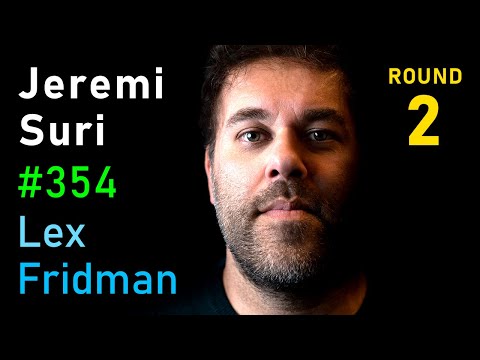
Jeremi Suri: Civil War, Slavery, Freedom, and Democracy | Lex Fridman Podcast #354
Jeremi Suri (guest), Lex Fridman (host), Narrator
In this episode of Lex Fridman Podcast, featuring Jeremi Suri and Lex Fridman, Jeremi Suri: Civil War, Slavery, Freedom, and Democracy | Lex Fridman Podcast #354 explores unfinished Civil War: Institutions, Myths, and America’s Fragile Democracy Historian Jeremi Suri and Lex Fridman explore how the American Civil War never truly ended, but shifted into a long institutional struggle over who counts in democracy and who holds power. Suri argues that flaws of exclusion, deference to status over merit, and patriotic myths are baked into U.S. institutions and still shape conflicts over race, freedom, and elections today. They discuss Lincoln’s leadership, Reconstruction’s failures, the rise of white supremacist violence, modern election crises, and how war centralizes power in ways dangerous to democracy. Throughout, they return to the need for “inside outsiders,” courageous storytelling, and a new generation to reform institutions without burning them down.
Unfinished Civil War: Institutions, Myths, and America’s Fragile Democracy
Historian Jeremi Suri and Lex Fridman explore how the American Civil War never truly ended, but shifted into a long institutional struggle over who counts in democracy and who holds power. Suri argues that flaws of exclusion, deference to status over merit, and patriotic myths are baked into U.S. institutions and still shape conflicts over race, freedom, and elections today. They discuss Lincoln’s leadership, Reconstruction’s failures, the rise of white supremacist violence, modern election crises, and how war centralizes power in ways dangerous to democracy. Throughout, they return to the need for “inside outsiders,” courageous storytelling, and a new generation to reform institutions without burning them down.
Key Takeaways
America’s institutions embed old exclusions that still distort democracy.
Suri identifies three deep flaws: systematic exclusion of many groups from full participation, power tied to status and position rather than competence, and patriotic myths that block honest self-critique. ...
Get the full analysis with uListen AI
The Civil War was fundamentally about freedom, not just slavery’s existence.
Framing the war as a fight over “slavery” centers white elites; seeing it as a war over freedom highlights enslaved people’s agency, especially the 100,000+ former slaves who fled plantations, joined the Union army, and fought for their own liberation. ...
Get the full analysis with uListen AI
Most wars don’t end cleanly; conflicts continue through institutions and memory.
Unlike World War II’s total defeat and clear settlements, the Civil War ended with Confederate elites returning home, often armed, and reentering power structures. ...
Get the full analysis with uListen AI
Romanticizing revolution and “burning it all down” usually empowers the worst actors.
Suri argues that history shows institutional collapse tends to advantage the already powerful and ruthless, as in the French and Russian revolutions. ...
Get the full analysis with uListen AI
White supremacy and racial terror were institutional, not fringe, in U.S. history.
Postwar groups like the KKK weren’t just hooded outsiders; they overlapped with sheriffs, judges, and business leaders, and used violence to keep former slaves and other minorities from voting or holding power. ...
Get the full analysis with uListen AI
The U.S. electoral system is structurally prone to disputed outcomes and mistrust.
Close elections in 1876 and 1888—and again in 2000 and 2020—expose vulnerabilities created by the Electoral College, decentralized county-controlled procedures, and complex rules. ...
Get the full analysis with uListen AI
Leadership and storytelling can either civilize our worst impulses or unleash them.
War and crisis amplify human capacities for both brutality and courage. ...
Get the full analysis with uListen AI
Notable Quotes
“If you love your country, you want to encourage your institutions to get better and better. That’s what true leadership is about, not just cheerleading.”
— Jeremi Suri
“I don’t think it’s a war about slavery. I think it’s a war about freedom.”
— Jeremi Suri
“The war continues after the battles end. Our system is built on the presumption that when we sign a piece of paper, everyone can go home. That’s not what happens.”
— Jeremi Suri
“I want to live in a society that’s pluralistic. A democratic society should be a society where people disagree, but can still work together.”
— Jeremi Suri
“The gift of the last few years is that we’ve been able to see the horror around us. Knowing there’s a problem, naming the problem, gives us a chance to fix the problem.”
— Jeremi Suri
Questions Answered in This Episode
If many of our core institutions are structurally flawed, what specific reforms would most effectively reduce exclusion and increase genuine democratic participation today?
Historian Jeremi Suri and Lex Fridman explore how the American Civil War never truly ended, but shifted into a long institutional struggle over who counts in democracy and who holds power. ...
Get the full analysis with uListen AI
How should we balance preserving historical figures like Lincoln or Jefferson with confronting their hypocrisies in education, monuments, and public memory?
Get the full analysis with uListen AI
What practical steps could the U.S. take to modernize elections—technologically and institutionally—without deepening partisan mistrust?
Get the full analysis with uListen AI
How can individuals cultivate the “inside outsider” role Suri praises, challenging their own institutions without becoming consumed by cynicism or tribalism?
Get the full analysis with uListen AI
To what extent are current culture wars and partisan divides truly new, versus recurrences of unresolved conflicts from Reconstruction and the post–Civil War era?
Get the full analysis with uListen AI
Transcript Preview
... the war continues after the battles end. This is something that's hard for Americans to understand. Our system is built with the presumption when war is over, when we s- sign a piece of paper-
Mm-hmm.
... everyone can go home. That's not what happens.
The following is a conversation with Jeremy Surrey, a historian at UT Austin. This is a Lex Fridman podcast. To support it, please check out our sponsors in the description, and now, dear friends, here's Jeremy Surrey. What is the main idea, the- the main case that you make in your new book, Civil War by Other Means: America's Long and Unfinished Fight for Democracy?
So our democratic institutions in the United States, they are filled with many virtues and many, uh, elements in their design that improve our society and allow for innovation, but they also have many flaws in them, as any institutions created by human beings have. And the flaws in our institutions go back to a number of judgments and perspectives that people in the 17th, 18th, and 19th centuries had, and those flaws have been built into our institutions and they continue to hinder innovation and growth in our society. Three of the flaws that I emphasize in this, uh, book are flaws of exclusion, the ways our institutions exclude people, not just African-Americans, many different groups, um, the ways our institutions also, uh, give power to certain people who have position rather than skill or intelligence or quality, and third, and most of all, the ways our institutions embed certain myths in our society, myths that prevent us from gaining the knowledge we need to improve our world. In all of these ways, our democracy is hindered by the false reverence for institutions that actually need to be reformed, just as we need to highlight the good elements of them. That's really what my book is about.
And then the myth, the- the- the false reverence, what are we talking about there?
So there's a way in which, uh, we believe that, uh, if we love our country, it's somehow wrong to criticize our institutions. I believe if you love your country, you want to encourage your institutions to get better and better. I love my university where I work, but I want it to be better. We have many flaws. I love my family, but I'm constantly telling family members how they can be better. Uh, that's what true knowledge leadership is about, not just cheerleading.
What's the counterpoint to that? 'Cause, uh, the other extreme is a- a deep, all-encompassing cynicism towards institutions. So for me, I like the idea of loving America, which seems to be sometimes a politicized statement these days, that you believe in the ideals of this country. That seems to be, um... that seems to be either a naive or a political statement the way it's interpreted. So the flip side of that, having a healthy skepticism of institutions is good, but having a complete paralyzing cynicism seems to be bad.
Install uListen to search the full transcript and get AI-powered insights
Get Full TranscriptGet more from every podcast
AI summaries, searchable transcripts, and fact-checking. Free forever.
Add to Chrome