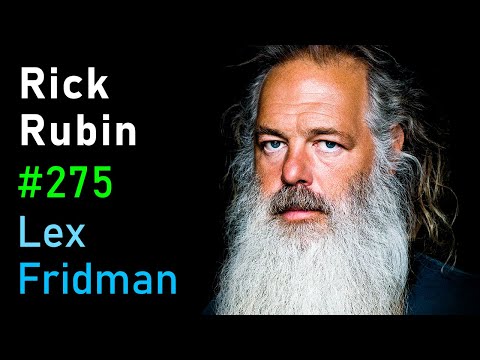
Rick Rubin: Legendary Music Producer | Lex Fridman Podcast #275
Rick Rubin (guest), Lex Fridman (host), Narrator, Narrator, Narrator, Narrator, Narrator, Narrator, Narrator
In this episode of Lex Fridman Podcast, featuring Rick Rubin and Lex Fridman, Rick Rubin: Legendary Music Producer | Lex Fridman Podcast #275 explores rick Rubin on Art, Listening, Vulnerability, and Channeling the Unknown Rick Rubin and Lex Fridman dive into the nature of music, creativity, and what it means to truly listen and collaborate. Rubin describes his minimalist, experimental approach to producing as a process of coming in blank, protecting artists, and testing every idea without ego. They explore specific songs and artists—from Marvin Gaye and Johnny Cash to Adele and the Beatles—to illustrate how context, lyrics, space, and vulnerability shape emotional impact. The conversation broadens into philosophy, depression, fame, mortality, and the belief that ideas are “broadcast” from elsewhere, with artists serving as antennas rather than owners of genius.
Rick Rubin on Art, Listening, Vulnerability, and Channeling the Unknown
Rick Rubin and Lex Fridman dive into the nature of music, creativity, and what it means to truly listen and collaborate. Rubin describes his minimalist, experimental approach to producing as a process of coming in blank, protecting artists, and testing every idea without ego. They explore specific songs and artists—from Marvin Gaye and Johnny Cash to Adele and the Beatles—to illustrate how context, lyrics, space, and vulnerability shape emotional impact. The conversation broadens into philosophy, depression, fame, mortality, and the belief that ideas are “broadcast” from elsewhere, with artists serving as antennas rather than owners of genius.
Key Takeaways
Come to each project blank and prioritize deep listening over preconceptions.
Rubin deliberately avoids fixed methods, entering every collaboration without a plan, focusing instead on neutrally absorbing what the artist plays and says before forming any opinion.
Get the full analysis with uListen AI
Test every idea in practice instead of debating it in theory.
In Rubin’s studio, any suggestion—no matter how bad it sounds verbally—must be tried, because imagined outcomes differ wildly from how something actually sounds once performed.
Get the full analysis with uListen AI
Use reduction and ‘ruthless edits’ to reveal the essential core of a work.
He favors simplicity, removing layers until only what is indispensable remains, then adding back only what truly enhances the emotional impact rather than diluting it.
Get the full analysis with uListen AI
Create safety and intimacy so artists can be fully vulnerable.
Rubin emphasizes eliminating performance pressure—minimizing cameras, observers, and external commentary—so musicians can access raw emotion without feeling watched or judged.
Get the full analysis with uListen AI
Protect art from business timelines and external opinions while still seeking honest critique.
He sees one key producer role as shielding artists from commercial and institutional pressures, yet also stresses the importance of a trusted circle that can say, “this isn’t good enough,” from love, not fear.
Get the full analysis with uListen AI
View ideas as signals broadcast by the universe, with people as antennas.
Rubin believes many people receive similar ideas because the time for those ideas has come; the difference lies in who acts on them and who has tuned into their particular ‘antenna.’
Get the full analysis with uListen AI
Give everything you have to a piece, then let go of regret.
He treats each work like a diary entry of a moment in time: if he’s genuinely done his best, there’s no room for self-criticism later, only an honest record of who he was then.
Get the full analysis with uListen AI
Notable Quotes
“There are no right answers for anything involved in art. We’re all trying experiments to find a way.”
— Rick Rubin
“I come to every project blank… My goal is not to form an opinion. It’s to understand.”
— Rick Rubin
“If we embrace that not knowing, we’ll have a healthier experience going through life.”
— Rick Rubin
“If it could be better, it’s not done. When it’s done, it’s the best it can be.”
— Rick Rubin
“I believe we know close to nothing about anything.”
— Rick Rubin
Questions Answered in This Episode
How can non-artists apply Rubin’s ‘come in blank’ approach to their own work or relationships?
Rick Rubin and Lex Fridman dive into the nature of music, creativity, and what it means to truly listen and collaborate. ...
Get the full analysis with uListen AI
Where is the line between healthy protection of an artist and over-sheltering them from necessary friction or critique?
Get the full analysis with uListen AI
If ideas are ‘broadcast’ and we’re just antennas, what responsibility do we have for the art we create?
Get the full analysis with uListen AI
How might the ruthless editing mindset change not just albums, but careers, projects, or even personal habits?
Get the full analysis with uListen AI
In a world obsessed with metrics and speed, how can creative people carve out the unstructured time and safety Rubin says great work requires?
Get the full analysis with uListen AI
Transcript Preview
... there are no right answers for anything involved in art. It's, we're, we're all trying experiments to find a way. And even for the things that I work on, I don't have a set way that I do anything. Every, I come to every project blank.
Maybe you're just a meat vehicle, and you're channeling ideas from somewhere else.
I believe we know close to nothing, close to nothing, about anything. If we embrace that not knowing, we'll have a healthier experience going through life.
The following is a conversation with Rick Rubin, one of the greatest music producers of all time, known for bringing the best out of anyone he works with, no matter the genre of music or even the medium of art, or just the medium of creating something beautiful in this world. And the list of musicians he produced includes many, many, many of the greats over the past 40 years, including the Beastie Boys, Eminem, Metallica, LL Cool J, Kanye West, Slayer, Tom Petty, Johnny Cash, Dixie Chicks, Aerosmith, Adele, Danzig, Red Hot Chili Peppers, System of a Down, Jay-Z, Black Sabbath. I can keep going for a very long time here. Most importantly, Rick is just an amazing human being. We became fast friends, which is surreal to say and is just an incredible honor. I felt truly heard as a person when I spent the day with him eating some delicious Texas barbecue, talking about life, about music, about art, about beauty. This was a conversation, an experience I'll never forget. This is the Lex Fridman Podcast. To support it, please check out our sponsors in the description. And now, dear friends, here's Rick Rubin. Are you nervous?
Not shaky, but I would say I feel, uh, uneasy. And I feel like the sooner we start talking, the more relaxed we'll get.
Yeah. Or maybe we should sit in this moment and enjoy the nervousness of it. Let me start with Nietzsche. He said, "Without music, life would be a mistake." What do you think he means by that? Let's talk some philosophy. Let's try to analyze Friedrich Nietzsche from a century ago.
It seems like music has the ability to bring us so much, uh, depth in our soul that's hard to access any other way. And without it, there would be a, a loss beyond, beyond the pleasure of it. Um, feels like it's a window into something else.
Something that no other medium can express quite the same way.
I would say n- not as automatically. Something about music c- can do it automatically. Maybe poetry or maybe certain abstract, uh, forms can get us there. But there's something about music that really can get us there quickly.
But it's also the time, the place, the history. There's something about, like, a lot of my family's still in Philly. There's something about driving through Jersey and listening to B- Bruce Springsteen. And then it just, I'll get, like, emotional (laughs) . Like, uh, listening to, like, I'm On Fire that, like, uh, one o- o- one of my favorite Bruce Springsteen songs. There's a, there's a, the, there's a haunting kinda strumming to it. Uh, it's not a strumming. It, it's, it's actually picked. It has a country feel to it, almost like a Johnny Cash feel, actually. And it, I don't know, makes me feel... So, for people who don't know I'm On Fire, that song is, I guess, a love song to a woman that you can't have because she's married or she's with somebody else, which, I guess, is quite a lot of love songs. But there's something about the haunting nature of the guitar. And then it has to be driving through Jersey. And I feel like everyone has fallen in love with a Jersey girl at one point in their life (laughs) . I don't know if that's true for e- for everybody. But I f- I feel like that. I haven't either, but I just feel-
Install uListen to search the full transcript and get AI-powered insights
Get Full TranscriptGet more from every podcast
AI summaries, searchable transcripts, and fact-checking. Free forever.
Add to Chrome