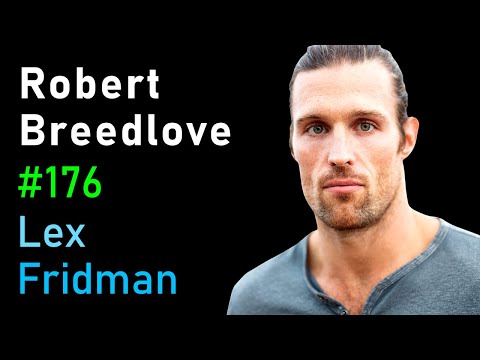
Robert Breedlove: Philosophy of Bitcoin from First Principles | Lex Fridman Podcast #176
Lex Fridman (host), Robert Breedlove (guest), Narrator
In this episode of Lex Fridman Podcast, featuring Lex Fridman and Robert Breedlove, Robert Breedlove: Philosophy of Bitcoin from First Principles | Lex Fridman Podcast #176 explores bitcoin, Sovereignty, and Morality: Rethinking Money From First Principles Lex Fridman and Robert Breedlove explore money as a foundational human technology, tying it to sovereignty, free will, and the evolution of civilization from hunter‑gatherers to modern nation‑states.
Bitcoin, Sovereignty, and Morality: Rethinking Money From First Principles
Lex Fridman and Robert Breedlove explore money as a foundational human technology, tying it to sovereignty, free will, and the evolution of civilization from hunter‑gatherers to modern nation‑states.
Breedlove argues that property, money, and even governments emerge from deep biological imperatives like territoriality, and that centralized control of money (via central banks and inflation) corrupts incentives, morality, and social cohesion.
They position Bitcoin as a breakthrough: a form of “absolute digital scarcity” and open monetary network that cannot be monopolized, potentially re‑aligning incentives toward long‑term thinking, individual sovereignty, and freer markets.
The conversation ranges into evolutionary biology, Austrian economics, myth and religion, entrepreneurship, and personal philosophy, using these lenses to question existing institutions and to frame Bitcoin as both a technological and moral revolution.
Key Takeaways
Sovereignty ultimately lies with the individual, not the state.
Breedlove defines sovereignty as the authority to act as you see fit, arguing that despite political structures, each person retains an irreducible inner freedom of choice, akin to Viktor Frankl’s “final human freedom.”
Get the full analysis with uListen AI
Property is information—a social relationship, not the physical asset.
He reframes property as the socially acknowledged exclusive relationship between a person and an asset, emphasizing that it’s fundamentally informational (who has the legitimate claim) rather than material.
Get the full analysis with uListen AI
Money is a technology that compresses information and extends the mind.
Money is described as a universal medium of exchange and a form of “data compression” that encodes the history of sacrifices and successes into prices, shaping how we think, plan, and compare possible actions.
Get the full analysis with uListen AI
Inflation acts as legalized counterfeiting, corrupting incentives and morality.
Central bank money printing is likened to a technological backdoor that lets some obtain “something for nothing,” distorting price signals, shortening time horizons, incentivizing subtle fraud (e. ...
Get the full analysis with uListen AI
Free markets generate ‘pragmatic truth’ through prices, tools, and virtue.
In Austrian terms, markets discover usable truths: accurate prices (demand vs. ...
Get the full analysis with uListen AI
Bitcoin represents the discovery of absolute digital scarcity.
Because of its fixed 21 million cap and difficulty adjustment, no amount of energy or political power can inflate its supply, making it a kind of “digital gold” that perfects the monetary properties of divisibility, durability, recognizability, portability, and scarcity.
Get the full analysis with uListen AI
Open, decentralized monetary networks may outcompete closed, state systems.
Like the internet outcompeting intranets, Bitcoin as an open, voluntary, globally auditable system harnesses more distributed intelligence and reduces enforcement costs, potentially undermining the viability of centralized fiat regimes over time.
Get the full analysis with uListen AI
Notable Quotes
“Property is information. It's not the actual asset.”
— Robert Breedlove
“People don't have ideas. Ideas have people.”
— Robert Breedlove
“Inflation is just theft integrated into the money. It's a technology backdoor.”
— Robert Breedlove
“Bitcoin is more than an invention; it's the discovery of absolute scarcity.”
— Robert Breedlove
“The way of the warrior is the resolute acceptance of death.”
— Robert Breedlove (quoting Musashi)
Questions Answered in This Episode
If value, not matter or information, is fundamental to reality, how does that change how we should build economic and political institutions?
Lex Fridman and Robert Breedlove explore money as a foundational human technology, tying it to sovereignty, free will, and the evolution of civilization from hunter‑gatherers to modern nation‑states.
Get the full analysis with uListen AI
To what extent can Bitcoin realistically restrain state power if major governments coordinate against it instead of competing with each other?
Breedlove argues that property, money, and even governments emerge from deep biological imperatives like territoriality, and that centralized control of money (via central banks and inflation) corrupts incentives, morality, and social cohesion.
Get the full analysis with uListen AI
Are there important social or psychological harms caused by fiat money and inflation that we still underestimate or haven’t clearly identified?
They position Bitcoin as a breakthrough: a form of “absolute digital scarcity” and open monetary network that cannot be monopolized, potentially re‑aligning incentives toward long‑term thinking, individual sovereignty, and freer markets.
Get the full analysis with uListen AI
Can myth, religion, and stories be consciously redesigned to support a Bitcoin-based, sovereignty-focused civilization without becoming new dogmas?
The conversation ranges into evolutionary biology, Austrian economics, myth and religion, entrepreneurship, and personal philosophy, using these lenses to question existing institutions and to frame Bitcoin as both a technological and moral revolution.
Get the full analysis with uListen AI
If markets reward certain virtues, which human qualities might flourish—and which might wither—in a world where Bitcoin is the dominant money?
Get the full analysis with uListen AI
Transcript Preview
The following is a conversation with Robert Breedlove, someone who caught my attention and was recommended highly as a rigorous scholar and thinker in the space of decentralized finance and Bitcoin. His podcast, titled What Is Money? is a good representation of the way his mind works. He's willing to talk through ideas for many hours, (laughs) willing to listen, willing to think, which makes him a great companion in conversation to explore the history, philosophy, and future of money. Quick mention of our sponsors: Fundrise, Element, Munk Pack, and Better Help. Check them out in the description to support this podcast. As a side note, let me say that I'll have a number of conversations in the coming months on Bitcoin and other cryptocurrencies. None of these conversations are financial advice. That's not a legal warning, that's a genuine description of my goals and approach with these chats. At least for a while, I personally won't actively invest in Bitcoin or any other cryptocurrencies, except to learn about the technology itself. I don't think this should be a journalistic standard like the New York Times tried to establish, which I very much disagree with. In my humble opinion, I think journalists should be free to invest in Bitcoin if they want to. Luckily, I'm not a journalist. I just know my own psychology and I feel that my thinking will be muddled by excitement if I invest before I understand. I feel the same way about Tesla, for example. I still don't own any Tesla stock and I am still indeed fascinated by Tesla autopilot as an artificial intelligence system. I work hard to be cognizant of the biases that arise in my mind and always try to choose the path that maximizes or maintains a freedom of thought as much as possible. Also let me say that I try to be very careful in selecting guests based not only on the contents of their ideas, but the richness, complexity, music, style of their mind and character. Yes, I will talk with people with whom you and I may disagree, people who some may call bad or even evil human beings. I want to understand them because I believe that, as Solzhenitsyn said, "The battle line between good and evil runs through the heart of every man." I think if you always run from evil, you become blind to the truth of human nature. This is the Lex Fridman Podcast, and here is my conversation with Robert Breedlove. Rousseau opens his 1762 book, The Social Contract, with the following statement: "Man is born free and everywhere he's in chains." So, you talk about freedom and sovereignty quite a bit. What do these ideas mean to you, the idea of sovereignty?
Freedom and sovereignty, um, I think they're very closely related. Let's start just focusing on sovereignty, which is a word I don't think we talk about enough. Um, and the general definition of that I would give is the authority to act as you see fit. Um, and it's a word that's etymologically associated with words like monarchy, money, reign. So historically, it's referred to whatever the locus of supreme power is in the sphere of human action. So whether if you go, like, back in ancient Egypt, the pharaoh had absolute sovereignty and everyone else was pretty much operating according to his interests. You fast-forward to today, modern Western democracy, we have, um, more decentralized sovereignty in that we all get to go vote and elect officials that make decisions on our behalf. So the, the theme of sovereignty across history is that it's been gradually decentralizing across our different models of socioeconomics. And, um, it's largely... You could say it's rooted heavily in the money, I would argue, which is something we'll get a lot into here, where if you have money you have the authority to act as you see fit in the world. Um, and even in our current political sphere, if you have enough money, you can actually shape- reshape the rules, right? You can reshape laws, you can lobby Congress. Um, if you're in, in a certain situation like many billionaires, you can negotiate your own tax treaty such that you can get favorable tax treatment with certain jurisdictions in the world. So this concept of, of sovereignty, um, which today we call... It's, uh, common to call states or nation-states or governments sovereign, meaning that they have power over people. Um, but as I argue in a lot of my writing, I actually think that sovereignty inheres within the individual and that we each have our own interiorized space of choice, which is something like Viktor Frankl called the final human freedom, in that we, no matter what our circumstances are, no matter what, uh, exogenous situation we face, we always have this endogenous power to choose how we respond to it.
Install uListen to search the full transcript and get AI-powered insights
Get Full TranscriptGet more from every podcast
AI summaries, searchable transcripts, and fact-checking. Free forever.
Add to Chrome