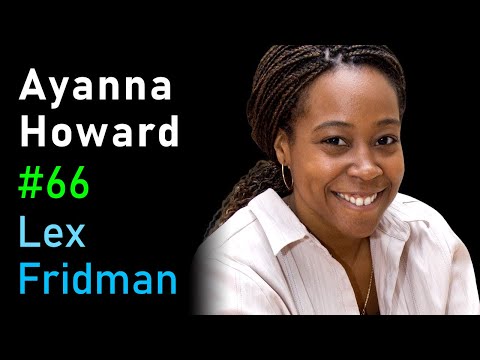
Ayanna Howard: Human-Robot Interaction & Ethics of Safety-Critical Systems | Lex Fridman Podcast #66
Lex Fridman (host), Ayanna Howard (guest)
In this episode of Lex Fridman Podcast, featuring Lex Fridman and Ayanna Howard, Ayanna Howard: Human-Robot Interaction & Ethics of Safety-Critical Systems | Lex Fridman Podcast #66 explores ayanna Howard on Imperfect Robots, Human Trust, and Ethical AI Ayanna Howard and Lex Fridman explore how real-world robots must be less than theoretically ‘perfect’ to function well alongside messy, unpredictable humans. They discuss autonomous vehicles, bias and fairness in AI, and why every developer inevitably bears ethical responsibility when their code impacts human lives. Howard emphasizes that AI is often still less biased than humans, but must be systematically audited, corrected, and designed with adaptation to people at its core. The conversation ranges from medical and educational robots to robot rights, future labor displacement, and whether humans might one day fall in love with AI systems.
Ayanna Howard on Imperfect Robots, Human Trust, and Ethical AI
Ayanna Howard and Lex Fridman explore how real-world robots must be less than theoretically ‘perfect’ to function well alongside messy, unpredictable humans. They discuss autonomous vehicles, bias and fairness in AI, and why every developer inevitably bears ethical responsibility when their code impacts human lives. Howard emphasizes that AI is often still less biased than humans, but must be systematically audited, corrected, and designed with adaptation to people at its core. The conversation ranges from medical and educational robots to robot rights, future labor displacement, and whether humans might one day fall in love with AI systems.
Key Takeaways
Robots must adapt to human reality, not just follow rules perfectly.
Theoretical ‘perfection’ as 100% rule‑following and accuracy doesn’t work in dynamic human environments (e. ...
Get the full analysis with uListen AI
Trust in robots is behavioral, and over‑trust is a major risk.
Howard defines trust by what people actually do, not what they say on surveys; once early experiences with a system are positive, users can quickly swing from hyper‑vigilance to complacency, which is dangerous for tech like autopilot or medical AI.
Get the full analysis with uListen AI
Developers cannot avoid ethics; their code can directly cost lives.
From self‑driving systems to medical decision support, Howard stresses that programmers hold power akin to physicians: their design choices can kill or save people, so ethical reflection and ‘self‑testing’ for harms must be part of everyday development.
Get the full analysis with uListen AI
AI can be biased yet still less biased than humans—and easier to fix.
Historical data encodes social biases (in healthcare, criminal justice, etc. ...
Get the full analysis with uListen AI
Systematic mechanisms for finding ethical ‘bugs’ are missing.
Today, bias problems are caught ad hoc by individual researchers; Howard proposes ‘ethics bug bounties’ where companies pay outsiders to find unfair outcomes, mirroring security bug programs and leveraging diverse perspectives on harm.
Get the full analysis with uListen AI
The hardest HRI problems sit at the interface: adaptation and learning.
For Howard, the real challenge is not just better mechanics or perception, but designing AI that can robustly model, engage, and personalize to different humans or groups across domains like therapy, education, and assistive robotics.
Get the full analysis with uListen AI
Automation will widen inequality unless we invest in access and retraining.
She’s less worried about total job loss and more about who can transition; highly educated workers will adapt, but those without strong educational foundations risk being left behind unless we build serious, AI‑enabled workforce development and equitable access to AI’s benefits.
Get the full analysis with uListen AI
Notable Quotes
“We really want perfection with respect to a robot’s ability to adapt to us, not perfection with respect to rules we just made up anyway.”
— Ayanna Howard
“Robotic algorithms don’t kill people; developers of robotic algorithms kill people.”
— Ayanna Howard
“The worst AI is still better than us—at least in terms of these bias decisions.”
— Ayanna Howard
“Great gift, being a developer, great responsibility—and this is how you combine those.”
— Ayanna Howard
“I don’t believe we should have an AI for president, but I do believe that a president should use AI as an advisor.”
— Ayanna Howard
Questions Answered in This Episode
How can designers practically balance safety with human‑like flexibility when programming robots that operate around people?
Ayanna Howard and Lex Fridman explore how real-world robots must be less than theoretically ‘perfect’ to function well alongside messy, unpredictable humans. ...
Get the full analysis with uListen AI
What concrete tools or training should be added to computer science education so developers internalize and manage their ethical responsibilities?
Get the full analysis with uListen AI
In domains like healthcare or policing, who should decide when AI performance is ‘good enough’ compared to biased human baselines?
Get the full analysis with uListen AI
How far should society go in legally protecting advanced robots—should they be treated more like property, like animals, or something new entirely?
Get the full analysis with uListen AI
What would an effective, large‑scale system for continuously auditing and correcting AI bias look like in practice, across companies and governments?
Get the full analysis with uListen AI
Transcript Preview
The following is a conversation with Ayanna Howard. She's a roboticist, professor at Georgia Tech, and director of the Human Automation Systems Lab, with research interests in human-robot interaction, assistive robots in the home, therapy gaming apps, and remote robotic exploration of extreme environments. Like me, in her work, she cares a lot about both robots and human beings, and so I really enjoyed this conversation. This is the Artificial Intelligence podcast. If you enjoy it, subscribe on YouTube, give it five stars on Apple Podcast, follow on Spotify, support it on Patreon, or simply connect with me on Twitter @lexfridman, spelled F-R-I-D-M-A-N. I recently started doing ads at the end of the introduction. I'll do one or two minutes after introducing the episode, and never any ads in the middle that can break the flow of the conversation. I hope that works for you and doesn't hurt the listening experience. This show is presented by Cash App, the number one finance app in the App Store. I personally use Cash App to send money to friends, but you can also use it to buy, sell, and deposit bitcoin in just seconds. Cash App also has a new investing feature. You can buy fractions of a stock, say $1 worth, no matter what the stock price is. Broker services are provided by Cash App Investing, a subsidiary of Square and member SIPC. I'm excited to be working with Cash App to support one of my favorite organizations called FIRST, best known for their FIRST robotics and Lego competitions. They educate and inspire hundreds of thousands of students in over 110 countries, and have a perfect rating on Charity Navigator, which means the donated money is used to maximum effectiveness. When you get Cash App from the App Store or Google Play, and use code LEXPODCAST, you'll get $10, and Cash App will also donate $10 to FIRST, which again is an organization that I've personally seen inspire girls and boys to dream of engineering a better world. And now, here's my conversation with Ayanna Howard. What, or who, is the most amazing robot you've ever met, or perhaps had the biggest impact on your career?
I haven't met her, but I grew up with her, but of course Rosie. So, and I think it's because also-
Who's Rosie?
Rosie from the Jetsons. She is all things to all people, right?
(laughs)
Think about it, like anything you wanted, it was like magic, it happened. Um-
So people not only an-anthropomorphize, but project whatever they wish for the robot to be onto-
Onto Rosie.
... Rosie.
But also, I mean, think about it, she was socially engaging. She every so often had an attitude, right? Um, she kept us honest. She, she would push back sometimes when, you know, George was doing some weird stuff. Um, but she cared about people, especially the kids. Uh, she's, she was like the, the perfect robot. (laughs)
Install uListen to search the full transcript and get AI-powered insights
Get Full TranscriptGet more from every podcast
AI summaries, searchable transcripts, and fact-checking. Free forever.
Add to Chrome