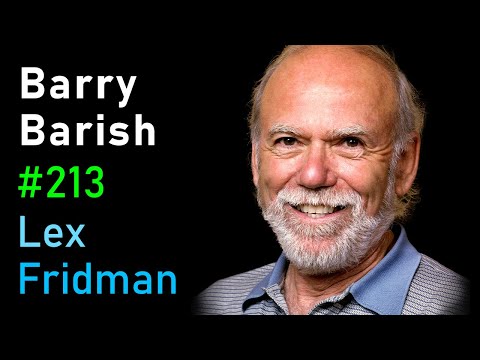
Barry Barish: Gravitational Waves and the Most Precise Device Ever Built | Lex Fridman Podcast #213
Lex Fridman (host), Barry Barish (guest)
In this episode of Lex Fridman Podcast, featuring Lex Fridman and Barry Barish, Barry Barish: Gravitational Waves and the Most Precise Device Ever Built | Lex Fridman Podcast #213 explores barry Barish on LIGO, gravity’s whispers, and human curiosity’s risks Barry Barish discusses the decades‑long quest to detect gravitational waves through LIGO, an interferometer capable of measuring distortions thousands of times smaller than a proton. He explains the historical and theoretical path from Newton and Einstein to modern experimental confirmation, detailing the extreme engineering required to isolate such tiny signals from Earth's noise. The conversation broadens into black holes, dark matter/energy, and the hope that gravitational-wave astronomy will reveal early‑universe physics and maybe clues toward unifying quantum mechanics and general relativity. Alongside the science, Barish reflects on curiosity, big-team collaboration, the social risks of scientific progress, Russian literature, and what it means to live a meaningful finite life.
Barry Barish on LIGO, gravity’s whispers, and human curiosity’s risks
Barry Barish discusses the decades‑long quest to detect gravitational waves through LIGO, an interferometer capable of measuring distortions thousands of times smaller than a proton. He explains the historical and theoretical path from Newton and Einstein to modern experimental confirmation, detailing the extreme engineering required to isolate such tiny signals from Earth's noise. The conversation broadens into black holes, dark matter/energy, and the hope that gravitational-wave astronomy will reveal early‑universe physics and maybe clues toward unifying quantum mechanics and general relativity. Alongside the science, Barish reflects on curiosity, big-team collaboration, the social risks of scientific progress, Russian literature, and what it means to live a meaningful finite life.
Key Takeaways
Curiosity is an innate human asset that education and culture often suppress.
Barish argues that children’s relentless questioning is systematically discouraged by parents and schools, and that scientists are essentially people who managed to keep that childlike curiosity alive rather than having it ‘beaten out’ of them.
Get the full analysis with uListen AI
Einstein’s general relativity reframes gravity as curved spacetime, enabling the prediction of gravitational waves.
Newton’s theory could predict motions but not the mechanism of attraction; Einstein’s theory describes mass distorting spacetime (like a bowling ball on a trampoline), leading him—by analogy with electromagnetism—to intuit the existence of gravitational waves.
Get the full analysis with uListen AI
Measuring gravitational waves required building the most precise instrument in history.
LIGO measures distortions of spacetime on the order of 10⁻¹⁸ meters—about one‑thousandth the width of a proton—over 4‑km arms, demanding extreme vacuum systems, multi‑stage passive isolation, and active seismic noise cancellation analogous to noise‑canceling headphones.
Get the full analysis with uListen AI
Gravitational‑wave detection turned a theoretical prediction into a new observational window on the universe.
The first LIGO detection in 2015 of merging black holes—an event 1. ...
Get the full analysis with uListen AI
Black holes and early‑universe signals may hold clues to unifying physics.
Barish sees black holes as prime laboratories where extreme gravity and quantum effects meet, potentially offering empirical hints toward reconciling quantum field theory with general relativity—something purely theoretical attempts like string theory have failed to do predictively.
Get the full analysis with uListen AI
Scientific progress is a ‘ratchet’: new knowledge can’t be unlearned and can be dangerous.
Using nuclear physics and AI/bioengineering as examples, Barish notes that curiosity inevitably drives powerful discoveries whose societal and existential risks we may not be mature enough to manage, echoing concerns about nuclear weapons and future technologies.
Get the full analysis with uListen AI
Big-science projects succeed when teams feel they achieve more together than alone.
Barish emphasizes that leading LIGO meant attracting top talent and structuring work so that combined efforts yielded results no individual group could achieve, aligning egos around a romantic, shared goal rather than individual credit.
Get the full analysis with uListen AI
Notable Quotes
“People that do science somehow have maintained something that kids always have… curiosity that didn’t get beaten out of us.”
— Barry Barish
“Newton had the most successful theory in physics ever, but it never told you why the apple was attracted to the Earth.”
— Barry Barish
“We had to reduce the shaking of the Earth by one part in 10¹². That’s just a mechanical engineering problem.”
— Barry Barish
“Our first detection happened 1.3 billion years ago—when life on Earth was just going from single‑cell to multi‑cell. We and that event were both slowly developing to meet at that moment.”
— Barry Barish
“We have an embarrassment that we have two different theories of physics… I don’t think we’re close [to unifying them] without some experimental clues.”
— Barry Barish
Questions Answered in This Episode
How might future, more sensitive gravitational‑wave detectors change our understanding of the Big Bang and the very early universe?
Barry Barish discusses the decades‑long quest to detect gravitational waves through LIGO, an interferometer capable of measuring distortions thousands of times smaller than a proton. ...
Get the full analysis with uListen AI
What practical lessons about managing risk should AI and biotech researchers take from the nuclear age and the ‘ratchet of curiosity’ Barish describes?
Get the full analysis with uListen AI
In what ways can education systems be redesigned to protect and cultivate the kind of curiosity Barish says is innate but often suppressed?
Get the full analysis with uListen AI
What kinds of gravitational‑wave signatures or anomalies would most strongly hint at new physics beyond general relativity or standard particle theory?
Get the full analysis with uListen AI
How should we fairly recognize individual achievement versus team effort in massive scientific collaborations like LIGO when prizes can only name a few people?
Get the full analysis with uListen AI
Transcript Preview
The following is a conversation with Barry Barish, a theoretical physicist at Caltech, and the winner of the Nobel Prize in physics for his contributions to the LIGO detector and the observation of gravitational waves. LIGO, or the Laser Interferometer Gravitational-Wave Observatory, is probably the most precise measurement device ever built by humans. It consists of two detectors with four kilometer-long vacuum chambers situated 3,000 kilometers apart, operating in unison to measure motion that is 10,000 times smaller than the width of a proton. It is the smallest measurement ever attempted by science, a measurement of gravitational waves caused by the most violent and cataclysmic events in the universe, occurring over tens of millions of light years away. To support this podcast, please check out our sponsors in the description. This is the Lex Fridman Podcast, and here is my conversation with Barry Barish. You've mentioned that you were always curious about the physical world, and that, uh, an early question you remember stood out where you asked your dad, "Why does ice float on water?" And he couldn't answer, and this was very (laughs) surprising to you. Uh, so you went on to learn why. Maybe you can speak to what are some early questions in math and physics that, uh, really sparked your curiosity?
Yeah. Th- that, that memory is, uh, um, kind of something I use to illustrate, uh, something I think that's common in science, is that people that do science somehow have maintained, um, maintain something that kids always have. Uh, well, a small kid, eight years old or so, uh, asks you so many questions usually, typically, that you consider them pests, you tell them to stop asking so many questions. Um, and, uh, somehow our system manages to kill that in most people. Uh, so, in school we make people do s- study and w- do their things, but not to pester them by asking too many questions. And, uh, um, I think not just myself, but I think it's typical of scientists like myself, that, uh, uh, have somehow escaped that. Maybe we're still children or maybe we somehow didn't get it beaten out of us. But I think it's, uh... I teach in college level and it's, to me, uh, one of the biggest deficits is the lack of curiosity, if you want, that we've beaten out of them, 'cause I think it's an innate human quality.
Is there some advice or insights you can give to how to keep that flame of curiosity going?
I think it's a problem of both parents and, and, uh, that parents should be, should realize that's a great quality we have, that you're curious and that's good. Instead we have s- we have expressions like, "Curiosity killed the cat."
(laughs)
And, and, uh, and then more. But I mean that basically it's not, not thought to be a good thing. You get i- curiosity killed the cat means if you're too curious you get in trouble. And, uh, it can lead to trouble.
Install uListen to search the full transcript and get AI-powered insights
Get Full TranscriptGet more from every podcast
AI summaries, searchable transcripts, and fact-checking. Free forever.
Add to Chrome