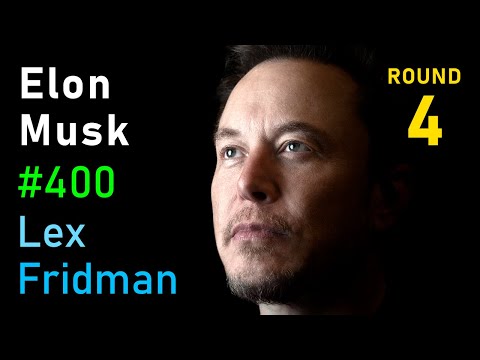
Elon Musk: War, AI, Aliens, Politics, Physics, Video Games, and Humanity | Lex Fridman Podcast #400
Lex Fridman (host), Elon Musk (guest), Narrator
In this episode of Lex Fridman Podcast, featuring Lex Fridman and Elon Musk, Elon Musk: War, AI, Aliens, Politics, Physics, Video Games, and Humanity | Lex Fridman Podcast #400 explores elon Musk on war, AI, aliens, video games, and human destiny Elon Musk and Lex Fridman discuss the nature and inevitability of war, current global conflicts, and how conspicuous acts of kindness can be a powerful geopolitical strategy to break cycles of hatred. Musk then dives into AI and xAI’s Grok, emphasizing truth-seeking, physics-based reasoning, and the long‑term goal of understanding the universe, plus the need for regulation and energy efficiency in large‑scale AI. They connect real‑world AI (Tesla Autopilot, Optimus) and LLMs as converging paths toward AGI, explore consciousness, the Fermi paradox, and the urgency of making humanity multi‑planetary. The conversation is threaded with humor, politics, criticism of institutions, video games (especially Diablo and Elden Ring), and reflections on Musk’s personal life, optimism, and struggles.
Elon Musk on war, AI, aliens, video games, and human destiny
Elon Musk and Lex Fridman discuss the nature and inevitability of war, current global conflicts, and how conspicuous acts of kindness can be a powerful geopolitical strategy to break cycles of hatred. Musk then dives into AI and xAI’s Grok, emphasizing truth-seeking, physics-based reasoning, and the long‑term goal of understanding the universe, plus the need for regulation and energy efficiency in large‑scale AI. They connect real‑world AI (Tesla Autopilot, Optimus) and LLMs as converging paths toward AGI, explore consciousness, the Fermi paradox, and the urgency of making humanity multi‑planetary. The conversation is threaded with humor, politics, criticism of institutions, video games (especially Diablo and Elden Ring), and reflections on Musk’s personal life, optimism, and struggles.
Key Takeaways
Conspicuous acts of kindness can be a strategic antidote to terrorism and hatred.
Musk argues that in conflicts like Israel–Gaza, overreaction creates more extremists; the most effective counter to groups like Hamas is deliberate, transparent, large‑scale humanitarian action that undermines their narrative and reduces the number of new terrorists created.
Get the full analysis with uListen AI
War is likely a permanent feature of civilization, but its scale and impact can be managed.
He believes war has always existed and likely always will, rooted in limbic instincts visible in animals like chimpanzees, but strategic choices, diplomacy, and historical learning (e. ...
Get the full analysis with uListen AI
The main civilizational risks—nuclear war and unaligned AI—require proactive oversight and prioritization.
Musk emphasizes that although the current probability of nuclear war seems low, existing arsenals can end civilization, and powerful AI systems need independent, technically competent regulators who can inspect leading labs and raise alarms even without direct enforcement power.
Get the full analysis with uListen AI
Efficient AI will be limited more by energy and infrastructure than by chips alone.
He predicts a shift from GPU shortages to power‑distribution and then raw electricity shortages, with global electricity demand tripling due to EVs, heating, and AI; this makes ‘useful compute per watt’ and large‑scale grid‑level batteries strategically critical.
Get the full analysis with uListen AI
Real‑world AI and LLMs are converging paths toward general intelligence, but efficiency matters.
Tesla’s vision‑based, end‑to‑end Autopilot and Optimus learn the world from video with roughly 100 watts, while LLMs rely on brute‑force compute; Musk expects future systems to move closer to brain‑like efficiency and sees Tesla’s constraints as an advantage.
Get the full analysis with uListen AI
Free speech only exists if unpopular or disliked views are allowed and context‑checked, not censored.
On X, Musk wants a ‘level playing field’ where all political sides can speak, with community‑driven fact‑checking (Community Notes) rather than top‑down moderation; he sees legacy Twitter as captured by far‑left activists and legacy media as structurally biased toward negativity.
Get the full analysis with uListen AI
Becoming multi‑planetary is, in Musk’s view, a necessary filter for survival, not a luxury.
Given stellar evolution and planetary risks, he argues that any one‑planet civilization is ultimately doomed; he expects we’d likely find many dead one‑planet civilizations if we explore the galaxy and sees SpaceX’s mission as racing that deadline.
Get the full analysis with uListen AI
Notable Quotes
“If you’re not going to just outright commit genocide, the real question is: for every Hamas member you kill, how many did you create?”
— Elon Musk
“Physics is the law; everything else is a recommendation.”
— Elon Musk
“This is the first time in the history of Earth that it’s been possible for life to extend beyond Earth. That window is open now, and it may never open again.”
— Elon Musk
“Free speech only matters if people you don’t like are allowed to say things you don’t like.”
— Elon Musk
“Killing the demons in a video game calms the demons in my mind.”
— Elon Musk
Questions Answered in This Episode
How realistic is Musk’s proposal that ‘conspicuous acts of kindness’ could meaningfully change the trajectory of conflicts like Israel–Gaza or Ukraine, given political realities on the ground?
Elon Musk and Lex Fridman discuss the nature and inevitability of war, current global conflicts, and how conspicuous acts of kindness can be a powerful geopolitical strategy to break cycles of hatred. ...
Get the full analysis with uListen AI
If war is effectively inevitable, what specific institutions or technologies could most reduce its frequency and destructiveness in the 21st century?
Get the full analysis with uListen AI
How can regulators practically gain enough technical depth and independence to oversee frontier AI systems without being captured by industry or politics?
Get the full analysis with uListen AI
Will AI systems like Grok and real‑world AI (Autopilot/Optimus) truly converge into a unified general intelligence, or will they remain specialized domains that need to be stitched together?
Get the full analysis with uListen AI
What ethical frameworks should guide humanity’s push to become multi‑planetary, especially if we encounter signs of other civilizations or potentially life‑bearing worlds?
Get the full analysis with uListen AI
Transcript Preview
The following is a conversation with Elon Musk, his fourth time on this, the Lex Fridman Podcast.
(whistling)
(laughs)
(whistling)
I thought you were gonna finish it.
(whistling)
It's one of the greatest themes in all of film history.
(whistling) Yeah, it's great.
So, I was just thinking about the Roman Empire, as one does.
(laughs) There's that whole meme, uh, where (laughs) old guys are, are thinking-
Yeah.
... about the Roman Empire at least once a day.
Yeah. And half the population is confused whether it's true or not. But more seriously, thinking about the wars going on in the world today, and as you know, uh, war and military conquest has been a big part of, uh, Roman society and culture. And it, I think, has been a big part of most empires and dynasties throughout human history. So...
Yeah. They usually, uh, came as a result of conquest. I mean, there's some, like the Austria-Hungarian Empire, where there was just a lot of, uh, sort of clever marriages. Um...
But fundamentally, there's an engine of conquest.
Yeah. Almost always.
And they celebrate excellence in warfare. Many of the leaders were excellent generals.
Yeah.
That kind of thing. So, big-picture question, grok-approved. I ask if this is a good question to ask, and-
Kid-tested, grok-approved?
Yeah. (laughs) Uh, at least on fun mode.
(laughs)
Uh, (laughs) uh,
(laughs)
...to what degree do you think war is part of human nature versus a consequence of, uh, how human societies are structured? I ask this as you have somehow controversially been a proponent of peace.
I'm, uh, generally a proponent of peace. I mean, ignorance is perhaps, in my view, the real enemy to be countered. That's the real hard part. Not, you know, fighting other humans. Um, but a- all creatures fight. I mean, the, the, the jungle is a... You look at the j-... People think of, of this nature as perhaps some sort of peaceful thing, but in fact, it is not. There's some quite funny Werner H- Werner Herz- Herzog thing, where he's, like, in the jungle, like, saying that it's, like, basically just murder and death in every direction.
Mm-hmm.
I mean, the, the, the plants and animals in the jungle are constantly trying to kill and eat each other, every single day, every minute. So it's not like, uh, you know, we're unusual in that respect.
Well, there's, there's a relevant question here, whether with greater intelligence, uh, comes greater control over these base instincts for violence.
Yes. We have much more of an ability to control our, our, um, Olympic instinct for violence than, say, a chimpanzee. And in fact, if, if one looks at, say, chimpanzee society, it is not friendly. I mean, the, bonobos are an exception. Um, but chimpanzee society is, uh, filled with violence, and it's quite, quite horrific, frankly. But that's, that's our limbic system in action. Like, you don't want to be on the wrong side of a chimpanzee. He'll eat your face off and tear your nuts off.
Install uListen to search the full transcript and get AI-powered insights
Get Full TranscriptGet more from every podcast
AI summaries, searchable transcripts, and fact-checking. Free forever.
Add to Chrome