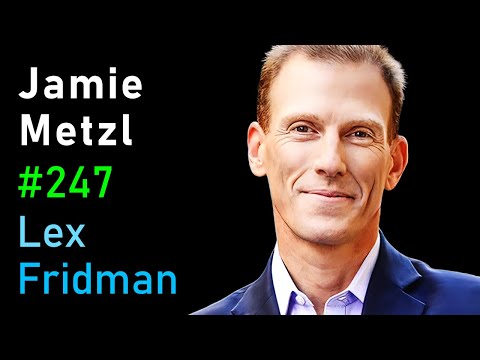
Jamie Metzl: Lab Leak Theory | Lex Fridman Podcast #247
Lex Fridman (host), Jamie Metzl (guest), Lex Fridman (host), Lex Fridman (host), Lex Fridman (host)
In this episode of Lex Fridman Podcast, featuring Lex Fridman and Jamie Metzl, Jamie Metzl: Lab Leak Theory | Lex Fridman Podcast #247 explores jamie Metzl argues COVID likely lab-related, demands transparent global accountability Jamie Metzl lays out why he believes, at roughly an 80–90% confidence level, that COVID-19 most likely stems from an accidental lab-related incident in Wuhan, rather than a natural spillover, emphasizing that all current evidence is circumstantial but heavily weighted toward a lab link.
Jamie Metzl argues COVID likely lab-related, demands transparent global accountability
Jamie Metzl lays out why he believes, at roughly an 80–90% confidence level, that COVID-19 most likely stems from an accidental lab-related incident in Wuhan, rather than a natural spillover, emphasizing that all current evidence is circumstantial but heavily weighted toward a lab link.
He describes a pattern of Chinese government suppression, data deletion, and political obstruction that, in his view, turned an accident into a global catastrophe by preventing timely global response and later blocking serious origin investigations.
The conversation also examines the roles of Western institutions and figures such as EcoHealth Alliance, Peter Daszak, Anthony Fauci, Francis Collins, and the WHO, critiquing lack of transparency, definitional games over “gain-of-function,” and politicized science communication.
In the latter part, Metzl and Fridman zoom out to broader issues: authoritarianism vs. free speech, global governance failures, genetic engineering and embryo selection, the ethics of future human enhancement, and Metzl’s One Shared World initiative for tackling shared existential risks.
Key Takeaways
The current evidence is circumstantial but heavily tilted toward a lab-associated origin.
Metzl argues that geography (Wuhan’s unique coronavirus labs), the virus’s human-adapted features, the missing evolutionary intermediates, and the documented research plans (e. ...
Get the full analysis with uListen AI
China’s systematic cover-up likely magnified the pandemic’s global toll.
He details delayed genome release, blocked WHO access, destroyed samples, gag orders on scientists, and punishment of whistleblowers, contending that this suppression of early information and ongoing obstruction of origin inquiries are “criminal” in effect, regardless of the underlying origin.
Get the full analysis with uListen AI
Western institutions also failed on transparency and rigor around risky virology research.
Metzl criticizes EcoHealth Alliance and Peter Daszak for conflicts of interest and orchestrating early statements dismissing lab-leak as a conspiracy, and faults NIH/NIAID leadership for narrow, technical defenses over ‘gain-of-function’ rather than full disclosure of what was actually funded and how risks were managed.
Get the full analysis with uListen AI
The initial WHO joint study on origins was structurally compromised and politically constrained.
He describes how China gained veto power over international experts, restricted access to raw data and lab records, steered the mandate toward zoonotic origins, and influenced the public messaging (“extremely unlikely” lab origin), forcing external pressure before WHO leadership reset the process with a new advisory group (SAGO).
Get the full analysis with uListen AI
Future pandemic preparedness requires stronger global rules that can pierce absolute sovereignty.
Metzl argues that the Westphalian model of nation-states is mismatched to borderless risks like pandemics, climate change, and nuclear war; he calls for a more empowered WHO and binding global frameworks, while acknowledging the political resistance from powerful states like China.
Get the full analysis with uListen AI
Genetic engineering and embryo selection will fundamentally change human reproduction and raise profound ethical questions.
He outlines how IVF, preimplantation genetic testing, induced pluripotent stem cells, and genome editing (e. ...
Get the full analysis with uListen AI
Building a global movement of citizens is essential to address shared existential risks.
Through his One Shared World project, Metzl argues we must cultivate a “global constituency” that pressures governments to balance national interests with planetary ones, and demonstrates concrete steps like youth-driven UN resolutions on water, sanitation, and pandemic protection for all.
Get the full analysis with uListen AI
Notable Quotes
“Of all the places in the world to have an outbreak of a SARS-like bat coronavirus, it’s in the one city with the largest collection of bat coronaviruses and the leading lab that was actively manipulating them.”
— Jamie Metzl
“There is and can be no debate about whether or not there has been a cover-up. There has been a cover-up.”
— Jamie Metzl
“We’re the first species in nearly four billion years of evolution that has the ability to read, write, and hack the code of life. We’d better be pretty careful.”
— Jamie Metzl
“The big lesson of this pandemic is that all of our fates are tied to everybody else’s fates.”
— Jamie Metzl
“These aren’t conversations about science; science brings us to the conversation. The conversation is about values and ethics.”
— Jamie Metzl
Questions Answered in This Episode
If China were to acknowledge a lab-related origin, what specific global mechanisms could ensure accountability without triggering economic collapse or war-level retaliation?
Jamie Metzl lays out why he believes, at roughly an 80–90% confidence level, that COVID-19 most likely stems from an accidental lab-related incident in Wuhan, rather than a natural spillover, emphasizing that all current evidence is circumstantial but heavily weighted toward a lab link.
Get the full analysis with uListen AI
How should the world regulate high-risk virology and gain-of-function-style research across borders, especially given divergent political systems and transparency norms?
He describes a pattern of Chinese government suppression, data deletion, and political obstruction that, in his view, turned an accident into a global catastrophe by preventing timely global response and later blocking serious origin investigations.
Get the full analysis with uListen AI
What would a truly independent, adequately empowered WHO look like in practice, and how could states be persuaded to cede it more authority over outbreak investigations?
The conversation also examines the roles of Western institutions and figures such as EcoHealth Alliance, Peter Daszak, Anthony Fauci, Francis Collins, and the WHO, critiquing lack of transparency, definitional games over “gain-of-function,” and politicized science communication.
Get the full analysis with uListen AI
As embryo selection and genome editing become more powerful, who should decide which traits are acceptable to select or modify, and how do we protect diversity and the “value of flaws”?
In the latter part, Metzl and Fridman zoom out to broader issues: authoritarianism vs. ...
Get the full analysis with uListen AI
What concrete steps can an individual listener take to meaningfully support better global governance on pandemics and other shared risks, beyond social media advocacy?
Get the full analysis with uListen AI
Transcript Preview
The following is a conversation with Jamie Metzl, author specializing in topics of genetic engineering, biotechnology, and geopolitics. In the past two years, he has been outspoken about the need to investigate and keep an open mind about the origins of COVID-19. In particular, he has been keeping an extensive up-to-date collection of circumstantial evidence in support of what is colloquially known as lab leak hypothesis, that COVID-19 leaked in 2019 from the Wuhan Institute of Virology. In part, I wanted to explore the idea in response to the thoughtful criticism to parts of the Francis Collins episode. I will have more and more difficult conversations like this with people from all walks of life and with all kinds of ideas. I promise to do my best to keep an open mind and yet to ask hard questions while together searching for the beautiful and the inspiring in the mind of the other person. It's a hard line to walk gracefully, especially for someone like me who's a bit of an awkward introvert with barely the grasp of the English language or any language except maybe Python and C++. But I hope you stick around, be patient and empathetic, and maybe learn something new together with me. This is the Lex Fridman Podcast. To support it, please check out our sponsors in the description and now here's my conversation with Jamie Metzl. What is the probability, in your mind, that COVID-19 leaked from a lab? In your write-up, I believe you said 85%. I know it's just a percentage, we can't really be exact with these kinds of things, but it gives us a sense where your mind is, where your intuition is. So, as it stands today, what would you say is that probability?
I would stand by what I've been saying since really the middle of last year. It's more likely and not, in my opinion, uh, that the pandemic stems from an accidental lab incident in Wuhan. Is it 90%? Is it 65%? I mean, that's kind of arbitrary. But when I stack up all of the available evidence, and all of it on both sides is circumstantial, it weighs very significantly toward a lab incident origin.
So, before we dive into the specifics, at a high level, what, uh, types of evidence, what intuition, what ideas are leading you to, uh, to have that kind of estimate? Is it possible to kind of condense... When- when you look at the wall of evidence before you, where's your source, the- the strongest source of your intuition for this?
Yeah. And- and I would have to say it's just logic and deductive reasoning. So, before I make the case for why I think it's most likely a lab incident origin, let's just say why it could be, and still could be what we, uh, natural origin. All of this is, uh, natural origin in the se- in the sense that it's a- a bat virus backbone, horseshoe bat virus, uh, backbone. Um, yeah.
Install uListen to search the full transcript and get AI-powered insights
Get Full TranscriptGet more from every podcast
AI summaries, searchable transcripts, and fact-checking. Free forever.
Add to Chrome