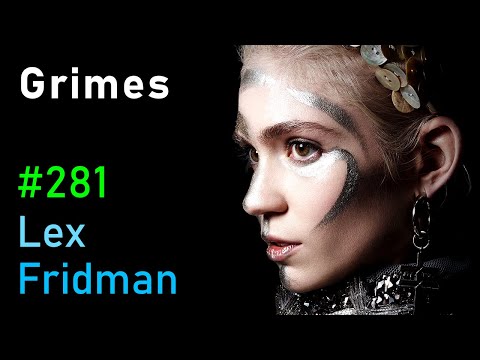
Grimes: Music, AI, and the Future of Humanity | Lex Fridman Podcast #281
Grimes (guest), Lex Fridman (host), Narrator, Narrator, Narrator
In this episode of Lex Fridman Podcast, featuring Grimes and Lex Fridman, Grimes: Music, AI, and the Future of Humanity | Lex Fridman Podcast #281 explores grimes explores Homo techno, AI futures, art, love, and death In this wide-ranging conversation, Grimes and Lex Fridman discuss how ubiquitous computing and the internet have transformed humans into a new species she calls “Homo techno,” with brains and behavior fundamentally altered by technology. They examine music as a form of collective, decentralized art that is merging with engineering, AI, and new business models, including ways to use tech to remove exploitative middlemen from the music industry. Grimes shares her evolving views on motherhood, optimism, and protopian futures, arguing for reprogramming the “human computer” toward creativity, non‑violence, and social good while warning about supply-chain fragility and digital hells. Throughout, they wrestle with consciousness, death, love, social media, and the ethical integration of superintelligent AI into human civilization.
Grimes explores Homo techno, AI futures, art, love, and death
In this wide-ranging conversation, Grimes and Lex Fridman discuss how ubiquitous computing and the internet have transformed humans into a new species she calls “Homo techno,” with brains and behavior fundamentally altered by technology. They examine music as a form of collective, decentralized art that is merging with engineering, AI, and new business models, including ways to use tech to remove exploitative middlemen from the music industry. Grimes shares her evolving views on motherhood, optimism, and protopian futures, arguing for reprogramming the “human computer” toward creativity, non‑violence, and social good while warning about supply-chain fragility and digital hells. Throughout, they wrestle with consciousness, death, love, social media, and the ethical integration of superintelligent AI into human civilization.
Key Takeaways
Technology has already pushed us into a new evolutionary phase Grimes calls “Homo techno.”
Constant interaction with computers and smartphones has rewired our brains compared to pre-digital humans, and these changes may be heritable. ...
Get the full analysis with uListen AI
Music production is a deeply underrated art form that most listeners don’t understand.
Grimes stresses that modern hits often hinge on innovative production as much as melody or lyrics, yet producers remain under-credited and under-compensated. ...
Get the full analysis with uListen AI
Art is best seen as a decentralized, collective conversation across history—not lone genius.
Instead of obsessing over authenticity and ownership, she frames artists as participants in a millennia-long dialogue, remixing and reinterpreting past works. ...
Get the full analysis with uListen AI
Tech can radically improve artists’ livelihoods by automating middlemen, not just raising royalties.
Grimes describes an app her manager is building to automate management, contracts, and royalty collection, potentially using smart contracts. ...
Get the full analysis with uListen AI
Motherhood has intensified her creativity and shifted her from cynicism toward optimistic ‘protopia.’
Watching consciousness emerge in her children reoriented her priorities and made her feel responsible for imagining better futures instead of only exploring darkness. ...
Get the full analysis with uListen AI
We need to redefine “profit” to include social good, especially for work like motherhood and education.
Grimes critiques capitalism for treating essential roles like caregiving as unpaid and invisible, even though raising “great humans” is fundamental to civilization. ...
Get the full analysis with uListen AI
The biggest civilizational risks may come from supply-chain collapse and bureaucratic inertia, not just AI itself.
Drawing on historical examples like the Bronze Age collapse and the Middle Ages, she warns that highly specialized societies can implode when logistics fail. ...
Get the full analysis with uListen AI
Notable Quotes
“I call us Homo techno. I think we have evolved into Homo techno, which is essentially a new species.”
— Grimes
“Art is kind of the collective memory of humans. When all this is gone, the only thing that’s really gonna be left is the art.”
— Grimes
“Don’t kill what you hate. Save what you love.”
— Grimes (citing Star Wars Episode VIII)
“This is the universe waking up. This is the universe seeing herself for the first time.”
— Grimes
“If we don’t ideate about futures that could be good, we won’t be able to get them. If everything is Blade Runner, then we’re gonna end up with Blade Runner.”
— Grimes
Questions Answered in This Episode
If we are truly becoming ‘Homo techno,’ who should decide how we consciously redesign the human mind and society?
In this wide-ranging conversation, Grimes and Lex Fridman discuss how ubiquitous computing and the internet have transformed humans into a new species she calls “Homo techno,” with brains and behavior fundamentally altered by technology. ...
Get the full analysis with uListen AI
How far should we go in using technology—like smart contracts and AI managers—to automate the business side of art and remove human intermediaries?
Get the full analysis with uListen AI
What concrete steps could governments and companies take to redefine “profit” so that motherhood, education, and social good are properly valued?
Get the full analysis with uListen AI
How can we design social media and future ‘metaverse’ spaces to cultivate creativity, empathy, and mental health instead of outrage and polarization?
Get the full analysis with uListen AI
If AI eventually surpasses us, what values should we build into it now so that it preserves and honors human consciousness rather than replacing it indifferently?
Get the full analysis with uListen AI
Transcript Preview
We are becoming cyborgs. Like, our brains are fundamentally changed. Everyone who grew up with electronics, we are fundamentally different from previous homo sapiens. I call us Homo techno. I- I- I think we have evolved into Homo techno, which is, like, essentially a new species. Previous technologies, I mean, may have even been more profound and moved us to a certain degree, but I think the computers are what make us Homo techno. I think this is what-
Yeah.
... it's a brain augmentation. And so it, like, allows for actual evolution. Like, the computers accelerate the degree to which all the other technologies can also be accelerated.
Would you classify yourself as a Homo sapien or a Homo techno?
Definitely Homo techno.
So you're-
I think we're all-
... you're, you're one of the early s- of the species?
I th- I think most of us are.
The following is a conversation with Grimes, an artist, musician, songwriter, producer, director, and a fascinating human being who thinks a lot about both the history and the future of human civilization, studying the dark periods of our past to help form an optimistic vision of our future. This is the Lex Fridman Podcast. To support it, please check out our sponsors in the description. And now, dear friends, here's Grimes.
Oh, yeah, the Cloudlifter. There you go.
There you go. You know your stuff. Have you ever used a Cloudlifter?
Yeah. I actually, this microphone and Cloudlifter is what Michael Jackson used, so.
No, really?
Yeah. This, this is, like, Thriller and stuff.
This mic?
This mic.
In a Cloudlifter?
And that, yeah. It's a, it's a incredible microphone.
Yes.
It's very flattering on vocals. I've used this a lot. It- it- it's great for demo vocals. It's great in a room. Like, it, sometimes it's easier to record vocals if you're just in a room, and, like, the music's playing, and you just want to, like, feel it, and it's not, so it's not in the headphones. And this mic is pretty directional, so I think it's, like, a good mic for, like, just vibing out and just getting a real good vocal take.
Just vibing?
Yeah.
Just in a room?
Anyway, this is the Miche-
This is the r-
... this is the Michael Jackson/Quincy Jones microphone.
(inhales) I feel way more badass now. All right.
(laughs)
Let's get in, you want to just get into it?
I guess so.
All right. One of your names, at least in this space and time, is C, like the letter C. And, and you told me that C means a lot of things. It's the speed of light, it's the render rate of the universe, it's "yes" in Spanish, it's the crescent moon, and it happens to be my favorite programming language 'cause it's, uh, it basically runs the world. But it's also powerful, fast, and it's dangerous 'cause you can mess things up really bad with it 'cause of all the pointers. But anyway, which of these associations, uh, with the name C is the coolest to you?
Install uListen to search the full transcript and get AI-powered insights
Get Full TranscriptGet more from every podcast
AI summaries, searchable transcripts, and fact-checking. Free forever.
Add to Chrome