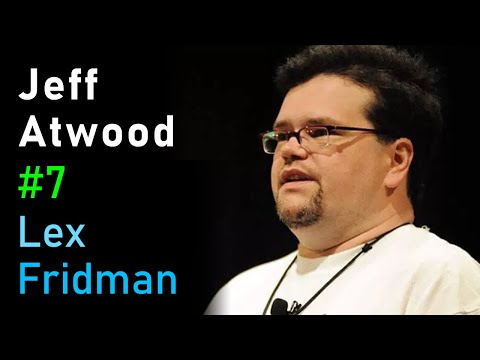
Jeff Atwood: Stack Overflow and Coding Horror | Lex Fridman Podcast #7
Lex Fridman (host), Jeff Atwood (guest)
In this episode of Lex Fridman Podcast, featuring Lex Fridman and Jeff Atwood, Jeff Atwood: Stack Overflow and Coding Horror | Lex Fridman Podcast #7 explores jeff Atwood on puzzles, people, and building strict online communities Jeff Atwood discusses what motivates programmers, arguing that puzzle‑solving, data‑driven tinkering, and peer recognition matter more than fame or money. He contrasts his early life as a hands‑on coder with his current role as a manager, describing leadership as ‘coding in language’—using communication, example, and shared decision‑making to scale impact. Atwood explains how Stack Overflow evolved into a strict, wiki‑like Q&A engine and why that strictness creates both exceptional answers and user anxiety. He then outlines Discourse’s mission: open‑source, community‑owned discussion software that supports richer, interest‑based conversations than social platforms like Facebook, and shares broader lessons on startups, community‑building, and the future of programming.
Jeff Atwood on puzzles, people, and building strict online communities
Jeff Atwood discusses what motivates programmers, arguing that puzzle‑solving, data‑driven tinkering, and peer recognition matter more than fame or money. He contrasts his early life as a hands‑on coder with his current role as a manager, describing leadership as ‘coding in language’—using communication, example, and shared decision‑making to scale impact. Atwood explains how Stack Overflow evolved into a strict, wiki‑like Q&A engine and why that strictness creates both exceptional answers and user anxiety. He then outlines Discourse’s mission: open‑source, community‑owned discussion software that supports richer, interest‑based conversations than social platforms like Facebook, and shares broader lessons on startups, community‑building, and the future of programming.
Key Takeaways
Programmers are driven by puzzles and data‑driven experimentation, not just money.
Atwood emphasizes the joy of beating on a problem with brute‑force code and data—like simulating shuffles or the Monty Hall problem—where you don’t need to be ‘smart’ so much as persistent and empirical.
Get the full analysis with uListen AI
Leadership is ‘coding in language’ and requires example, passion, and feedback.
He argues that good leaders model the behavior they want to see, stay visibly passionate about the underlying problem (not just their solution), and build systems for honest feedback and shared decision‑making among multiple leaders.
Get the full analysis with uListen AI
Strict systems like Stack Overflow’s produce higher‑quality results but more friction.
Over time Stack Overflow evolved into a narrow, strict Q&A tool: questions must be general, answerable, and reusable; reputation must map to real technical contribution, not jokes or social content. ...
Get the full analysis with uListen AI
Discussion forums fill a different need than Q&A and must embrace sociality.
Stack Overflow works for fact‑based, verifiable questions, but fails for social, hobbyist, or open‑ended topics like Lego or poker. ...
Get the full analysis with uListen AI
Healthy communities and products grow from persistent, visible, two‑way engagement.
Atwood describes blogging regularly, folding reader feedback into Stack Overflow, and using Meta communities to surface the ‘10% that’s gold’—including features he never would have thought of—showing that transparent reasoning and ritual participation attract and retain members.
Get the full analysis with uListen AI
To scale as a programmer, you eventually stop coding and work at higher abstractions.
He notes that beyond a certain point, your leverage comes from hiring, coordination, conceptual design, and communication—‘programming people and systems’—rather than writing individual lines of code, much like moving from assembly to high‑level languages.
Get the full analysis with uListen AI
Iteration speed is a core health metric for any software or tech company.
Atwood frames the time it takes to safely change a single word in the UI and ship it as the company’s ‘heartbeat’; if that cycle is weeks, you’re effectively dead, whereas fast, continuous iteration lets you outpace competitors and co‑evolve with users.
Get the full analysis with uListen AI
Notable Quotes
“Language is code.”
— Jeff Atwood
“Strictness isn’t the goal. Strictness produces better results.”
— Jeff Atwood
“Eventually, as a programmer, you have to kind of stop writing code to be effective.”
— Jeff Atwood
“I want a world where communities can own themselves, set their own norms, set their own rules.”
— Jeff Atwood
“If you can’t come up with one interesting thing per day to talk about, then you’re not trying hard enough.”
— Jeff Atwood
Questions Answered in This Episode
How could Stack Overflow better support true beginners without compromising its strict quality standards?
Jeff Atwood discusses what motivates programmers, arguing that puzzle‑solving, data‑driven tinkering, and peer recognition matter more than fame or money. ...
Get the full analysis with uListen AI
What concrete practices can technical leaders adopt to ‘code in language’ more effectively with their teams?
Get the full analysis with uListen AI
Where is the line between healthy strictness and unnecessary hostility in online technical communities?
Get the full analysis with uListen AI
How might Discourse evolve to compete with or complement large social platforms as more communication centralizes on them?
Get the full analysis with uListen AI
Given the trend toward higher‑level abstractions and AI assistance, what skills should new programmers prioritize to remain valuable over the next 10–20 years?
Get the full analysis with uListen AI
Transcript Preview
The following is a conversation with Jeff Atwood. He is the co-founder of Stack Overflow and Stack Exchange, websites that are visited by millions of people every single day. Much like with Wikipedia, it is difficult to understate the impact on global knowledge and productivity that these networks of sites have created. Jeff is also the author of the famed blog Coding Horror, and the founder of Discourse, an open source software project that seeks to improve the quality of our online community discussions. This conversation is part of the MIT course on Artificial General Intelligence, and the Artificial Intelligence Podcast. If you enjoy it, subscribe on YouTube, iTunes, or your podcast provider of choice, or simply connect with me on Twitter @lexfrid. Spelled F-R-I-D. And now, here's my conversation with Jeff Atwood. Having co-created and managed for a few years the world's largest community of programmers in Stack Overflow, 10 years ago, what do you think, uh, motivates most programmers? Is it fame, fortune, glory, process of programming itself, or is it the sense of belonging to a community?
I think it's, uh, puzzles really. I think it's this idea of working on puzzles independently of other people and just solving a problem, sort of like on your own almost. Although, you don't, nobody really works alone in programming anymore. But I will say there's a, there's an aspect of sort of hiding yourself away and just sort of beating on a problem til you solve it. Like, brute force basically, to me is what a lot of programming is, is like the computer's so fast, right, that you can do things that would take forever for a human, but you can just do 'em like so many times and so often that you, you get the answer, right?
You're saying just the pure act of tinkering with the code-
Yes.
... is, is the thing that drives most programmers. The, the joy, the struggle balanced within the joy of overcoming the, the brute force process of pain and suffering that eventually leads to something that actually works? That-
Well data's fun too. Like there's this thing called the, uh, the shuffling problem. Like the naïve shuffle that most programmers write has a huge flaw, and there's a (laughs) lot of articles online about this 'cause it can be really bad if you're like a casino and you have an unsophisticated programmer writing your shuffle algorithm. There are surprising ways to get this wrong, but the neat thing is, the way to figure that out is just to run your shuffle a bunch of times and see, like, how many orientations of cards you get. You should get a l- an equal distribution of all the cards. And with the naïve method of shuffling, if you just look at the data, if you just brute force and say, "Okay, I don't know what's gonna happen." Um, you just writ- write a program that does it a billion times and then see what the buckets look like of the data. And the Monty Hall problem is another example of that, where you have three doors and somebody gives you information about another door. So the an- correct answer is you should always switch, in the Monty Hall problem, which is not intuitive and peop- it freaks people out all the time, right? But, you can solve it with data. If you write a program that does the Monty Hall, you know, game, and then never switches then always switches and just compare, you would immediately see that you don't have to be smart, right? You don't have to figure out the answer algorithmically, you can just brute force it out with data and say, "Well I know the answer is this because I ran the program a billion times and these are the data buckets that I got from it." Right?
Install uListen to search the full transcript and get AI-powered insights
Get Full TranscriptGet more from every podcast
AI summaries, searchable transcripts, and fact-checking. Free forever.
Add to Chrome