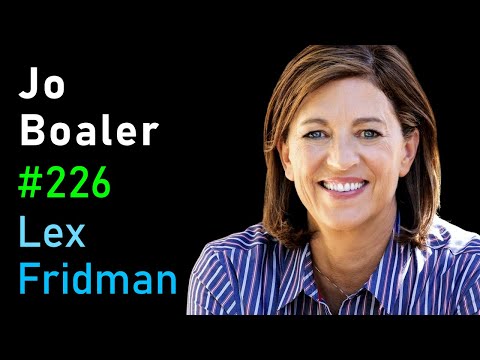
Jo Boaler: How to Learn Math | Lex Fridman Podcast #226
Lex Fridman (host), Jo Boaler (guest), Narrator
In this episode of Lex Fridman Podcast, featuring Lex Fridman and Jo Boaler, Jo Boaler: How to Learn Math | Lex Fridman Podcast #226 explores jo Boaler Redefines How We Learn, Teach, and Love Mathematics Lex Fridman and Jo Boaler discuss why mathematics is inherently visual, creative, and multidimensional rather than a rigid set of procedures and answers.
Jo Boaler Redefines How We Learn, Teach, and Love Mathematics
Lex Fridman and Jo Boaler discuss why mathematics is inherently visual, creative, and multidimensional rather than a rigid set of procedures and answers.
Boaler explains neuroscience findings on how rich, varied math experiences build connected brains, and argues that struggle, intuition, and collaboration are central to real mathematical thinking.
They critique traditional schooling—textbooks, grades, timed tests, and the myth of ‘math people’—and explore alternatives like big-idea teaching, visual tasks, and data science curricula.
The conversation emphasizes the transformational roles teachers and parents can play, the importance of believing in students’ potential, and practical ways to reduce math anxiety and foster deep, flexible thinking.
Key Takeaways
Make math visual, multi-sensory, and story-based.
Neuroscience shows that high achievers connect multiple brain pathways—numeric, visual, verbal, and physical. ...
Get the full analysis with uListen AI
Treat struggle as the productive core of learning, not a failure signal.
When students find math hard, their brains are making new connections; quitting usually stems from believing they’re ‘not a math person’. ...
Get the full analysis with uListen AI
Combat the ‘math people’ myth by explicitly conveying belief in students.
A single sentence—“I’m giving you this feedback because I believe in you”—was shown to raise achievement a year later. ...
Get the full analysis with uListen AI
Teach big ideas through rich tasks instead of fragmented standards.
Breaking math into dozens of tiny standards and short textbook exercises hides the conceptual map. ...
Get the full analysis with uListen AI
Use collaboration to build deeper reasoning and reduce social comparison.
Students initially treat group work as parallel solo work and compare who's ‘better’; when taught to truly collaborate, they start valuing others’ perspectives, perform better on applied problems, and experience math as a shared creative endeavor.
Get the full analysis with uListen AI
Parents must avoid passing on math anxiety, especially through casual comments.
Studies show that parents’ math anxiety harms children’s achievement when they help with homework, and that mothers saying “I was bad at math” lowers daughters’ performance. ...
Get the full analysis with uListen AI
Design practice around questions, reflection, and pattern-hunting—not just repetition.
Simply rereading notes or watching explanations creates an illusion of understanding. ...
Get the full analysis with uListen AI
Notable Quotes
“You can take any area of maths and make it visual.”
— Jo Boaler
“We should all be thinking about maths visually.”
— Jo Boaler
“When you struggle, that's actually a really good time for your brain.”
— Jo Boaler
“Our school system is set up to value good memorizers and push away those creative deep thinkers.”
— Jo Boaler
“Scientists try to find a limit to how much you can learn—and they always come away not being able to find it.”
— Jo Boaler
Questions Answered in This Episode
How can a traditional teacher realistically shift toward ‘big idea’ math teaching within the constraints of pacing guides and standardized tests?
Lex Fridman and Jo Boaler discuss why mathematics is inherently visual, creative, and multidimensional rather than a rigid set of procedures and answers.
Get the full analysis with uListen AI
What specific classroom routines best help students reinterpret struggle and mistakes as positive parts of learning rather than evidence of lack of ability?
Boaler explains neuroscience findings on how rich, varied math experiences build connected brains, and argues that struggle, intuition, and collaboration are central to real mathematical thinking.
Get the full analysis with uListen AI
How might we redesign assessments so they reward creativity, visualization, and collaboration instead of speed and rote procedure?
They critique traditional schooling—textbooks, grades, timed tests, and the myth of ‘math people’—and explore alternatives like big-idea teaching, visual tasks, and data science curricula.
Get the full analysis with uListen AI
What are practical ways for parents with strong math anxiety to support their children’s mathematical growth without transmitting their own fears?
The conversation emphasizes the transformational roles teachers and parents can play, the importance of believing in students’ potential, and practical ways to reduce math anxiety and foster deep, flexible thinking.
Get the full analysis with uListen AI
If data science and programming become core in K–12 education, how should that reshape what we teach (and stop teaching) in algebra and calculus?
Get the full analysis with uListen AI
Transcript Preview
The following is a conversation with Jo Boaler, a mathematics educator at Stanford and co-founder of youcubed.org that seeks to inspire young minds with the beauty of mathematics. To support this podcast, please check out our sponsors in the description. This is the Lex Fridman podcast and here is my conversation with Jo Boaler. What to you is beautiful about mathematics?
I love a mathematics that some people don't even think of as mathematics (laughs) , which is beautiful, creative mathematics where we look at maths in different ways, we visualize it, we think about different solutions to problems. A lot of people think of maths as you have one method and one answer, and what I love about maths is the multiple different ways you can see things, different methods, different ways of seeing, different... in some cases, different solutions. So that is what is beautiful to me about mathematics, that you can see and solve it in many different ways. And also, the sad part that many people think that maths is just one answer and one method.
Mm-hmm. So to you the beautiful, the beauty emerges when you have a problem with a solution and you start adding other solutions, simpler solutions-
Mm-hmm.
... uh, weirder solutions, more interesting-
Yeah.
... some that are visual, some that are algebraic, geometry, all that kind of stuff.
Yeah. I mean, I, I always say that you can take any maths area and make it visual.
Mm-hmm.
And we say to teachers, "Give us your most dry, boring maths and we'll make it a visual, interesting, creative problem." And turns out you can do that with any area of maths. And I think we've given pe- it's been a great disservice to kids and others that it's always been numbers, lots and lots of numbers. Numbers can be great, but you can think about maths in other ways besides numbers.
Do you find that most people are better visual learners or is this just something that's complementary? The, uh, what, what's the kind of the full spectrum of students-
Mm-hmm.
... and the way they like to explore math would you say?
I mean, there's definitely people who come into the classes I do who are more interested in visual thinking and like visual approaches, but it turns out, what the neuroscience is telling us, is that when we think about maths there are two visual pathways in the brain and we should all be thinking about it visually. Some approaches have been to say, "Well, you're a visual learner so we'll give you visuals," and, "You're not a visual learner." But actually if you think you're not a visual learner, it's probably more important that you have a visual approach so you can develop that part of your brain.
So you were saying that there's some kind of interconnected aspect to it, so the visual connects with the nonvisual?
Install uListen to search the full transcript and get AI-powered insights
Get Full TranscriptGet more from every podcast
AI summaries, searchable transcripts, and fact-checking. Free forever.
Add to Chrome