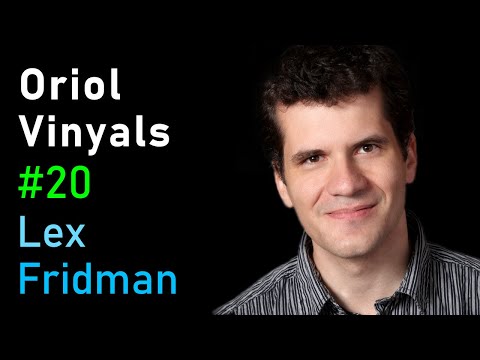
Oriol Vinyals: DeepMind AlphaStar, StarCraft, and Language | Lex Fridman Podcast #20
Lex Fridman (host), Oriol Vinyals (guest)
In this episode of Lex Fridman Podcast, featuring Lex Fridman and Oriol Vinyals, Oriol Vinyals: DeepMind AlphaStar, StarCraft, and Language | Lex Fridman Podcast #20 explores deepMind’s AlphaStar: StarCraft Mastery, Language Roots, and Future AI Oriol Vinyals discusses leading DeepMind’s AlphaStar project, the first StarCraft II system to beat top professional players, and explains why StarCraft is a uniquely challenging testbed for AI compared to Go or Atari.
DeepMind’s AlphaStar: StarCraft Mastery, Language Roots, and Future AI
Oriol Vinyals discusses leading DeepMind’s AlphaStar project, the first StarCraft II system to beat top professional players, and explains why StarCraft is a uniquely challenging testbed for AI compared to Go or Atari.
He details AlphaStar’s architecture, training pipeline, and the heavy reuse of sequence and language-modeling ideas (LSTMs, Transformers, imitation learning) to handle long, partially observable, real‑time decision processes.
The conversation covers the broader evolution of online gaming and esports, the role of self-play and population-based training, and how human-like constraints (APM limits, imperfect information) shape the research.
Vinyals reflects on the limits of current deep learning, the importance of generalization and meta‑learning, cautious views on AGI and AI risk, and how game-based research can feed back into language, vision, and real-world applications.
Key Takeaways
Treat complex environments as sequence problems to leverage language-model advances.
AlphaStar reuses sequence‑to‑sequence and Transformer ideas from neural machine translation, framing StarCraft as predicting the next action given a long history of observations and actions, which makes high-dimensional temporal decision-making tractable.
Get the full analysis with uListen AI
Bootstrap exploration with large-scale imitation learning to overcome sparse rewards.
Pure RL in StarCraft fails because almost all random early-game actions are catastrophically bad; initializing a policy from millions of human replays gives the agent basic competence and drastically reduces the exploration burden.
Get the full analysis with uListen AI
Use population-based self-play to cover diverse strategies, not a single ‘best’ policy.
The AlphaStar League intentionally maintains a population of agents with different ‘personalities’ (standard, greedy macro, cheese, all‑ins) so training covers the wide strategy space and avoids collapsing to a narrow self-play equilibrium.
Get the full analysis with uListen AI
Human-like constraints matter when evaluating ‘superhuman’ performance.
Enforcing realistic limits on actions per minute and precision is nontrivial, but essential to make comparisons with pros meaningful; otherwise the system could exploit inhuman speed and accuracy rather than better strategy.
Get the full analysis with uListen AI
Generalization and meta-learning are core unsolved problems in deep learning.
Today’s systems excel at a single task or game and must throw away weights to start over on new tasks; Vinyals argues progress requires models that can rapidly adapt to new domains (e. ...
Get the full analysis with uListen AI
Combining neural nets with discrete structure and programs may improve robustness.
Purely statistical neural approaches struggle with strong generalization and corner cases, whereas program-like components offer provable behavior (e. ...
Get the full analysis with uListen AI
Game-based AI research has direct feedback into language, vision, and tools.
Techniques developed for AlphaStar—large-scale imitation, Transformer variants, object/set representations, population self-play—are already influencing work in NLP, computer vision, and could inform assistants, planning systems, and complex simulation-based applications.
Get the full analysis with uListen AI
Notable Quotes
“For me, the main challenge in deep learning is generalization.”
— Oriol Vinyals
“It really felt like science fiction to think of doing the full game with just a neural network—and no rules.”
— Oriol Vinyals
“StarCraft is kind of chess where you don’t see the other side of the board, you’re building your own pieces, and you must gather resources to do it.”
— Oriol Vinyals
“A single neural net on a GPU is actually playing against these guys who are amazing.”
— Oriol Vinyals
“The formula that has worked best for me is: find a hard problem, then let that problem drive the research.”
— Oriol Vinyals
Questions Answered in This Episode
How could the AlphaStar approach be adapted to domains with real-world stakes, like logistics, healthcare, or finance, where exploration is costly or dangerous?
Oriol Vinyals discusses leading DeepMind’s AlphaStar project, the first StarCraft II system to beat top professional players, and explains why StarCraft is a uniquely challenging testbed for AI compared to Go or Atari.
Get the full analysis with uListen AI
What concrete benchmarks or task suites would convincingly demonstrate meta-learning and rapid cross-domain generalization in the next decade?
He details AlphaStar’s architecture, training pipeline, and the heavy reuse of sequence and language-modeling ideas (LSTMs, Transformers, imitation learning) to handle long, partially observable, real‑time decision processes.
Get the full analysis with uListen AI
How far can we push current Transformer-style architectures before fundamental limits in generalization or interpretability force a paradigm shift?
The conversation covers the broader evolution of online gaming and esports, the role of self-play and population-based training, and how human-like constraints (APM limits, imperfect information) shape the research.
Get the full analysis with uListen AI
In designing future AI benchmarks, how should we balance human-like constraints (speed, perception limits) against the desire to see what unconstrained systems can do?
Vinyals reflects on the limits of current deep learning, the importance of generalization and meta‑learning, cautious views on AGI and AI risk, and how game-based research can feed back into language, vision, and real-world applications.
Get the full analysis with uListen AI
What is the most promising way to integrate program-like, symbolic, or graph-based structure with deep learning in large, real-time decision problems like StarCraft?
Get the full analysis with uListen AI
Transcript Preview
The following is a conversation with Ariel Viñales. He's a senior research scientist at Google DeepMind, and before that, he was at Google Brain and Berkeley. His research has been cited over 39,000 times. He's truly one of the most brilliant and impactful minds in the field of deep learning. He's behind some of the biggest papers and ideas in AI, including sequence-to-sequence learning, audio generation, image captioning, neural machine translation, and of course, reinforcement learning. He's a lead researcher of the AlphaStar project, creating an agent that defeated a top professional at the game of StarCraft. This conversation is part of the Artificial Intelligence podcast. If you enjoy it, subscribe on YouTube, iTunes, or simply connect with me on Twitter @lexfridman, spelled F-R-I-D. And now here's my conversation with Ariel Viñales. You spearheaded the DeepMind team behind AlphaStar that recently beat a, uh, top professional player at StarCraft. So, you have an incredible wealth of work in deep learning and a bunch of fields, but let's talk about StarCraft first. Let's go back to the very beginning, even before AlphaStar, before DeepMind, before deep learning. First, what came, uh, first for you, a love for programming or a love for video games?
I think for me, it definitely came first the drive to play video games. I really liked computers. I didn't really code much, but what I would do is I would just mess with the computer, break it and fix it. That was the level of skills, I guess, that I gained in my very early days, I mean, when I was 10 or 11. Um, and then I- I really got into video games, especially StarCraft, actually, the first version. I spent most of my time just playing kind of pseudo-professionally, as professionally as you could play back in '98 in Europe, which was not a very main scene like the- what's called nowadays eSports.
Right. Of course, in the '90s. So, uh, how'd you get into StarCraft? What- what was your favorite race? How- how do you develop- how did you develop your skill? What- what was your strategy? All that kind of thing.
So as a player, I tended to try to play not many games, not to kind of disclose the strategies that I kind of developed, and I like to play random, actually. Not in competitions, but just to... I- I think in StarCraft there's, well, there's three main races, and I found it very useful to play with all of them. Um, so I would choose random many times, even sometimes in tournaments to gain skill on the three races, because it's not how you play against someone, but also if you understand the race because you play it, you also understand what's annoying, what... Then when you're on the other side, what to do to annoy that person, to try to gain advantages here and there and so on. So, I actually played random. Although I must say, in terms of favorite race, I really like Zerg. Um, I was probably best at Zerg, um, and that's probably what I tend to use towards the end of my career before starting university.
Install uListen to search the full transcript and get AI-powered insights
Get Full TranscriptGet more from every podcast
AI summaries, searchable transcripts, and fact-checking. Free forever.
Add to Chrome