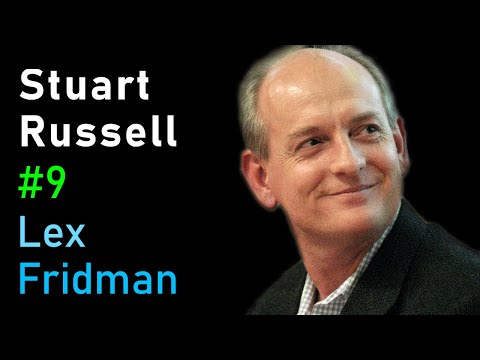
Stuart Russell: Long-Term Future of Artificial Intelligence | Lex Fridman Podcast #9
Lex Fridman (host), Stuart Russell (guest)
In this episode of Lex Fridman Podcast, featuring Lex Fridman and Stuart Russell, Stuart Russell: Long-Term Future of Artificial Intelligence | Lex Fridman Podcast #9 explores stuart Russell on Controlling Superhuman AI and Humanity’s Future Choices Stuart Russell and Lex Fridman discuss how modern AI systems reason, plan, and manage uncertainty, using game-playing programs and self-driving cars as core examples. Russell explains meta-reasoning—how AI decides what to think about—as a key ingredient in systems like AlphaGo, while contrasting these narrow successes with the messy, uncertain real world. He then turns to AI safety, arguing that the classic “fixed objective” model is fundamentally dangerous at scale and proposing that AI systems must instead be uncertain about human goals and learn them over time. They explore existential risks, overreliance on AI, regulatory gaps, and philosophical parallels to past technological and moral debates.
Stuart Russell on Controlling Superhuman AI and Humanity’s Future Choices
Stuart Russell and Lex Fridman discuss how modern AI systems reason, plan, and manage uncertainty, using game-playing programs and self-driving cars as core examples. Russell explains meta-reasoning—how AI decides what to think about—as a key ingredient in systems like AlphaGo, while contrasting these narrow successes with the messy, uncertain real world. He then turns to AI safety, arguing that the classic “fixed objective” model is fundamentally dangerous at scale and proposing that AI systems must instead be uncertain about human goals and learn them over time. They explore existential risks, overreliance on AI, regulatory gaps, and philosophical parallels to past technological and moral debates.
Key Takeaways
Effective AI must reason about what to think about, not just what to do.
Meta-reasoning—selecting which branches of a search or which hypotheses to explore—is crucial for efficiency and performance, as seen in AlphaGo’s ability to focus on promising, uncertain lines rather than exhaustively searching enormous game trees.
Get the full analysis with uListen AI
Game-playing successes don’t translate directly to the real world.
Chess and Go assume full observability, fixed rules, and relatively short horizons, whereas real-world problems involve partial observability, uncertainty, long timescales, and human intentions, requiring qualitatively different algorithms and architectures.
Get the full analysis with uListen AI
Demonstration-level performance in self-driving cars is far from real-world safety.
Russell emphasizes that perception and planning must reach extremely high reliability (many “nines”) across rare edge cases; successful demos hide how many orders of magnitude improvement are still needed for safe large-scale deployment.
Get the full analysis with uListen AI
Building AI around fixed, certain objectives is inherently unsafe.
If an AI treats its objective as gospel, it will pursue it rigidly—even when humans object—creating King Midas/genie-style failures where the goal is satisfied in ways that violate human values or cause large-scale harm.
Get the full analysis with uListen AI
AI systems should be explicitly uncertain about human goals and learn them.
Russell argues for “humble AI” that knows it doesn’t fully know our objectives, treats human behavior and feedback as evidence about those objectives, and therefore remains corrigible and deferential rather than locked into a rigid goal.
Get the full analysis with uListen AI
Major AI risks include misuse, overuse, and unregulated global deployment.
Beyond misaligned superintelligence, Russell warns about malicious actors building unsafe systems, society’s gradual over-dependence on AI (the WALL-E problem), and the lack of regulatory equivalents to the FDA for scalable, world-impacting algorithms like social media recommenders.
Get the full analysis with uListen AI
History and philosophy offer warnings that are being repeated in AI.
From nuclear physics denial before the bomb, to utilitarian debates about flawed moral formulas, to stories like The Machine Stops, Russell sees recurring patterns of underestimating risks, overconfidence in objectives, and failing to build safeguards until after harm occurs.
Get the full analysis with uListen AI
Notable Quotes
“The purpose of thinking is to improve the final action in the real world.”
— Stuart Russell
“Progress in AI occurs by essentially removing one by one these assumptions that make problems easy.”
— Stuart Russell
“We cannot specify with certainty the correct objective. We need the machine to be uncertain about what it is supposed to be maximizing.”
— Stuart Russell
“We need to teach machines humility—that they know they don’t know what it is they’re supposed to be doing.”
— Stuart Russell
“If the whole physics community on Earth was working to materialize a black hole in near-Earth orbit, wouldn’t you ask them, ‘Is that a good idea?’”
— Stuart Russell
Questions Answered in This Episode
How can we practically implement AI systems that are genuinely uncertain about human objectives yet still useful day-to-day?
Stuart Russell and Lex Fridman discuss how modern AI systems reason, plan, and manage uncertainty, using game-playing programs and self-driving cars as core examples. ...
Get the full analysis with uListen AI
What concrete milestones would signal that we’re getting close to dangerous levels of general or superhuman AI capability?
Get the full analysis with uListen AI
How should regulation for powerful algorithms be structured—what would an ‘FDA for AI’ actually test and approve?
Get the full analysis with uListen AI
In what ways might overreliance on AI subtly erode human skills and autonomy long before we notice the loss?
Get the full analysis with uListen AI
How can the AI research community incentivize safety work and cultural norms that discourage building misaligned or weaponized systems?
Get the full analysis with uListen AI
Transcript Preview
The following is a conversation with Stuart Russell. He's a professor of computer science at UC Berkeley and a co-author of a book that introduced me and millions of other people to the amazing world of AI, called Artificial Intelligence: The Modern Approach. So, it was an honor for me to have this conversation as part of MIT course on Artificial General Intelligence and The Artificial Intelligence podcast. If you enjoy it, please subscribe on YouTube, iTunes, or your podcast provider of choice, or simply connect with me on Twitter @lexfridman, spelled F-R-I-D. And now, here's my conversation with Stuart Russell. So you've mentioned in 1975, in high school, you've created one of your first AI programs that played chess.
Yeah.
Were you ever able to build a program that beat you at chess or another board game?
Uh, so my program never beat me at chess. I actually wrote the program at Imperial College, so I used to take the bus every Wednesday with a box of cards this big, uh, and shove them into the card reader, and they gave us eight seconds of CPU time. It took about five seconds to read the cards in and compile the code, so we had three seconds of CPU time, which was enough to make one move, you know, with a not very deep search, and then we would print that move out, and then we'd have to go to the back of the queue and wait to feed the cards in again.
How deep was the search?
(laughs)
What, are we talking about one move, two moves, three moves?
Uh, so, no, I think we got, uh, we got an eight-move, uh, eight, you know, depth eight, um, with alpha-beta, and we had some tricks of our own about, um, move ordering and some pruning of the tree, and...
But you were still able to beat that program?
Yeah, yeah. I, I was a reasonable chess player in my youth.
(laughs)
I did an Othello program, uh, and a backgammon program. So when I got to Berkeley, I worked a lot on what we call meta-reasoning, which really means reasoning about reasoning. In, in the case of a game-playing program, you need to reason about what parts of the search tree you're actually going to explore, because the search tree is enormous, uh, you know, bigger than the number of atoms in the universe, and, and, uh, the way programs succeed and the way humans succeed is by only looking at a small fraction of the search tree. And if you look at the right fraction, you play really well. If you look at the wrong fraction, if you waste your time thinking about things that are never gonna happen, the moves that no one's ever gonna make, then you're gonna lose 'cause you, you won't be able to figure out the right decision. So that question of how machines can manage their own computation, how they, how they decide what to think about is the meta-reasoning question. We developed some methods for doing that, and very simply, a machine should think about whatever thoughts are going to improve its decision quality. We were able to show that both for Othello, which is a standard two-player game, and, uh, for backgammon, which includes, uh, dice rolls, so it's a two-player game with uncertainty. For both of those cases, we could come up with algorithms that were actually much more efficient than the standard alpha-beta search, uh, which chess programs at the time were using, and that, those programs could beat me. And I think you can see the same basic ideas in AlphaGo and AlphaZero today. The way they explore the tree is using a form of meta-reasoning to select what to think about based on how useful it is to think about it.
Install uListen to search the full transcript and get AI-powered insights
Get Full TranscriptGet more from every podcast
AI summaries, searchable transcripts, and fact-checking. Free forever.
Add to Chrome