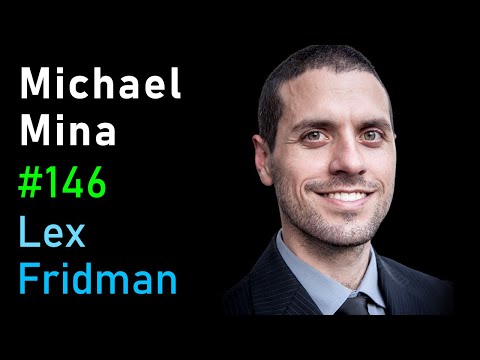
Michael Mina: Rapid Testing, Viruses, and the Engineering Mindset | Lex Fridman Podcast #146
Lex Fridman (host), Michael Mina (guest)
In this episode of Lex Fridman Podcast, featuring Lex Fridman and Michael Mina, Michael Mina: Rapid Testing, Viruses, and the Engineering Mindset | Lex Fridman Podcast #146 explores engineer’s blueprint: rapid tests, viral threat, and public health reimagined Lex Fridman and epidemiologist/immunologist Michael Mina discuss how cheap, rapid at‑home COVID tests could have drastically curtailed the pandemic if deployed at scale, and why regulatory and economic structures prevented that from happening.
Engineer’s blueprint: rapid tests, viral threat, and public health reimagined
Lex Fridman and epidemiologist/immunologist Michael Mina discuss how cheap, rapid at‑home COVID tests could have drastically curtailed the pandemic if deployed at scale, and why regulatory and economic structures prevented that from happening.
Mina explains virus biology and pathogen interactions, the difference between diagnosing infection and detecting contagiousness, and why antigen tests are ideal public-health tools even if they’re less sensitive than PCR for clinical diagnosis.
They explore systemic failures in U.S. public health, arguing for an engineering mindset and a new field of “public health engineering” that treats pandemics as solvable systems problems rather than purely medical ones.
The conversation broadens into pandemic futures, lab-engineered pathogens, AI in biology, Mina’s vision of a global ‘virus weather map,’ and his personal journey through Buddhism, meditation, and disaster response in Sri Lanka.
Key Takeaways
Mass, cheap rapid antigen testing can flip exponential growth into exponential decline.
If widely available at-home tests remove even 30–40% of infectious people from chains of transmission (by informing them to self-isolate), the effective reproduction number (R) drops below 1, causing cases to shrink rather than explode.
Get the full analysis with uListen AI
Antigen tests are optimized for contagiousness detection, not historical diagnosis.
PCR detects tiny amounts of viral RNA long after someone stops being infectious, while antigen tests tend to turn positive mainly when viral load is high and transmissible—making them more useful for real-time public-health decisions.
Get the full analysis with uListen AI
Regulatory frameworks built for clinical diagnostics are actively blocking public-health tools.
In the U. ...
Get the full analysis with uListen AI
Cost and manufacturing scale are solvable engineering problems, not fundamental barriers.
Simple lateral-flow strip tests cost around $1–$1. ...
Get the full analysis with uListen AI
Pandemic response needs an engineering mindset, not solely medical decision-making.
Mina argues that physicians and ‘ivory tower’ academics often chase perfect diagnostic accuracy, while engineers think in terms of systems, tradeoffs, and population-level impact—exactly what is required to stop spread quickly.
Get the full analysis with uListen AI
A global ‘immunological observatory’ could function like a weather system for viruses.
By continuously sampling anonymized blood/plasma and profiling antibodies at scale, we could detect new pathogens early, map spread in near real-time, and give individuals and policymakers risk forecasts (“high COVID flu activity in your ZIP code today—wear a mask”).
Get the full analysis with uListen AI
Future biological risks include both natural influenza shifts and engineered pathogens.
Flu’s segmented genome enables abrupt, highly transmissible antigenic shifts, and modern biotechnology plus AI-driven protein design will increasingly allow deliberate or accidental creation of highly dangerous viruses, making governance of gain-of-function and synthetic biology critical.
Get the full analysis with uListen AI
Notable Quotes
“We let perfection get in the way of actually doing something at all.”
— Michael Mina
“This is an engineering problem, and we put physicians in charge of it.”
— Michael Mina
“This stupid little paper strip test could have changed the course of the pandemic.”
— Michael Mina
“In public health, we only care about finding the people who are infectious today.”
— Michael Mina
“We go into every flu season blindfolded with our hands tied behind our back.”
— Michael Mina
Questions Answered in This Episode
What concrete policy mechanisms could bypass or reform current FDA/CMS rules to authorize rapid tests explicitly as public-health tools rather than medical devices?
Lex Fridman and epidemiologist/immunologist Michael Mina discuss how cheap, rapid at‑home COVID tests could have drastically curtailed the pandemic if deployed at scale, and why regulatory and economic structures prevented that from happening.
Get the full analysis with uListen AI
How would a global immunological observatory handle privacy, consent, and data governance while still offering high-resolution, real-time viral ‘weather’ forecasts?
Mina explains virus biology and pathogen interactions, the difference between diagnosing infection and detecting contagiousness, and why antigen tests are ideal public-health tools even if they’re less sensitive than PCR for clinical diagnosis.
Get the full analysis with uListen AI
In practice, how should societies balance the benefits of gain-of-function and AI-enabled protein design research with the existential risks they create?
They explore systemic failures in U. ...
Get the full analysis with uListen AI
What institutional structures would a new discipline of ‘public health engineering’ require, and how could universities and governments seed it quickly?
The conversation broadens into pandemic futures, lab-engineered pathogens, AI in biology, Mina’s vision of a global ‘virus weather map,’ and his personal journey through Buddhism, meditation, and disaster response in Sri Lanka.
Get the full analysis with uListen AI
Given what we’ve learned from COVID-19, what early-warning signals and response triggers should be in place before the next potentially catastrophic influenza or coronavirus emerges?
Get the full analysis with uListen AI
Transcript Preview
The following is a conversation with Michael Mina. He's a professor at Harvard doing research on infectious disease and immunology. The most defining characteristic of his approach to science and biology is that of a first principles thinker and engineer, focused not just on defining the problem but finding the solution. In that spirit, we talk about cheap rapid at-home testing, which is a solution to COVID-19 that, to me, has become one of the most obvious powerful and doable solutions that, frankly, should have been done months ago and still should be done now. As we talk about, its accuracy is high for detecting actual contagiousness, and hundreds of millions can be manufactured quickly and relatively cheaply. In general, I love engineering solutions like these, even if government bureaucracies often don't. It respects science and data. It respects our freedom. It respects our intelligence and basic common sense. Quick mention of each sponsor followed by some thoughts related to the episode. Thank you to Brave, a fast browser that feels like Chrome but has more privacy-preserving features. Athletic Greens, the all-in-one drink that I start every day with to cover all my nutritional bases. ExpressVPN, the VPN I've used for many years to protect my privacy on the internet. And Cash App, the app I use to send money to friends. Please check out these sponsors in the description to get a discount and to support this podcast. As a side note, let me say that I've always been solution-oriented, not problem-oriented. It saddens me to see that public discourse disproportionately focuses on the mistakes of those who dare to build solutions rather than applaud their attempt to do so. Teddy Roosevelt said it well in his The Man in the Arena speech over 100 years ago, "I should say that both the critic and the creator are important, but in my humble estimation, there are too many now of the former and not enough of the latter." So while we spread the derisive words of the critic on social media, making it viral, let's not forget that this world is built on the blood, sweat, and tears of those who dare to create. If you enjoy this thing, subscribe on YouTube, review it with five stars on Apple Podcasts, follow on Spotify, support on Patreon, or connect with me on Twitter, @lexfridman. And now, here's my conversation with Michael Mina. What is the most beautiful, mysterious, or surprising idea in the biology of humans or viruses that you've ever come across in your work? Sorry for the overly philosophical question. (laughs)
(laughs) Wow. Well, that's a great question. You know, I love the pathogenesis of viruses and, uh, one of the things that I've worked on, uh, a lot is trying to understand how viruses interact with each other. And, uh, so pre-, you know, all this COVID stuff (laughs) , I was, uh, I was really, really dedicated to understanding, uh, how, uh, how viruses impact, uh, other pathogens, so how if somebody gets an infection with one thing or a vaccine, does it either benefit or harm you from other things that appear to be unrelated to, in the, uh, to most people. And so one, one system which is highly detrimental to humans but what I think is just immensely fascinating is measles. And, uh, measles gets into a kid's body. The immune system picks it up and, uh, essentially, uh, grabs the virus and, uh, does exactly what it's supposed to do, which is to take this virus and bring it into the immune system so that the immune system can learn from it, can develop an immune response to it, but instead measles plays a trick. It gets into the immune system, serves almost as a Trojan horse, and instead of getting eaten by these g- by these cells, it just takes them over and it ends up proliferating in the very cells that were supposed to kill it. Uh, and, uh, it just distributes throughout the entire body, gets into the bone marrow, kills off children's, uh, immune memories, and so it essentially, uh, what I've found and what my research has found is that this one virus was responsible for as much as half of all the infectious disease deaths in kids before we started vaccinating against it 'cause it was just wiping out children's immune memories to all different pathogens which is, you know, I think, um, just astounding. It's just amazing to watch it spread throughout bodies. We've done the studies in monkeys and, and you can watch it just destroy and obliterate people's immune memories in the same way that, you know, some parasite might destroy somebody's brain when... you know, it's...
Install uListen to search the full transcript and get AI-powered insights
Get Full TranscriptGet more from every podcast
AI summaries, searchable transcripts, and fact-checking. Free forever.
Add to Chrome