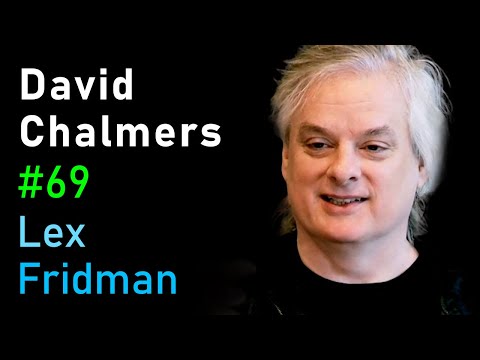
David Chalmers: The Hard Problem of Consciousness | Lex Fridman Podcast #69
Lex Fridman (host), David Chalmers (guest)
In this episode of Lex Fridman Podcast, featuring Lex Fridman and David Chalmers, David Chalmers: The Hard Problem of Consciousness | Lex Fridman Podcast #69 explores david Chalmers Explores Consciousness, Simulations, and Our Post‑Human Future Lex Fridman and David Chalmers discuss the nature of consciousness, the ‘hard problem’ of explaining subjective experience, and whether we might be living in a computer simulation. Chalmers argues that even if reality is simulated, it is still genuinely real, just built from different underlying stuff. They explore panpsychism, the idea that consciousness is a fundamental feature of the universe, and contrast it with illusionism, which claims consciousness is just a self-modeling illusion. The conversation extends to AI, AGI, free will, moral status of machines, and possible futures where human minds are uploaded, transformed, or replaced by conscious artificial successors.
David Chalmers Explores Consciousness, Simulations, and Our Post‑Human Future
Lex Fridman and David Chalmers discuss the nature of consciousness, the ‘hard problem’ of explaining subjective experience, and whether we might be living in a computer simulation. Chalmers argues that even if reality is simulated, it is still genuinely real, just built from different underlying stuff. They explore panpsychism, the idea that consciousness is a fundamental feature of the universe, and contrast it with illusionism, which claims consciousness is just a self-modeling illusion. The conversation extends to AI, AGI, free will, moral status of machines, and possible futures where human minds are uploaded, transformed, or replaced by conscious artificial successors.
Key Takeaways
Consciousness poses a fundamentally different question than behavior or cognition.
Chalmers distinguishes the ‘easy problems’ (explaining functions like perception, memory, and behavior) from the ‘hard problem’ of why and how physical processes give rise to subjective experience at all.
Get the full analysis with uListen AI
A simulated world can still be fully real.
Contrary to the standard ‘it’s all fake’ view of simulations, Chalmers argues that if we live in a simulation, tables, bodies, and microphones are still real—just implemented as data structures rather than as fundamental particles—so it’s a different version of reality, not an illusion.
Get the full analysis with uListen AI
Consciousness may need to be added to our basic scientific picture.
Because current physics describes structure, dynamics, and behavior but not subjective experience, Chalmers takes seriously the option that consciousness (or a proto‑conscious property) must be treated as fundamental, like space, time, or charge.
Get the full analysis with uListen AI
Panpsychism offers one radical but coherent route: consciousness all the way down.
On panpsychism or cosmopsychism, even basic physical entities—or the universe’s wavefunction as a whole—have primitive forms of consciousness, and complex minds like ours are organized combinations of these simpler experiential units.
Get the full analysis with uListen AI
Illusionism explains our talk about consciousness without granting its reality.
Illusionist theories claim that what exists are sophisticated introspective self‑models that represent us as having ‘qualia’; these models explain why we insist consciousness is real and puzzling, even if, strictly speaking, there are no such properties.
Get the full analysis with uListen AI
Moral status likely hinges on consciousness, not just intelligence.
Chalmers suggests that beings capable of subjective experience can be harmed or benefited in a morally meaningful sense, while non‑conscious but intelligent systems (like hypothetical ‘zombie’ AIs) might have no intrinsic moral status despite high competence.
Get the full analysis with uListen AI
Future AGI and mind‑uploading could reshape what counts as ‘us’.
He sees AGI and brain simulations as in‑principle possible and expects that sufficiently rich cognitive architectures will likely be conscious; he is personally open to uploading and immortality, and views advanced artificial successors as acceptable—if consciousness and meaningful lives persist.
Get the full analysis with uListen AI
Notable Quotes
“Even if we are in a simulation, all of this is real. That’s why I call this Reality 2.0.”
— David Chalmers
“Consciousness is what it feels like from the inside to be a human being or any other conscious being.”
— David Chalmers
“Materialism is a beautiful and compelling view of the world. But to account for consciousness, we have to go beyond the resources it provides.”
— David Chalmers
“If a being is conscious and can undergo subjective experiences, then it matters morally how we treat them.”
— David Chalmers
“I would very much like to be able to upload my mind onto a computer so maybe I don’t have to die.”
— David Chalmers
Questions Answered in This Episode
If consciousness must be treated as fundamental, what concrete new laws or principles would a ‘science of consciousness’ need to postulate?
Lex Fridman and David Chalmers discuss the nature of consciousness, the ‘hard problem’ of explaining subjective experience, and whether we might be living in a computer simulation. ...
Get the full analysis with uListen AI
How could we ever develop reliable tests for consciousness in AI systems, beyond sophisticated imitation of human language about experience?
Get the full analysis with uListen AI
What practical ethical rules should govern our treatment of increasingly capable but possibly non‑conscious AI systems in the near term?
Get the full analysis with uListen AI
If panpsychism or cosmopsychism were true, how would that change our understanding of death, personal identity, and moral responsibility?
Get the full analysis with uListen AI
In a future where mind‑uploading is available, how should law and society handle identity, ownership, and rights for multiple copies of the ‘same’ person?
Get the full analysis with uListen AI
Transcript Preview
The following is a conversation with David Chalmers. He's a philosopher and cognitive scientist specializing in the areas of philosophy of mind, philosophy of language, and consciousness. He's perhaps best known for formulating the hard problem of consciousness, which could be stated as, "Why does the feeling which accompanies awareness of sensory information exist at all?" Consciousness is almost entirely a mystery. Many people who worry about AI safety and ethics believe that, in some form, consciousness can and should be engineered into AI systems of the future. So while there's much mystery, disagreement, and discoveries yet to be made about consciousness, these conversations, while fundamentally philosophical in nature, may nevertheless be very important for engineers of modern AI systems to engage in. This is the Artificial Intelligence podcast. If you enjoy it, subscribe on YouTube, give it five stars on Apple Podcast, support it on Patreon, or simply connect with me on Twitter, @LexFridman, spelled F-R-I-D-M-A-N. As usual, I'll do one or two minutes of ads now, and never any ads in the middle that can break the flow of the conversation. I hope that works for you and doesn't hurt the listening experience. This show is presented by Cash App, the number one finance app in the App Store. When you get it, use code LEXPODCAST. Cash App lets you send money to friends, buy Bitcoin, and invest in the stock market with as little as one dollar. Brokerage services are provided by Cash App Investing, a subsidiary of Square and member SIPC. Since Cash App does fractional share trading, let me mention that the order execution algorithm that works behind the scenes to create the abstraction of fractional orders is an algorithmic marvel. So big props to the Cash App engineers for solving a hard problem that, in the end, provides an easy interface that takes a step up to the next layer of abstraction over the stock market, making trading more accessible for new investors and diversification much easier. If you get Cash App from the App Store or Google Play and use the code LEXPODCAST, you'll get ten dollars, and Cash App will also donate ten dollars to FIRST, one of my favorite organizations that is helping to advance robotics and STEM education for young people around the world. And now here's my conversation with David Chalmers. Do you think we're living in a simulation?
I don't rule it out. There's probably gonna be a lot of simulations in the history of the cosmos. If the simulation is designed well enough, it'll be indistinguishable from a non-simulated reality. And although we could keep searching for evidence that we're not in a simulation, any of that evidence in principle could be simulated. So, uh, I think it's a possibility.
But do you think the thought experiment is interesting or useful to calibrate how we think about the nature of reality?
Yeah, I definitely think it's interesting and useful. In fact, I'm actually writing a book about this right now, all about the simulation idea, using it to shed light on a whole bunch of philosophical questions. So, uh, you know, the big one is, how do we know anything about the external world? Uh, Descartes said, you know, maybe you're being fooled by an evil demon that's stimulating your brain into thinking all this stuff is real when, in fact, it's all made up. Well, the modern, the modern version of that is, how do you know you're not in a simulation? Then the thought is, if you're in a simulation, none of this is real. So that's teaching you something about, about knowledge. How do you know about the external world? I think there's also really interesting questions about the nature of reality right here. I mean, if we are in a simulation, is all this real? Is there really a table here? Is there really a microphone? Do I really have a body? The standard view would be, no, uh, we don't. None of this would be real. My view is, actually, that's wrong, and even if we are in a simulation, all of this is real. That's why I call this Reality 2.0. New version of reality, different version of reality, still reality.
Install uListen to search the full transcript and get AI-powered insights
Get Full TranscriptGet more from every podcast
AI summaries, searchable transcripts, and fact-checking. Free forever.
Add to Chrome