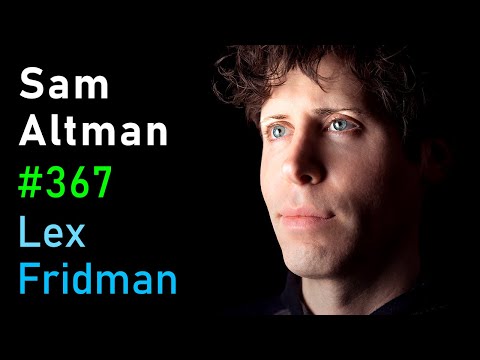
Sam Altman: OpenAI CEO on GPT-4, ChatGPT, and the Future of AI | Lex Fridman Podcast #367
Sam Altman (guest), Lex Fridman (host)
In this episode of Lex Fridman Podcast, featuring Sam Altman and Lex Fridman, Sam Altman: OpenAI CEO on GPT-4, ChatGPT, and the Future of AI | Lex Fridman Podcast #367 explores sam Altman on GPT-4, AGI risks, and reshaping work and power Sam Altman and Lex Fridman discuss GPT-4 as an early but pivotal step toward AGI, emphasizing both its remarkable capabilities and its current limitations. They unpack how large language models are built (data, scaling laws, RLHF, system messages) and how usability breakthroughs like ChatGPT changed public perception more than raw model improvements. A large portion of the conversation focuses on alignment, bias, safety testing, governance, and OpenAI’s unusual capped-profit structure amid competitive and political pressures. They also explore broader implications: impacts on jobs and programming, economic transitions, the possibility of superintelligence and fast takeoff, AI consciousness, and what it would mean for human meaning, democracy, and global coordination.
Sam Altman on GPT-4, AGI risks, and reshaping work and power
Sam Altman and Lex Fridman discuss GPT-4 as an early but pivotal step toward AGI, emphasizing both its remarkable capabilities and its current limitations. They unpack how large language models are built (data, scaling laws, RLHF, system messages) and how usability breakthroughs like ChatGPT changed public perception more than raw model improvements. A large portion of the conversation focuses on alignment, bias, safety testing, governance, and OpenAI’s unusual capped-profit structure amid competitive and political pressures. They also explore broader implications: impacts on jobs and programming, economic transitions, the possibility of superintelligence and fast takeoff, AI consciousness, and what it would mean for human meaning, democracy, and global coordination.
Key Takeaways
Usability and alignment layers matter as much as raw model capability.
Altman argues that ChatGPT’s impact came less from a new base model and more from reinforcement learning with human feedback (RLHF) and a simple chat interface that made latent capabilities accessible, aligned, and easy to control.
Get the full analysis with uListen AI
Alignment work and capability gains are deeply intertwined, not orthogonal.
Techniques like RLHF and interpretability are framed as both safety and capability tools: they make systems safer and also more useful, challenging the simple idea that safety always trades off against performance.
Get the full analysis with uListen AI
OpenAI favors iterative public deployment to reduce one-shot catastrophic failure risk.
Altman insists that releasing imperfect systems early allows society and researchers to discover capabilities and failure modes that OpenAI couldn’t find alone, and to build norms, regulations, and technical safeguards before super-capable models arrive.
Get the full analysis with uListen AI
Bias and speech control will require user-level steerability, not a single global value set.
Because no one model can be universally viewed as “unbiased,” Altman expects broad, democratically set bounds plus per-country and per-user tuning (e. ...
Get the full analysis with uListen AI
Near‑term risks like disinformation and economic shocks may arrive before true AGI.
Altman worries that LLMs could silently drive social media discourse, enable sophisticated propaganda, and rapidly disrupt labor markets well before any self-directed superintelligence appears, and that institutions are unprepared for this speed.
Get the full analysis with uListen AI
AI is rapidly transforming programming into a higher‑leverage, more collaborative activity.
Tools like GPT-4 and Copilot already let developers iterate via dialogue, offload boilerplate, and debug with the model, which Altman thinks will massively increase software output and shift human effort toward higher-level design and insight.
Get the full analysis with uListen AI
Governance and incentives are as critical as technical advances in determining outcomes.
OpenAI’s capped-profit structure, partnership with Microsoft, and calls for global input reflect a belief that unchecked capitalist incentives and centralized control over AGI pose serious dangers, and that multiple competing AGIs under democratic constraints may be safer.
Get the full analysis with uListen AI
Notable Quotes
“We want to make our mistakes while the stakes are low.”
— Sam Altman
“Better alignment techniques lead to better capabilities and vice versa.”
— Sam Altman
“I think it would be crazy not to be a little bit afraid.”
— Sam Altman
“This is the most complex software object humanity has yet produced, and it will be trivial in a couple of decades.”
— Sam Altman
“I think we are doing better at nuance than people realize. Twitter kind of destroyed some, and maybe we can get some back now.”
— Sam Altman
Questions Answered in This Episode
How far can scaling current large language model architectures take us toward true AGI before fundamentally new ideas are required?
Sam Altman and Lex Fridman discuss GPT-4 as an early but pivotal step toward AGI, emphasizing both its remarkable capabilities and its current limitations. ...
Get the full analysis with uListen AI
Who should legitimately have the authority to set the “broad bounds” of acceptable AI behavior at a global level, and how could that process be made democratic in practice?
Get the full analysis with uListen AI
What happens to social cohesion and truth-seeking when powerful LLMs can both generate and detect disinformation at scale—does this net out positively or negatively?
Get the full analysis with uListen AI
How should society balance transparency and openness with safety when it comes to releasing powerful base models and training data details?
Get the full analysis with uListen AI
If AI systems eventually demonstrate convincing signs of consciousness or subjective experience, what criteria should we use to decide when they deserve moral consideration?
Get the full analysis with uListen AI
Transcript Preview
We have been a misunderstood and badly mocked org for a long time. Like, when we started... when we, like, announced the org at the end of 2015 and said we were going to work on AGI, like, people thought we were batshit insane.
Yeah.
You know? Like, I, (laughs) I remember at the time, a eminent AI scientist at a large industrial AI lab was, like, DM'ing individual reporters being like, you know, "These people aren't very good, and it's ridiculous to talk about AGI, and I can't believe you're giving them the time of day." And it's like, that was the level of, like, pettiness and rancor in the field at a new group of people saying, "We're going to try to build AGI."
So OpenAI and DeepMind was a small collection of folks who were brave enough to talk about AGI, um, in the face of mockery.
We don't get mocked as much now.
We don't get mocked as much now. The following is a conversation with Sam Altman, CEO of OpenAI, the company behind GPT-4, ChatGPT, DALL-E, Codex, and many other AI technologies which both individually and together constitute some of the greatest breakthroughs in the history of artificial intelligence, computing, and humanity in general. Please allow me to say a few words about the possibilities and the dangers of AI in this current moment in the history of human civilization. I believe it is a critical moment. We stand on the precipice of fundamental societal transformation, where soon, nobody knows when, but many, including me, believe it's within our lifetime, the collective intelligence of the human species begins to pale in comparison, by many orders of magnitude, to the general superintelligence in the AI systems we build and deploy at scale. This is both exciting and terrifying. It is exciting because of the enumerable applications we know and don't yet know that will empower humans to create, to flourish, to escape the widespread poverty and suffering that exist in the world today, and to succeed in that old, all too human pursuit of happiness. It is terrifying because of the power that superintelligent AGI wields to destroy human civilization, intentionally or unintentionally, the power to suffocate the human spirit in the totalitarian way of George Orwell's 1984, or the pleasure-fueled mass hysteria of Brave New World, where, as Huxley saw it, people come to love their oppression, to adore the technologies that undo their capacities to think. That is why these conversations with the leaders, engineers, and philosophers, both optimists and cynics, is important now. These are not merely technical conversations about AI. These are conversations about power, about companies, institutions, and political systems that deploy, check, and balance this power, about distributed economic systems that incentivize the safety and human alignment of this power, about the psychology of the engineers and leaders that deploy AGI, and about the history of human nature, our capacity for good and evil at scale. I'm deeply honored to have gotten to know and to have spoken with, on and off the mic, with many folks who now work at OpenAI, including Sam Altman, Greg Brockman, Ilya Sutskever, Wojciech Zaremba, Andrej Karpathy, Jakub, uh, Pacholke, and many others. It means the world that Sam has been totally open with me, willing to have multiple conversations, including challenging ones, on and off the mic. I will continue to have these conversations, to both celebrate the incredible accomplishments of the AI community and to steel-man the critical perspective on major decisions various companies and leaders make, always with the goal of trying to help in my small way. If I fail, I will work hard to improve. I love you all. This is the Lex Fridman Podcast. To support it, please check out our sponsors in the description. And now, dear friends, here's Sam Altman. High level, what is GPT-4? How does it work, and, uh, what to you is most amazing about it?
Install uListen to search the full transcript and get AI-powered insights
Get Full TranscriptGet more from every podcast
AI summaries, searchable transcripts, and fact-checking. Free forever.
Add to Chrome