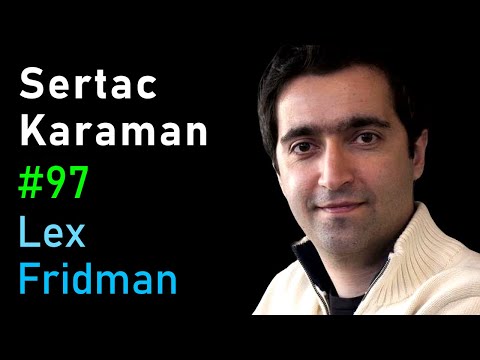
Sertac Karaman: Robots That Fly and Robots That Drive | Lex Fridman Podcast #97
Lex Fridman (host), Sertac Karaman (guest)
In this episode of Lex Fridman Podcast, featuring Lex Fridman and Sertac Karaman, Sertac Karaman: Robots That Fly and Robots That Drive | Lex Fridman Podcast #97 explores sertac Karaman maps our robotic future: cars, drones, society, tradeoffs Lex Fridman and MIT professor/Optimus Ride co‑founder Sertac Karaman discuss the technical and societal challenges of deploying robots that both drive and fly. They contrast autonomous cars versus drones at scale, exploring perception, simulation, human behavior modeling, and the role of machine learning. Karaman explains Optimus Ride’s geo‑fenced, human‑in‑the‑loop autonomy strategy and contrasts it with Tesla’s and Waymo’s approaches, including safety, business models, and data. The conversation closes on high‑speed autonomous drone racing, hardware–software co‑design, and Bellman’s equation as a foundational yet computationally daunting idea in decision‑making.
Sertac Karaman maps our robotic future: cars, drones, society, tradeoffs
Lex Fridman and MIT professor/Optimus Ride co‑founder Sertac Karaman discuss the technical and societal challenges of deploying robots that both drive and fly. They contrast autonomous cars versus drones at scale, exploring perception, simulation, human behavior modeling, and the role of machine learning. Karaman explains Optimus Ride’s geo‑fenced, human‑in‑the‑loop autonomy strategy and contrasts it with Tesla’s and Waymo’s approaches, including safety, business models, and data. The conversation closes on high‑speed autonomous drone racing, hardware–software co‑design, and Bellman’s equation as a foundational yet computationally daunting idea in decision‑making.
Key Takeaways
Scaling autonomy in human environments is harder than isolated robotics.
Industrial robots and Mars rovers work in structured or remote settings; putting thousands of autonomous cars or drones into everyday human spaces adds layers of algorithmic, legal, business, and social complexity that we haven’t solved at large scale.
Get the full analysis with uListen AI
Autonomous cars will likely reach dense deployment before autonomous air transport.
Ground vehicles can leverage and modestly adapt existing infrastructure and safety paradigms, whereas filling the ‘agile airspace’ with passenger drones involves harder safety, airspace management, and technology certification problems.
Get the full analysis with uListen AI
Simulation’s biggest frontier is realistic humans, not just physics and sensors.
We can now simulate dynamics and cameras increasingly well, but convincingly simulating human appearance and behavior—and using that to train and test autonomy—remains a core unsolved bottleneck.
Get the full analysis with uListen AI
Human behavior prediction and game‑theoretic interaction are central to safe autonomy.
Knowing where others are is no longer enough; vehicles must predict what humans will do and understand social cues (aggression, deference, signaling) while also handling being ‘abused’ as non‑human agents in human spaces.
Get the full analysis with uListen AI
Human‑in‑the‑loop fleets can bridge the gap to full autonomy.
Optimus Ride pushes a model where a small control center staff supervises many vehicles, intervening for efficiency rather than safety; this enables higher speeds and better service now, without waiting for perfect end‑to‑end autonomy.
Get the full analysis with uListen AI
Geo‑fenced autonomous shuttles can unlock economic and urban design value quickly.
Serving transportation‑deprived campuses or districts with small autonomous vehicles can reduce shuttle pain points, reclaim expensive parking land, and improve livability while building public familiarity with robots.
Get the full analysis with uListen AI
Hardware–software co‑design is crucial for high‑speed, high‑throughput autonomy.
To enable aggressive drone flight or last‑millisecond crash avoidance, systems must process sensor data far faster than humans can, which likely requires rethinking cameras, compute architectures, and on‑sensor processing rather than just faster CPUs.
Get the full analysis with uListen AI
Notable Quotes
“The real challenge of our time is to take these vehicles and put them into places where humans are present.”
— Sertac Karaman
“We may almost see a whole mushrooming of this technology in all kinds of places that we didn’t expect before, and that may be the real surprise.”
— Sertac Karaman
“You either put money for the lidar or you pay money for the compute. If you don’t put the lidar, it’s a more expensive system because we have to put in a lot of compute.”
— Sertac Karaman
“I’d love to build autonomous vehicles like drones that can go far faster than any human possibly can.”
— Sertac Karaman
“There are some things that are so far ahead people think they’re close, and there are things that are actually close people think are far ahead.”
— Sertac Karaman
Questions Answered in This Episode
How should regulators and cities decide the balance between efficiency and livability when deploying large fleets of autonomous vehicles?
Lex Fridman and MIT professor/Optimus Ride co‑founder Sertac Karaman discuss the technical and societal challenges of deploying robots that both drive and fly. ...
Get the full analysis with uListen AI
What metrics or milestones would meaningfully indicate that fully camera‑only autonomous driving is ready for large‑scale deployment?
Get the full analysis with uListen AI
How can we ethically collect and use the massive human behavior datasets needed to train realistic predictive models for autonomy?
Get the full analysis with uListen AI
In a world of human‑in‑the‑loop fleets, what new jobs and skills will be required for ‘AV controllers’ or remote supervisors?
Get the full analysis with uListen AI
What are promising approaches to overcoming current hardware bottlenecks (sensor bandwidth, compute, latency) for ultra‑fast, safety‑critical autonomous maneuvers?
Get the full analysis with uListen AI
Transcript Preview
The following is a conversation with Sertac Karaman, a professor at MIT, co-founder of the autonomous vehicle company Optimus Ride, and is one of the top roboticists in the world, including robots that drive and robots that fly. To me personally, he has been a mentor, a colleague, and a friend. He's one of the smartest, most generous people I know, so it was a pleasure and honor to finally sit down with him for this recorded conversation. This is the Artificial Intelligence Podcast. If you enjoy it, subscribe on YouTube, review it with five stars on Apple Podcasts, support it on Patreon, or simply connect with me on Twitter @LexFridman, spelled F-R-I-D-M-A-N. As usual, I'll do a few minutes of ads now and never any ads in the middle that can break the flow of the conversation. I hope that works for you and doesn't hurt the listening experience. This show is presented by Cash App, the number one finance app in the App Store. When you get it, use the code LEXPODCAST. Cash App lets you send money to friends, buy Bitcoin, and invest in the stock market with as little as $1. Since Cash App allows you to send and receive money digitally, let me mention a surprising fact about physical money: it costs 2.4 cents to produce a single penny. In fact, I think it costs $85 million annually to produce them. That's a crazy little fact about physical money. So again, if you get Cash App from the App Store or Google Play and use the code LEXPODCAST, you get $10, and Cash App will also donate $10 to FIRST, an organization that is helping to advance robotics and STEM education for young people around the world. And now here's my conversation with Sertac Karaman. Since you have worked extensively on both, what is the more difficult task, autonomous flying or autonomous driving?
That's a good question. I think that autonomous flying, just kind of doing it for consumer drones and so on, the kinds of applications that we're looking at right now, is probably easier. And so I think that that's maybe one of the reasons why it took off, like literally a little earlier than the autonomous cars. But I think if we look ahead, I would think that, you know, the real benefits of autonomous flying, unleashing them in like transportation, logistics, and so on, I think it's a lot harder than autonomous driving. So I think my guess is that, you know, we've seen a few kinda machines fly here and there, but we really haven't yet seen any kind of, you know, machine like, like at massive scale, large scale being deployed and flown, and so on. And I think that's gonna be after we kind of resolve some of the large-scale deployments of autonomous driving.
So what's the hard part? What-what's your intuition behind why at scale when consumer-facing drones are tough?
So I think, in general, at scale, it's tough. Like for example, when you think about it, um, we have actually deployed a lot of robots in the, let's say, the past 50 years.
Install uListen to search the full transcript and get AI-powered insights
Get Full TranscriptGet more from every podcast
AI summaries, searchable transcripts, and fact-checking. Free forever.
Add to Chrome