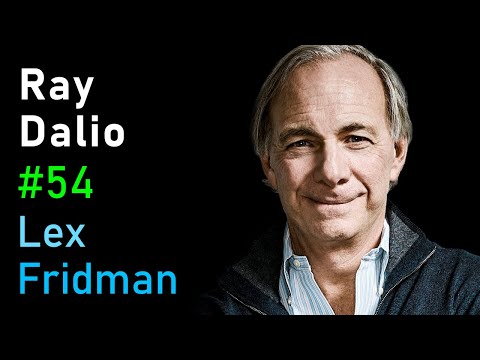
Ray Dalio: Principles, the Economic Machine, AI & the Arc of Life | Lex Fridman Podcast #54
Lex Fridman (host), Ray Dalio (guest), Narrator
In this episode of Lex Fridman Podcast, featuring Lex Fridman and Ray Dalio, Ray Dalio: Principles, the Economic Machine, AI & the Arc of Life | Lex Fridman Podcast #54 explores ray Dalio on truth, risk, AI, money, and life’s arc Ray Dalio and Lex Fridman explore how to pursue ambitious goals by grounding decisions in truth, experimentation, and an idea meritocracy rather than conventional wisdom. Dalio explains his five-step process for turning audacious dreams into reality, emphasizing radical open-mindedness, thoughtful disagreement, and learning from failure—especially his own public collapse in the early 1980s.
Ray Dalio on truth, risk, AI, money, and life’s arc
Ray Dalio and Lex Fridman explore how to pursue ambitious goals by grounding decisions in truth, experimentation, and an idea meritocracy rather than conventional wisdom. Dalio explains his five-step process for turning audacious dreams into reality, emphasizing radical open-mindedness, thoughtful disagreement, and learning from failure—especially his own public collapse in the early 1980s.
They discuss shapers like Elon Musk and Bill Gates, highlighting traits such as combining big-picture vision with attention to detail, orchestrating diverse talent, and staying both highly confident and deeply uncertain. Dalio also unpacks how the economic machine works, the roles of money and credit, and why debt cycles and monetary policy repeat throughout history.
On technology, he outlines when AI and algorithms should augment or replace human decision-making, and when they are dangerous—especially if the future diverges from the past and we lack deep causal understanding. The conversation closes with reflections on automation, inequality, universal basic income, money and happiness, and the psychological arc of a human life, culminating in his core formula: “Pain plus reflection equals progress.”
Key Takeaways
Treat truth as accurate understanding of reality, discovered through experimentation.
Dalio argues that you rarely “know” in advance; instead you start with the best available homework, then learn what’s true by iterating—setting goals, identifying problems, diagnosing root causes, designing solutions, and executing while learning from feedback.
Get the full analysis with uListen AI
Combine audacious dreaming with ruthless realism and radical open-mindedness.
Successful shapers maintain big, exciting visions while simultaneously fearing they might be wrong; this tension drives them to stress-test ideas, seek dissenting views, and adjust quickly rather than relying on delusion or blind confidence.
Get the full analysis with uListen AI
Build or join an idea meritocracy to make better decisions than any individual can.
Dalio’s core organizational insight is to systematize thoughtful disagreement: get independent thinkers, rate their credibility, expose disagreements openly, and let the best ideas—rather than hierarchy or ego—drive decisions.
Get the full analysis with uListen AI
Understand money and credit to navigate economic cycles instead of being victimized by them.
Most “money” is actually credit; when it’s overextended, predictable debt crises follow. ...
Get the full analysis with uListen AI
Use AI for processing known patterns, not for reasoning about unknown futures.
Dalio cautions that machine learning works well when the future resembles the past and tasks are repetitive, but it’s dangerous to rely on opaque models when causal mechanisms aren’t understood and conditions are changing.
Get the full analysis with uListen AI
Address automation and inequality as a national emergency focused on opportunity, not just cash.
He sees technology as massively beneficial yet deeply destabilizing, widening income and opportunity gaps; therefore, investment in early childhood, education, and equal opportunity is more fundamental than blanket UBI checks that may be misused or displace better programs.
Get the full analysis with uListen AI
Prioritize meaningful work, meaningful relationships, and evolution over wealth accumulation.
Beyond a basic comfort level, more money doesn’t correlate with happiness; instead, life satisfaction comes from community, contribution, and personal evolution across life’s three phases—learning, striving, and then helping others succeed without you.
Get the full analysis with uListen AI
Notable Quotes
“Truth, or more precisely, an accurate understanding of reality, is the essential foundation of any good outcome.”
— Ray Dalio
“Don’t confuse delusion with not knowing.”
— Ray Dalio
“If the future can be different from the past, and you don’t have deep understanding, you should not rely on AI.”
— Ray Dalio
“What’s common produces only common results. If you want unique, you have to have a unique approach.”
— Ray Dalio
“Pain plus reflection equals progress.”
— Ray Dalio
Questions Answered in This Episode
How can an individual practically start building an “idea meritocracy” in a small team or personal life?
Ray Dalio and Lex Fridman explore how to pursue ambitious goals by grounding decisions in truth, experimentation, and an idea meritocracy rather than conventional wisdom. ...
Get the full analysis with uListen AI
Where is the line between healthy audacity and destructive delusion when pursuing a big dream?
They discuss shapers like Elon Musk and Bill Gates, highlighting traits such as combining big-picture vision with attention to detail, orchestrating diverse talent, and staying both highly confident and deeply uncertain. ...
Get the full analysis with uListen AI
Given current debt levels and political dynamics, how likely is a major debt crisis in the coming decades and what signals should we watch?
On technology, he outlines when AI and algorithms should augment or replace human decision-making, and when they are dangerous—especially if the future diverges from the past and we lack deep causal understanding. ...
Get the full analysis with uListen AI
In which real-world decisions today is AI already overused in ways that Dalio would consider dangerous?
Get the full analysis with uListen AI
What concrete policy mix would best address automation-driven inequality while preserving innovation and economic dynamism?
Get the full analysis with uListen AI
Transcript Preview
The following is a conversation with Ray Dalio. He's the founder, co-chairman, and co-chief investment officer of Bridgewater Associates, one of the world's largest and most successful investment firms that is famous for the principles of radical truth and transparency that underlie its culture. Ray is one of the wealthiest people in the world, with ideas that extend far beyond the specifics of how he made that wealth. His ideas that are applicable to everyone are brilliantly summarized in his book, Principles. They are also even further condensed on several other platforms, including YouTube, where, for example, a 30-minute video titled How the Economic Machine Works is one of the best educational videos I personally have ever seen on YouTube. Once again, you may have noticed that the people I've been speaking with are not just computer scientists, but philosophers, mathematicians, writers, psychologists, physicists, economists, investors, and soon, much more. To me, AI is much bigger than deep learning, bigger than computing. It is our civilization's journey into understanding the human mind and creating echoes of it in a machine. That journey includes the mechanisms of our economy, of our politics, and the leaders that shape the future of both. This is the Artificial Intelligence podcast. If you enjoy it, subscribe on YouTube, give it five stars on Apple Podcasts, support it on Patreon, or simply connect with me on Twitter @lexfridman, spelled F-R-I-D-M-A-N. This show is presented by Cash App, the number one finance app in the App Store. I personally use Cash App to send money to friends, but you can also use it to buy, sell, and deposit Bitcoin. Most Bitcoin exchanges take days for a bank transfer to become investable. Through Cash App, it takes seconds. Cash App also has a new investing feature. You can buy fractions of a stock, which to me is a really interesting concept. So you can buy of one dollar's worth, no matter what the stock price is. Brokerage services are provided by Cash App Investing, a subsidiary of Square and member SIPC. I'm excited to be working with Cash App to support one of my favorite organizations that many of you may know and have benefited from called FIRST, best known for their FIRST Robotics and Lego competitions. They educate and inspire hundreds of thousands of students in over 110 countries and have a perfect rating on Charity Navigator, which means the donated money is used to maximum effectiveness. When you get Cash App from the App Store or Google Play and use code LEXPODCAST, you'll get ten dollars, and Cash App will also donate ten dollars to FIRST, which again is an organization that I've personally seen inspire girls and boys to dream of engineering a better world. And now, here's my conversation with Ray Dalio. Truth, or more precisely, an accurate understanding of reality, is the essential foundation of any good outcome. I believe you've said that. Let me ask an absurd-sounding question at the high philosophical level. So what is truth? When you're trying to do something different than everybody else is doing, and perhaps something that has not been done before, how do you accurately analyze the situation? How do you accurately discover the truth, the nature of things?
Install uListen to search the full transcript and get AI-powered insights
Get Full TranscriptGet more from every podcast
AI summaries, searchable transcripts, and fact-checking. Free forever.
Add to Chrome