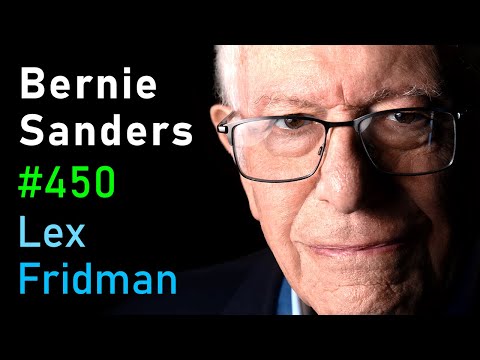
Bernie Sanders Interview | Lex Fridman Podcast #450
Bernie Sanders (guest), Lex Fridman (host)
In this episode of Lex Fridman Podcast, featuring Bernie Sanders and Lex Fridman, Bernie Sanders Interview | Lex Fridman Podcast #450 explores bernie Sanders on oligarchy, healthcare, and building grassroots political power Bernie Sanders discusses his life in politics, from civil rights activism in the 1960s to his underdog presidential runs, framing his core agenda—healthcare for all, higher wages, and taxing the rich—as popular but suppressed by entrenched interests.
Bernie Sanders on oligarchy, healthcare, and building grassroots political power
Bernie Sanders discusses his life in politics, from civil rights activism in the 1960s to his underdog presidential runs, framing his core agenda—healthcare for all, higher wages, and taxing the rich—as popular but suppressed by entrenched interests.
He argues the United States is drifting toward oligarchy, where billionaires, corporations, and lobbyists dominate politics, blocking reforms like Medicare for All, higher minimum wages, and public funding of elections.
Sanders defends his critique of "hypercapitalism" while acknowledging the value of innovation, advocating instead for a strong social safety net alongside a dynamic private sector.
Throughout, he emphasizes bottom‑up change: only sustained grassroots movements, not lone politicians, can overcome corporate power and transform both the Democratic Party and the broader political system.
Key Takeaways
The core Sanders agenda is broadly popular, but structurally blocked.
Policies like Medicare for All, higher minimum wages, and taxing billionaires poll well across party lines, yet are resisted by party establishments, corporate donors, and lobbyists who benefit from the status quo.
Get the full analysis with uListen AI
The US political-economic system is trending toward oligarchy.
Sanders argues that concentrated corporate ownership and billionaire campaign spending—amplified by Citizens United—mean a small elite effectively shapes legislation, pricing, and elections, similar to oligarchic models elsewhere.
Get the full analysis with uListen AI
Healthcare dysfunction is both economically wasteful and morally destructive.
The US spends about twice as much per person as other rich countries while leaving tens of millions uninsured or underinsured; people delay care, skip medications, and face bankruptcy, leading to tens of thousands of preventable deaths annually.
Get the full analysis with uListen AI
Public funding of elections is central to reducing the power of big money.
Sanders proposes small-donor qualification thresholds combined with public financing and strict spending caps, arguing this would free candidates from dependence on wealthy donors and allow genuine competition of ideas.
Get the full analysis with uListen AI
Economic gains from productivity have largely bypassed workers.
Over 50 years of rising productivity, real wages have been mostly stagnant for typical workers while trillions of dollars in wealth have shifted from the bottom 90% to the top 1%, fueling justified working‑class anger.
Get the full analysis with uListen AI
Grassroots, bottom‑up organizing is the only durable path to reform.
Citing MLK, Debs, and recent progressive victories, Sanders maintains that real change—on healthcare, wages, or democratic reform—comes when millions are organized and demanding it, not when individuals quietly negotiate at the top.
Get the full analysis with uListen AI
A humane economy can balance innovation with a strong social safety net.
Pointing to Scandinavia and parts of Europe, he argues societies can encourage entrepreneurship while guaranteeing healthcare, education, housing, and decent retirement, and limiting extreme concentrations of wealth.
Get the full analysis with uListen AI
Notable Quotes
“The ideas that I am talking about are ideas that are widely supported.”
— Bernie Sanders
“We are moving to an oligarchic form of society… What do you think is happening in the United States?”
— Bernie Sanders
“If you work 40 hours a week in the richest country in the history of the world, you should not be living in poverty.”
— Bernie Sanders
“Sometimes you can run and lose and you really win if your goal is not just individual power, but transforming society.”
— Bernie Sanders
“The establishment wants to tell you: ‘The world is the way it is… You have no power. Give up.’ What we showed is, guess what? You do have power.”
— Bernie Sanders
Questions Answered in This Episode
How realistic is Sanders’s timeline and funding model for transitioning the US to Medicare for All, given current political and industry opposition?
Bernie Sanders discusses his life in politics, from civil rights activism in the 1960s to his underdog presidential runs, framing his core agenda—healthcare for all, higher wages, and taxing the rich—as popular but suppressed by entrenched interests.
Get the full analysis with uListen AI
What concrete steps could an average citizen take to help overturn Citizens United and push for public financing of elections?
He argues the United States is drifting toward oligarchy, where billionaires, corporations, and lobbyists dominate politics, blocking reforms like Medicare for All, higher minimum wages, and public funding of elections.
Get the full analysis with uListen AI
Where should the line be drawn between rewarding innovation and preventing harmful concentrations of wealth and power?
Sanders defends his critique of "hypercapitalism" while acknowledging the value of innovation, advocating instead for a strong social safety net alongside a dynamic private sector.
Get the full analysis with uListen AI
Can the Democratic Party realistically become a consistent party of the working class while remaining reliant on large donors and corporate support?
Throughout, he emphasizes bottom‑up change: only sustained grassroots movements, not lone politicians, can overcome corporate power and transform both the Democratic Party and the broader political system.
Get the full analysis with uListen AI
How might the US adapt successful elements of Scandinavian social democracies without undermining its own distinctive strengths in innovation and entrepreneurship?
Get the full analysis with uListen AI
Transcript Preview
The ideas that I am talking about are ideas that are widely supported. Everything that I talk about, raising the minimum wage, healthcare for all, a tax system which demands the billionaires to pay their fair share, those are all popular ideas. But people didn't know. You gotta run for president and have 20,000 people come out to your rallies and win 23 states, they say, "Hmm, well maybe those eyes are not, ideas are not so crazy after all," and we gotta entertain 'em. The establishment doesn't like that, they really don't. They wanna tell you, and this is their main, this is how they succeed, what they say, Lex, is, "The world is the way it is. It always will be this way. We got the wealth. We got the power. And don't think of anything else. This is, this is the way it is. You, you have no power. Give up." That, they don't say it quite that way, but that's really what the intent is. And what we showed is, guess what? You know, running a- a- a- a- a, uh, an outsider campaign, we took on the Democratic establishment. We came close to winning it, and we did win 23 states. And the ideas that we're talking about are the ideas that working class people and young people believe in.
The following is a conversation with Bernie Sanders, senator from Vermont and two-time presidential candidate, both times as the underdog, who against the long odds captivated the support and excitement of millions of people, both on the left and the right. This is the Lex Fridman Podcast. To support it, please check out our sponsors in the description. And now, dear friends, here's Bernie Sanders. Growing up, did you ever think you'd be a politician?
Nope.
(laughs)
Not in a million years.
Uh, yeah, I know that you hate talking about yourself, which is rare for a politician, I would say.
(laughs)
What's your philosophy behind that? You like talking about the issues, you like talking about-
Yeah, I do. I mean, you know, everybody talks about themselves. It's not about me. You know, nice guy, not a nice guy. What's a ... What, you know, politics should be about is the issues facing the people of our country, the people of the world, and how we're going to address it. That's what it should be.
That said, there's, uh, interesting aspects to your life story. For example, in, uh, 1963, you were very active in, uh, the civil rights movement, got arrested even for, uh, protesting segregation in Chicago. And, uh, you attended the, the famous March on Washington where MLK gave his, uh, I Have a Dream speech. What was that like?
It was extraordinary. Took a bus ride down with fellow students from the University of Chicago, and there was a zillion people there. Uh, I'm not sure if it was the first time I'd ever been in Washington in my life. But it was, you know, it was a very impressive moment. And what he was talking about, what people very often forget about that, it was not only racial justice, it was jobs. Jobs and justice, that was the name of that rally. And, uh, so it's something I've never forgotten.
Install uListen to search the full transcript and get AI-powered insights
Get Full TranscriptGet more from every podcast
AI summaries, searchable transcripts, and fact-checking. Free forever.
Add to Chrome