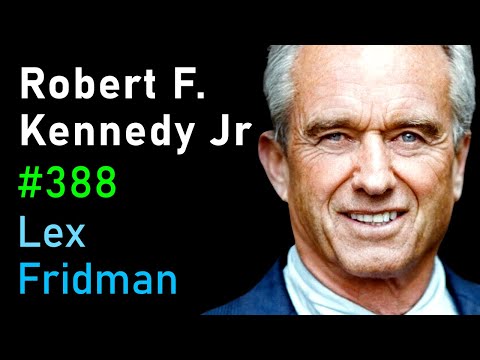
Robert F. Kennedy Jr: CIA, Power, Corruption, War, Freedom, and Meaning | Lex Fridman Podcast #388
Robert F. Kennedy Jr. (guest), Lex Fridman (host), Lex Fridman (host), Lex Fridman (host), Lex Fridman (host), Lex Fridman (host)
In this episode of Lex Fridman Podcast, featuring Robert F. Kennedy Jr. and Lex Fridman, Robert F. Kennedy Jr: CIA, Power, Corruption, War, Freedom, and Meaning | Lex Fridman Podcast #388 explores robert F. Kennedy Jr. on war, power, science, freedom, and faith Lex Fridman interviews presidential candidate Robert F. Kennedy Jr. about U.S. foreign policy, the Ukraine–Russia war, the CIA, media, Big Pharma, and vaccines, as well as his personal philosophy and spirituality. Kennedy argues that American neocon policy provoked Russia, that the Ukraine war is an unnecessary U.S.-driven proxy war, and that regime change in nuclear powers is reckless. He alleges deep-seated corruption and anti-democratic tendencies within the CIA and pharmaceutical regulators, tying them to censorship, captured media, and unsafe vaccination practices. The conversation closes with his views on Democratic values, his own recovery from addiction, the role of God and meaning, and his daily discipline and health routine.
Robert F. Kennedy Jr. on war, power, science, freedom, and faith
Lex Fridman interviews presidential candidate Robert F. Kennedy Jr. about U.S. foreign policy, the Ukraine–Russia war, the CIA, media, Big Pharma, and vaccines, as well as his personal philosophy and spirituality. Kennedy argues that American neocon policy provoked Russia, that the Ukraine war is an unnecessary U.S.-driven proxy war, and that regime change in nuclear powers is reckless. He alleges deep-seated corruption and anti-democratic tendencies within the CIA and pharmaceutical regulators, tying them to censorship, captured media, and unsafe vaccination practices. The conversation closes with his views on Democratic values, his own recovery from addiction, the role of God and meaning, and his daily discipline and health routine.
Key Takeaways
Diplomacy with adversaries is essential to avoid catastrophic war.
Kennedy invokes his uncle JFK’s backchannel talks with Khrushchev during the Cuban Missile Crisis as proof that empathetic dialogue and seeing the world through an adversary’s eyes can literally prevent nuclear annihilation, and argues modern leaders must do the same with Russia and other rivals.
Get the full analysis with uListen AI
NATO expansion and U.S. policy significantly shaped Russia’s behavior in Ukraine.
He contends that broken assurances on NATO’s eastward expansion, missile deployments near Russia, and U. ...
Get the full analysis with uListen AI
Regime change in nuclear powers is dangerously irresponsible.
Kennedy distinguishes between criticizing Vladimir Putin and advocating his overthrow, arguing that actively seeking regime change in a nuclear-armed state risks escalation to Armageddon and is not America’s legitimate role.
Get the full analysis with uListen AI
Media and intelligence agencies can collude to shape and restrict public discourse.
Referencing Operation Mockingbird and the modern Trusted News Initiative, he claims elements of the CIA and major outlets coordinate narratives, suppress dissenting views on topics like COVID and Ukraine, and label critics as conspiracy theorists, eroding trust and undermining democratic debate.
Get the full analysis with uListen AI
Regulatory capture undermines drug and vaccine safety.
Kennedy argues that pharmaceutical companies fund a large share of FDA and NIH budgets and sometimes personally enrich regulators via royalties, creating powerful incentives to fast-track products and downplay harms; he calls for independent, truly adversarial safety regulation rather than industry-aligned oversight.
Get the full analysis with uListen AI
Existential technologies demand cooperative global governance, not militarized rivalry.
He believes AI and advanced bioweapons pose civilizational risks that cannot be managed unilaterally, urging the U. ...
Get the full analysis with uListen AI
Personal meaning and freedom come from duty, service, and moral discipline.
Drawing on Camus, Stoicism, and his own recovery from addiction, Kennedy describes freedom not as license but as self-restraint and service to others, arguing that everyday moral choices and a sense of spiritual surrender transformed his life and sustained his activism.
Get the full analysis with uListen AI
Notable Quotes
“It’s not our business to change the Russian government.”
— Robert F. Kennedy Jr.
“We’re all just inches away from barbarity, and the thing that keeps us safe in this country are the institutions of our democracy and our Constitution.”
— Robert F. Kennedy Jr. (quoting his father’s view)
“The evidence that the CIA was involved in my uncle’s murder... is so insurmountable and overwhelming that it’s beyond any reasonable doubt.”
— Robert F. Kennedy Jr.
“Once you appoint yourself an arbiter of what’s true and what’s not true, your job is no longer to inform the public; your job now is to manipulate the public.”
— Robert F. Kennedy Jr.
“I had tried everything, earnestly and honestly, for a decade to try to stop, and I could not do it under my own power. And then, all of a sudden, it was lifted effortlessly.”
— Robert F. Kennedy Jr.
Questions Answered in This Episode
Which of Kennedy’s foreign policy claims about NATO, Minsk, and U.S. intentions in Ukraine are most contested by mainstream historians and diplomats, and what evidence exists on both sides?
Lex Fridman interviews presidential candidate Robert F. ...
Get the full analysis with uListen AI
How should democratic societies balance combating harmful misinformation with preserving open scientific and political debate, especially during crises like pandemics?
Get the full analysis with uListen AI
What concrete reforms could realistically reduce regulatory capture in agencies like the FDA and NIH without crippling drug and vaccine innovation?
Get the full analysis with uListen AI
If AI and bioweapons require cooperative global governance, what mechanisms could actually align the interests of geopolitical rivals who do not trust one another?
Get the full analysis with uListen AI
To what extent do Kennedy’s personal experiences with addiction, faith, and family history constructively shape his political judgment, and where might they introduce bias or blind spots?
Get the full analysis with uListen AI
Transcript Preview
It's not our business to change the Russian government. And anybody who thinks it's a good idea to do regime change in Russia, which has more nuclear weapons than we do, um, is, I think irresponsible. And, you know, Vladimir Putin himself has said, w- you know, "We will not live in a world without Russia." And it was clear when he said that, that he was talking about himself. And I... And he has his hand on a button that could bring, you know, Armageddon to the entire planet. So, why are we messing with this? It's not our job to change that regime. And, and we should be making f- friends with the Russians. We shouldn't be treating them as an enemy. Now we've pushed them into the camp with China. That's not a good thing for our country and by the way, you know, what we're doing now does not appear to be weakening Putin at all.
The following is a conversation with Robert F. Kennedy Jr., candidate for the President of the United States, running as a Democrat. Robert is an activist, lawyer and author, who has challenged some of the world's most powerful corporations, seeking to hold them accountable for the harm they may cause. I love science and engineering. These two pursuits are, to me, the most beautiful and powerful in the history of human civilization. Science is our journey, our fight for uncovering the laws of nature and leveraging them to understand the universe and to lessen the amount of suffering in the world. Some of the greatest human beings I've ever met, including most of my good friends, are scientists and engineers. Again, I love science. But science cannot flourish without epistemic humility, without debate, both in the pages of academic journals and in the public square, in good faith, long-form conversations. Agree or disagree, I believe Robert's voice should be part of the debate. To call him a conspiracy theorist and arrogantly dismiss everything he says, without addressing it, diminishes the public's trust in the scientific process. At the same time, dogmatic skepticism of all scientific output on controversial topics, like the pandemic, is equally, if not more dishonest and destructive. I recommend that people read and listen to Robert F. Kennedy Jr., his arguments and his ideas. But I also recommend, as I say in this conversation, that people read and listen to Vincent Racaniello from This Week in Virology, Dan Wilson from Debunk The Funk, and the Twitter and books of Paul Offit, Eric Topol and others, who are outspoken in their disagreement with Robert. It is disagreement, not conformity, that bends the long arc of humanity towards truth and wisdom. In this process of disagreement, everybody has a lesson to teach you, but we must have the humility to hear it and to learn from it. This is the Lex Fridman podcast. To support it, please check out our sponsors in the description, and now, dear friends, here's Robert F. Kennedy Jr. It's the 4th of July, Independence Day, so simple question, simple big question. What do you love about this country, the United States of America?
Install uListen to search the full transcript and get AI-powered insights
Get Full TranscriptGet more from every podcast
AI summaries, searchable transcripts, and fact-checking. Free forever.
Add to Chrome